Bosch vs Miele: The Ultimate Dishwasher Showdown
An objective, data-informed comparison of Bosch vs Miele dishwashers, evaluating performance, reliability, efficiency, and ownership costs to help homeowners choose the right brand.


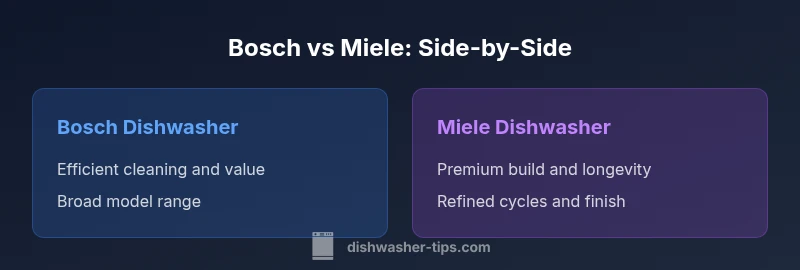
Bosch dishwasher vs Miele: For most homeowners, Bosch delivers strong value with efficient cleaning and low operating costs, while Miele emphasizes premium build quality and long-term durability. The key decision comes down to upfront investment versus longevity and features. This comparison analyzes performance, reliability, and total cost of ownership to help you choose the brand that fits your kitchen and budget.
Bosch vs Miele: What matters most in a dishwasher
When comparing bosch dishwasher vs miele, the core differences show up in value, longevity, and design philosophy. Bosch has earned a reputation for efficient performance, compact fit in many kitchens, and broad model availability across price tiers. Miele, by contrast, emphasizes premium materials, long-term durability, and refined wash systems that maintain performance over years. Dishwasher Tips analyses suggests most homeowners will appreciate Bosch for daily reliability and cost-per-use, while buyers seeking a premium, long-lasting appliance will find Miele appealing. In practice, your decision should revolve around two axes: upfront investment and expected lifespan. If you cook frequently and value low running costs, bosch offers compelling return on investment; if you want a device that lasts for decades with distinctive engineering, miele may justify the premium. Across households, the choice often comes down to whether you prioritize economical operation and broad aftersales support or premium fit, finish, and longevity. The bosch dishwasher vs miele comparison is not a single right answer; it’s a trade-off based on personal priorities and home context.
Reliability, warranty, and service networks
Brand reliability is a complex mix of component quality, engineering, and service coverage. Bosch pays attention to corrosion resistance of racks and efficient water usage, while offering a wide service network across many regions. Miele positions itself as premium with an emphasis on durability and component longevity; their service network is strong in many markets, with longer warranty assumptions on higher-tier models. According to Dishwasher Tips, the reliability narrative depends heavily on usage patterns and maintenance habits. If you prefer a brand with easy access to replacement parts and a broad installer/repair ecosystem, Bosch is attractive. If you’re willing to invest in a premium service experience and value a longer lifetime appliance, Miele’s approach often pays off in practice. Consider your local support availability, how easy it is to obtain parts, and whether extended warranty options are offered for the models you’re considering. A strong service network reduces total ownership risk for either brand.
Cleaning performance and drying results
Cleaning performance is not just about the wash cycle; it’s about consistency, dry performance, and residue control. Bosch models typically excel at efficient cleaning with reliable soil removal and good drying performance, especially when paired with modern racks and sensors. Miele solutions emphasize meticulous washing routines and thorough drying, often delivering excellent results on heavily soiled loads and glassware, thanks to premium builds and refined spray patterns. Dishwasher Tips notes that real-world results depend on load placement and maintenance. A well-organized rack and the correct detergent choice can elevate outcomes for both brands. If you regularly wash plastics, which brand handles drying more consistently may matter. In practice, Bosch tends to deliver solid all-around performance for a broader user base, while Miele may edge out in scenarios that reward premium cycles and gentler handling of delicate items. Knowledge of your typical load types helps frame the right choice.
Energy use, water consumption, and noise
Energy efficiency and noise are two of the most tangible daily considerations. Bosch focuses on compact, efficient operation with quiet models and strong insulation across many product lines. Miele also emphasizes quiet operation and efficient water use, but often pairs premium components with a design intent toward long-term durability and low-temperature cleaning options. The decision between bosch dishwasher vs miele here hinges on personal tolerance for running costs and comfort. If you live in an open-plan space with late-night dishwashing, a quieter Bosch model can make a noticeable difference, and the brand’s broad model variety gives you flexibility. For households that value premium insulation and a calm kitchen environment, a higher-end Miele may provide the quiet you require. The price-to-performance trade-off is real, so weigh your usage patterns and energy priorities. Dishwasher Tips suggests reviewing model-specific decibel ratings and energy labels to compare apples to apples.
Design, capacity, and kitchen fit
The way a dishwasher integrates with a kitchen matters as much as its wash performance. Bosch offers a broad range of widths and interior configurations that fit many kitchen designs, including space-constrained layouts. Their interior shelving tends to balance adjustability and usability; many models support flexible rack configurations for cups, bowls, and tall items. Miele emphasizes premium fit, straightforward loading ergonomics, and high-quality finishes that complement modern kitchens. The interior design often features durable materials and smart load optimization that can improve user experience over many years. When choosing, measure the available width, height clearance, and door clearance with counters to avoid installation surprises. If your kitchen layout is modular or you anticipate reconfiguration, Bosch’s flexibility is advantageous; if you value premium aesthetics and longevity in a built-in look, Miele stands out.
Detergents, pods, and maintenance
Detergent compatibility can influence cleaning results and cost. Both brands accept standard dishwasher detergents and pods, but the user experience with auto-dose features and cycle optimization can differ. Bosch models often integrate straightforward detergent loading with efficient use of rinse aids and anti-splash features that protect dishes and glassware. Miele emphasizes careful formulation for longer-lasting results and may offer more advanced dosing options on higher-end models. Maintenance requirements are similar: periodic cleaning of filters, spray arms, and nozzles; occasional rack care; and mindful loading to avoid poor circulation. The right detergent choice, water hardness adjustments, and routine inspection of filters impact long-term performance for both brands. Dishwasher Tips recommends following manufacturer guidelines to maximize efficiency, and keeping the water softener in good condition where applicable.
Upfront cost vs total cost of ownership
From a pure upfront price viewpoint, many consumers perceive Bosch as offering a better balance of cost and capability, given the broad range of models across price points. Miele models tend to sit in the premium tier, reflecting their emphasis on build quality and longevity. The total cost of ownership includes energy and water usage, maintenance, potential repair costs, and the value of resale or extended warranties. Each brand has an ecosystem of service plans and parts availability that influence long-term affordability. Because prices vary by region and model line, it is best to compare across specific models rather than generalizations. Dishwasher Tips notes that evaluating cost over a typical appliance lifetime helps clarify which brand aligns with your budget and expectations for performance. If you plan to upgrade again within a decade, consider how each brand’s repair network might affect total expense.
Feature highlights: smart tech and ease of use
Smart features and user-friendly interfaces can define day-to-day satisfaction. Bosch often emphasizes intuitive controls, quick select cycles, and straightforward status indicators. Durable dashboards and modular racks simplify loading and unloading, which can contribute to a smoother daily experience. Miele emphasizes premium interfaces and longer-cycle options designed for gentle, thorough cleaning. Their programming tends to be designed for repeatable results across many load types, which can be helpful for households with varied dishware. Connectivity options, if available, can provide remote monitoring and troubleshooting, though the actual benefits depend on model tier. In practice, the best choice depends on whether you value ease of use and a simple interface (Bosch) or premium control and extensive customization (Miele). Dishwasher Tips recommends focusing on cycles that matter most to you, like heavy-duty, eco, or glassware programs, when evaluating models.
How to choose: a decision framework
To decide between bosch dishwasher vs miele, build a decision framework based on your kitchen layout, budget, and usage profile. Start with fit: confirm width, height, door swing, and installation constraints. Then examine performance demands: is energy efficiency your top priority, or do you need the gentlest handling for fragile items? Next, evaluate long-term expectations: how important is durability and residual value? Finally, consider serviceability and warranty terms in your region. A practical approach is to shortlist one mid-range Bosch model and one premium Miele model, compare them across load types (plates, bowls, glasses, plastics), and test key cycles (eco, heavy, quick). Involving a professional installer for measurement and guidance can reduce post-purchase surprises. The decision-making process will be smoother if you align your choice with your daily routines and kitchen space. The Bosch vs Miele choice is a personal one, but this framework helps translate preferences into a rational selection.
Common myths debunked
Myth 1: More expensive always means better cleaning. Reality: performance depends on the model, load, and cycles used; price often reflects durability and premium finishes, not necessarily everyday performance. Myth 2: If a model is quiet, it sacrifices cleaning power. Reality: many quiet models manage both, but you may trade off some cycle speed for lower noise. Myth 3: Brand loyalty guarantees service quality. Reality: local service networks and technician expertise matter more than brand name. By testing real-world loads and checking service options in your area, you can avoid common disappointments.
Comparison
| Feature | Bosch dishwasher | Miele dishwasher |
|---|---|---|
| Build quality and interior design | Solid mid-range to premium materials with flexible racks | Premium materials and long-lasting components |
| Washing performance | Strong overall cleaning with reliable results | Meticulous washing with emphasis on delicate items |
| Drying performance | Consistent drying across cycles | Excellent drying especially on premium cycles |
| Energy efficiency | Efficient water use and energy-conscious designs | Premium efficiency with long-term durability focus |
| Noise level | Very quiet options in many models | Quiet operation across premium lines |
| Price range (conceptual) | Mid-range to premium | Higher-end, premium tier |
| Warranty and service | Strong national service in many regions | Longer warranties on higher tier models |
| Best for | Budget-conscious buyers seeking value | Premium buyers prioritizing longevity and finish |
The Good
- Balanced value across model ranges
- Strong reliability and broad parts network
- Quiet operation options across both brands
- Good resale value for popular models
- Clear ownership pathways through service networks
Disadvantages
- Premium models from Miele can be costly
- Bosch lineups may require careful model selection for premium features
- Long-term durability expectations depend on maintenance
- Some advanced features are model-specific and not universal across brands
Bosch wins on value and efficiency; Miele wins on premium durability and finish.
Choose Bosch if you want solid performance with a favorable total cost of ownership. Choose Miele if long-term durability and premium finishes matter more, especially for built-in configurations.
People Also Ask
Which brand is more reliable, Bosch or Miele?
Both brands are highly reliable within their market segments. Bosch emphasizes consistent performance and easy maintenance, while Miele focuses on premium durability and long service life. Real-world reliability depends on model, usage, and maintenance.
Bosch is reliable and easy to service; Miele is built to last longer. Check the model and maintenance needs.
Are Bosch and Miele equally energy-efficient?
Both brands offer energy-efficient options across their lines, with Bosch often highlighting efficient water use and compact operation, while Miele emphasizes high-efficiency designs on premium models. Actual efficiency varies by model and cycle choice.
Yes, both have efficient options; check model labels and energy stars.
Which is better for small kitchens?
For tight spaces, Bosch's broader model range and compact designs give more flexible fit, while Miele’s premium lineup may require careful measurement. If space is the primary constraint, start with 24-inch Bosch models.
Bosch is usually better for small kitchens; check the exact width.
Do they offer similar warranties?
Warranties vary by region and model. Miele often offers longer coverage on higher-tier models, while Bosch provides strong coverage across many price points. Always review the specific model's terms.
Warranties vary; read the model details.
What about drying performance on plastics?
Drying results on plastics depend on model and cycle choice. Premium cycles from Miele may yield better plastic drying in some models; Bosch provides reliable drying across multiple cycles. Proper load placement matters.
Load plastics correctly and pick cycles that emphasize dry.
Is installation easier with Bosch or Miele?
Installation ease depends on cabinet fit and kitchen layout. Bosch models often offer flexible installation options; Miele built-in models require precise measurements for a premium finish. Consider professional measurement if unsure.
Pay attention to built-in dimensions.
What to Remember
- Check your budget against model tiers before buying
- Evaluate decibel ratings and cycle options for your space
- Prioritize warranty and service coverage in your region
- Consider load types to decide which brand suits your kitchen
- Use the decision framework to avoid buyer regrets