Dishwasher for Hard Water: Selection and Care
A data-driven guide to choosing and maintaining a dishwasher for hard water, covering built-in vs external softening, maintenance, and practical buying decisions.


Choosing a dishwasher for hard water hinges on mineral control and maintenance needs. In short, there are two viable paths: select a hard-water–optimized model with built-in softening or filtration, or pair a standard model with an external water-treatment approach. Both aim to minimize scale, improve detergent effectiveness, and keep dishes clean over time.
Why hard water matters for dishwashers
If you live in an area with hard water, mineral ions like calcium and magnesium can form scale on heating elements, spray arms, and filters inside the dishwasher. This buildup reduces water flow, heats unevenly, and inhibits detergent performance, leading to cloudy dishes and longer cycles. The impact compounds over time, potentially shortening the appliance’s life if maintenance is neglected. According to Dishwasher Tips, the mineral load from hard water is a primary driver of recurring cleaning problems, and addressing it early yields better long-term results. Understanding how hard water interacts with detergents and rinse aids helps homeowners choose the right setup without overpaying for features they won’t use. This article uses an analytical lens to compare options, costs, and maintenance strategies for a dishwasher for hard water.
Core features that help with hard water
Hard water challenges can be mitigated by design choices and care routines. Look for—among other criteria—a stainless steel tub, reinforced spray arms, and a robust filtration or ion-exchange system inside the unit. Built-in water-softening or anti-scale features reduce mineral deposition in the wash and rinse stages, which improves cleaning performance and prolongs spray effectiveness. Detergent compatibility matters too: many modern formulas include chelating agents designed to bind minerals and reduce film. The Dishwasher Tips team emphasizes checking this compatibility and ensuring there is a dedicated salt reservoir or an easily accessible softening option. In short, the best models for hard water integrate mineral-control hardware, durable materials, and user-friendly maintenance workflows.
Option A: Hard-water-optimized dishwashers
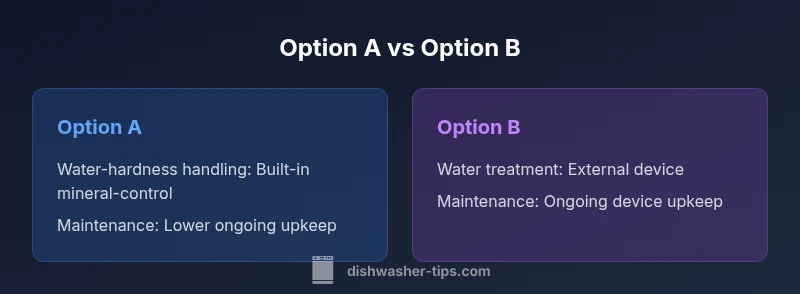
Option A emphasizes appliances engineered to manage mineral content directly. These models often feature resin-based or ion-exchange filtration, reinforced spray arms, and multi-stage filtration that minimizes mineral redeposition. They tend to perform well with standard detergents and textures, maintaining crystal-clear glassware and clean plates even in very hard water zones. Ideal scenarios include households with long-term residence in hard-water regions or renters who want a more self-contained solution without additional devices. The upfront cost is typically higher, but the long-term savings come from reduced scale buildup, fewer descale cycles, and steadier performance. When evaluating options, compare maximum rinse temperatures, cycle options that emphasize mineral control, and warranty coverage for filtration components.
Option B: Standard dishwashers with external water treatment
Option B takes a modular approach: choose a standard dishwasher and supplement with external water treatment. This can be a salt-based water softener unit, inline conditioning device, or a countertop filtration system connected to the cold-water supply. The advantage is flexibility and potentially lower upfront costs, with the trade-off of ongoing maintenance for the external device and compatibility considerations with the dishwasher’s inlet. Renters or homeowners who want to preserve existing appliances may prefer this route. When evaluating, ensure the external device is rated for continuous daily use, verify compatibility with the dishwasher’s water inlet, and factor in replacement salt or cartridge costs over time.
How mineral buildup affects cleaning performance
Mineral buildup interferes with spray patterns and reduces effective water contact with dishes. Scale on heating elements can cause uneven heating, which lowers detergent solubility and rinsing efficiency. In hard water regions, users often notice white film on utensils, cloudiness on glassware, and soap-dish residue that indicates poor mineral management. The Dishwasher Tips analysis shows that cleaning performance improves when mineral content is controlled either inside the appliance or via consistent external water treatment. Even small gains in mineral control can translate into faster cycles, more reliable cleaning, and less frequent descaling needs.
Maintenance routines to prevent mineral buildup
Prevention is cheaper than cure. Start with regular cleaning of filters and spray arms, following the manufacturer’s guidance. Run a descale cycle or a vinegar-descalant routine every several months in hard water zones, depending on usage and mineral load. Use the correct rinse aid and ensure it is topped up, as rinse aids significantly affect drying and spotting in mineral-rich water. Keep the salt reservoir (for models that use salt) full, and verify the system’s regeneration cycle if applicable. A proactive maintenance schedule reduces suds, improves energy efficiency, and helps maintain optimal detergent performance. The Dishwasher Tips team recommends documenting maintenance dates to establish a predictable routine.
Detergents and rinse aids for hard water
Detergents formulated for hard water often include chelating agents, which bind minerals and minimize film. Look for products labeled as “hard water optimized” or with explicit mineral-binding chelants. Pair detergents with a high-quality rinse aid to counteract whitening and spotting. Remember to adjust dosing based on water hardness and soil level, as overdosing can create excess suds that interfere with rinse performance. For many households, using a compatible rinse aid with the right detergent provides a simple, effective way to combat mineral-related residue. The combination of a suitable detergent and rinse aid is one of the most reliable ways to improve performance without significant structural changes to the appliance.
Real-world scenarios: decision trees for choosing between options
Consider two common scenarios. Scenario 1: you own a home in a region with very hard water and plan to stay long-term. A hard-water-optimized dishwasher (Option A) could be cost-effective in the long run due to reduced maintenance and reliable performance. Scenario 2: you rent or expect to relocate within a few years and prefer flexibility. A standard dishwasher with external water treatment (Option B) offers adaptability and lower upfront cost, though ongoing maintenance costs may accrue. In both cases, factor in local water hardness, expected lifecycle, and willingness to perform routine maintenance. The right choice balances performance with cost and convenience.
Installation considerations and testing water hardness
Begin with a water hardness test kit to quantify grains per gallon or parts per million. If the hardness exceeds a moderate threshold, you should plan for mineral-control strategies. When installing, ensure plumbing connections are secure, avoid backflow risks, and confirm the dishwasher’s intake pressures align with the external treatment device if you choose Option B. For new purchases, verify compatibility with your water supply system and confirm warranty coverage for mineral-control features. Professional installation can simplify alignment of hard-water strategies, reduce leaks, and ensure efficient operation early in the life of the appliance.
Practical buying checklist for a dishwasher for hard water
Before purchasing, compare at least two or three models in the hard-water category. Check the tub material (stainless preferred), the presence of integrated mineral-control features, warranty terms, and ease of maintenance. Verify recommended sanitization cycles, rinse aid compatibility, and detergent guidance for hard water. Consider future needs such as whether you may relocate, the availability of replacement parts, and the cost of consumables like salt and filters. A methodical checklist reduces decision fatigue and leads to a more durable, cost-effective choice.
Final guidance and next steps
For homeowners evaluating their options, the decision often comes down to balancing upfront cost with long-term maintenance costs and cleaning performance. A dishwasher for hard water that includes built-in mineral-control features tends to deliver the most consistent results in mineral-rich supply areas. If your situation favors flexibility or budget constraints, pairing a standard dishwasher with a reliable external treatment device provides a viable path without committing to higher upfront spend. The Dishwasher Tips team emphasizes aligning your choice with water hardness, ongoing maintenance willingness, and long-term needs.
Comparison
| Feature | Hard-water-optimized dishwasher | Standard dishwasher + external water treatment |
|---|---|---|
| Water hardness handling | Built-in mineral-control features | Relies on external softener / treated water |
| Detergent compatibility | Optimized for mineral-rich water | Depends on external device and detergent choice |
| Maintenance burden | Lower maintenance with integrated system | Ongoing maintenance for external device |
| Initial cost | Higher upfront cost | Lower upfront cost |
| Best for | Very hard water regions / long-term stays | Renters / flexible setups |
The Good
- Improved mineral management with built-in features can reduce scale buildup
- External softeners provide flexibility for renters
- Longer appliance life with proper maintenance
- Potentially lower long-term detergent and cleaning costs with effective mineral control
Disadvantages
- Higher upfront cost for hard-water-optimized models
- Ongoing maintenance for external water treatment may be required
- Not all external solutions are compatible with every dishwasher
- Potential warranty considerations if using external devices incorrectly
Hard-water optimization generally offers the best long-term performance, but external treatment provides flexible, lower upfront options for many households.
Choose a hard-water–optimized dishwasher if you plan to stay put and want maximum reliability. If you need flexibility or lower upfront costs, pair a standard model with a proven external water-treatment solution and maintain it regularly.
People Also Ask
Can a standard dishwasher handle hard water without modifications?
A standard dishwasher can perform reasonably well in moderately hard water, but mineral buildup may cause film and inefficiencies. Modifications such as compatible rinse aids or an external softening device can improve results. The exact outcome depends on water hardness and usage patterns.
A standard dishwasher can work in moderate hardness, but you’ll likely need additives or an external softener for consistently clean results.
What is the best solution for very hard water?
For very hard water, a hard-water-optimized dishwasher often yields the most reliable results with less maintenance, followed by a secondary approach with an external water-softener device if you prefer flexibility. Evaluate lifecycle cost and maintenance requirements.
Hard-water-optimized models usually win for very hard water, but external softeners can work if you want flexibility.
How often should I descale my dishwasher in hard water areas?
Descale frequency depends on hardness and usage. In very hard water regions, a descaling cycle every few months is common, but always follow the manufacturer’s guidelines. If you notice white residue or reduced cleaning performance, descale sooner.
Descale every few months in hard water areas, or as soon as you notice buildup.
Are there detergents specifically for hard water?
Yes. Look for detergents labeled for hard water, with chelating agents that bind minerals. Pair with a quality rinse aid to reduce mineral film and improve drying. Always follow dosing recommendations.
Yes, use hard-water detergents with chelating agents and a good rinse aid.
Will using a water softener void the warranty?
Warranty terms vary by manufacturer. Check the manual and contact support for clarification before installing external devices. Aligning with the manufacturer’s guidelines helps preserve coverage.
Check your warranty terms before adding external devices to avoid surprises.
Is a stainless steel tub better for hard water?
Stainless steel tubs resist staining and corrosion better than plastic, especially in hard water. They also fare better with mineral-rich cycles, but maintenance and proper rinse aids are still important to prevent mineral films.
A stainless tub is generally better for hard water, but maintenance still matters.
What to Remember
- Prioritize built-in mineral-control features for long-term hard water comfort
- Consider external treatment if you value flexibility and lower upfront costs
- Regular maintenance and proper rinse aids are essential with hard water
- Test your water hardness to guide the right choice
- If unsure, consult warranty terms before adding external devices