Is a Dishwasher Worth It in India? A Practical Guide
Explore whether investing in a dishwasher makes sense in India, considering upfront costs, water and energy use, space, and daily routines. A data-driven, practical guide for homeowners and renters.


Among Indian households, a modern dishwasher is worth it for families of four or more who cook regularly and value time savings, faster cleanup, and consistent sanitation. If you run it 4–5 times per week with access to reliable electricity and water, the long-term savings on detergent, water, and labor can offset the upfront cost.
The Indian Context: Is a Dishwasher Worth It Here?
According to Dishwasher Tips, adoption of dishwashers in Indian urban homes has risen in recent years, driven by busy work schedules, rising apartment living, and the desire for consistent sanitation. In India, the decision to buy often hinges on space, water availability, electricity reliability, and the cost gap between manual washing and machine cleaning. For many households, hand washing remains the norm due to perceived complexity and upfront price, but compact or portable dishwashers can fit in typical urban kitchens. This section explores who benefits, where a dishwasher makes sense, and the trade-offs you should weigh before buying.
Key Factors to Consider Before Buying
Before you add a dishwasher to your kitchen, consider how your daily life will interact with the machine. Family size, cooking intensity, and cleaning frequency set the baseline for value. If you live in a city with regular power supply and moderate water hardness, a dishwasher becomes more attractive. Space constraints and installation logistics should not be underestimated in Indian homes, where kitchens vary widely in layout. Finally, compare upfront costs against ongoing costs like detergent, electricity, and potential water charges. Dishwasher Tips emphasizes thinking in terms of cycles per week, not only sticker price.
- Family size and meal patterns
- Water hardness and supply reliability
- Installation space and cabinet clearance
- Energy tariffs and potential subsidies
- Availability of local repair and service
According to Dishwasher Tips, a thoughtful choice based on real-life usage beats buying on impulse. A breakdown of your weekly dishwashing load helps you pick capacity and cycle options that maximize savings.
Cost Picture: Upfront and Operating Costs in India
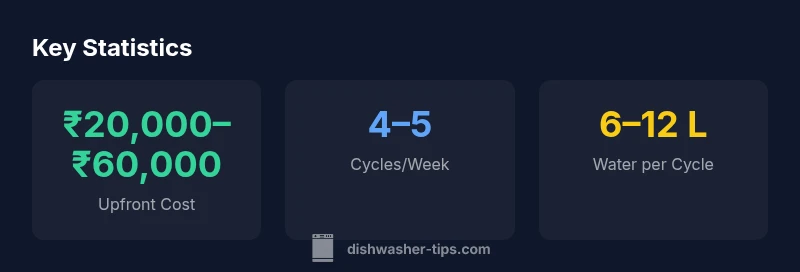
Cost is the dominant consideration for most buyers. Entry to mid-range models in India often fall in the ₹20,000–₹60,000 bracket, with installation and plumbing typically adding another ₹2,000–₹8,000 depending on the home’s existing setup. Operating costs hinge on local electricity tariffs and water rates. In general, per-cycle energy use can range from about 0.5 to 1.2 kWh, and water usage per cycle is typically between 6 and 12 liters, depending on settings and load. While you might save on labor and detergent, the ROI depends on how often you run cycles. Dishwasher Tips analysis highlights that households with higher weekly dish loads reach payback faster, especially when they can leverage eco or quick cycles to minimize running time.
The cost picture improves if you own the home, have space for installation, and can schedule cycles during lower-tariff periods. Renters should consider portable or countertop models where permanent installation isn’t feasible. Language in the Indian market stresses flexibility—look for models with good service coverage and reliable after-sales support.
Efficiency, Water, and Hygiene: What Changes with a Dishwasher?
A modern dishwasher can offer consistent cleaning and improved hygiene compared with hand-washing, especially for higher volumes and for items that require thorough drying. Indian households may notice differences in detergents and rinse aids required to combat hard water, which can scale residues and cloud glassware. Eco modes typically use less water and energy, but may lengthen cycle times. In markets with hard water, descaling every few months can help maintain performance. Hygiene benefits come from standardized temperatures and targeted sanitizing cycles, which reduce manual handling and potential cross-contamination. If your water quality is challenging, pair the machine with a water softener or rinse aid, and ensure proper filter maintenance to preserve effectiveness.
Dishwasher Tips notes that urban households with reliable electricity and a well-chosen model experience the most consistent outcomes, while rural areas may face supply interruptions that dampen the value proposition.
Which Indian Households Benefit Most?
The strongest candidates are families of four or more who cook regularly, live in apartments with constrained kitchen space, and can ensure consistent power and water. Busy professionals who want to reclaim time, or households with shared cooking duties, also gain from the predictability and convenience of machine cleaning. For renters, compact or portable dishwashers are a practical bridge where permanent installation isn’t possible, provided there’s a reliable power source and a space to place the unit. For households with limited dishwashing capacity or who dislike handling fragile glassware, a dishwasher can reduce breakage and mess.
Dishwasher Tips suggests evaluating your weekly dish load before deciding, because the perceived convenience scales with usage.
Buying Guide: What to Look For in an Indian Context
When shopping in India, prioritize capacity (6–8 place settings for typical families), energy efficiency (look for 4–5 star ratings where available), voltage compatibility (230V ranges are common), and service coverage near your home. Noise levels, cycle versatility (eco, quick, heavy, sanitize), and steam options matter for open-plan kitchens. Check for a robust filter system and easy access to spare parts and consumables like rinse aid and descalers. Warranty length and after-sales service can significantly affect long-term satisfaction, especially where parts are less available. Finally, consider installation realities—some homes require plumbing modifications or additional water filtration steps to maximize performance.
Practical Tips for Getting the Most Value
To maximize value, run a full load at least 4 times per week and use eco-friendly cycles when possible. Pre-rinse heavy soils to avoid extra cycles, but avoid wasting water by pre-rinsing too much. Use rinse aid to improve drying in areas with hard water, and clean the filter monthly to maintain efficiency. If you’re in a hard-water region, descaling every 2–3 months helps prevent limescale buildup that reduces performance. Regular service checks and a quick warranty review can prevent unexpected costs. When possible, schedule cycles during off-peak hours to reduce electricity costs. Finally, combine a dishwasher with a well-sealed kitchen to cut drying times and keep your space clean and hygienic.
Alternatives and Final Considerations
If installation complexity or cost is prohibitive, consider countertop or portable dishwashers that run on standard power and connect to a faucet. These units are often suitable for renters or small kitchens and can still deliver most of the hygiene benefits of a full-size model. If neither option fits your space, a well-organized hand-washing routine with a sterilizing rinse and drying area remains a viable alternative. In either path, the key is to align the purchase with your weekly dish load, water and energy costs, and the reliability of your home infrastructure.
Dishwasher usage vs hand washing: India context
| Aspect | Dishwasher Use in India | Hand Washing (Manual) |
|---|---|---|
| Water usage per cycle | 6–12 liters | Manual washing varies widely (per person) |
| Energy per cycle | 0.5–1.2 kWh | Dependent on washing intensity |
| Load capacity | 6–8 place settings | Flexible per individual wash |
| Annual maintenance (range) | ₹1,000–₹3,000 | Model dependent they require more or less maintenance |
People Also Ask
Is a dishwasher worth it for small households in India?
For very small households, the ROI is often limited due to lower dish loads. If your usage is light, a compact or countertop model may be more cost-effective. For larger families or busy households, the time saved and sanitation benefits often justify the investment.
If you cook infrequently, a dishwasher may not pay off; for larger households, it’s typically worth it.
What should I look for when buying a dishwasher in India?
Prioritize capacity (6–8 place settings), reliable service networks, energy efficiency, compatible voltage, and ease of maintenance. Check filter hygiene, available cycle options, and warranty coverage. Consider models that handle hard water with rinse aids and descalers.
Choose a model with good service nearby, energy efficiency, and a capacity that matches your family’s load.
Can renters use a dishwasher?
Yes, renters can use dishwashers with portable or countertop units that don’t require permanent plumbing. Ensure the landlord approves installation, and verify there’s a stable water supply and 230V power. These options offer flexibility without long-term commitments.
Portables are great for renters, provided you have landlord permission and power access.
Do dishwashers use more water than hand washing in India?
Modern dishwashers typically use a defined amount of water per cycle, often comparable to or less than manual washing for a full load. With hard water, rinsing aids and proper cycle selection can improve efficiency. Your real-world savings depend on how you wash by hand and how often you run cycles.
In many cases, a full dishwasher load uses water more efficiently than washing a full sink of dishes by hand.
What maintenance helps extend life in hard water areas?
Descale regularly with a recommended descaler, clean and rinse the filter monthly, and use rinse aid to prevent mineral buildup. Hard water can reduce efficiency and lead to faster wear, so proactive maintenance is key.
Descale often, clean filters, and use rinse aid to fight hard-water buildup.
Are countertop models viable options in India?
Countertop dishwashers are viable for small kitchens or renters with limited space. They usually have smaller capacities and require a faucet hookup, but they can provide most benefits for light to moderate dish loads.
Yes, if space is tight and loads are light to moderate.
“A dishwasher can be a smart investment in Indian urban homes when used consistently and paired with an energy- and water-efficient model.”
What to Remember
- Assess family size and weekly dish load first
- Weigh upfront costs against operating expenses
- Prioritize energy efficiency and service access
- Plan for water hardness and rinse aid needs
- Consider compact or portable options for renters