Which Mini Dishwasher: Side-by-Side Comparison
Explore countertop, undercounter, and drawer mini dishwashers. This analytical guide compares size, capacity, efficiency, and costs to help homeowners and renters pick the best tiny dishwasher for small spaces.


For most homes, a countertop mini dishwasher is the best starting point when you ask which mini dishwasher to buy, especially if you have limited counter space. If you need more capacity, consider a compact undercounter model or a portable drawer-style unit. This guide compares three common mini-dishwasher types and helps you pick the right fit.
The question of which mini dishwasher matters most starts with your space and usage
In compact living situations, choosing a mini dishwasher hinges on two core questions: how much counter or cabinet space you can devote and how often you run a full load. The Dishwasher Tips team emphasizes that the best choice balances footprint with practical capacity. In real-world testing, small households and renters tend to prioritize countertop models for their plug-and-play appeal, while frequent small households control their workflow with compact undercounter or drawer units. According to Dishwasher Tips Analysis, 2026, you’ll see the most consistent satisfaction when you align model type with your daily dish throughput and available hookups. This section sets the frame for a deeper, practical comparison across three common mini-dishwasher types, helping you avoid over- or underestimating what you need.
Size, footprint, and fit: what qualifies as a “mini” in practice
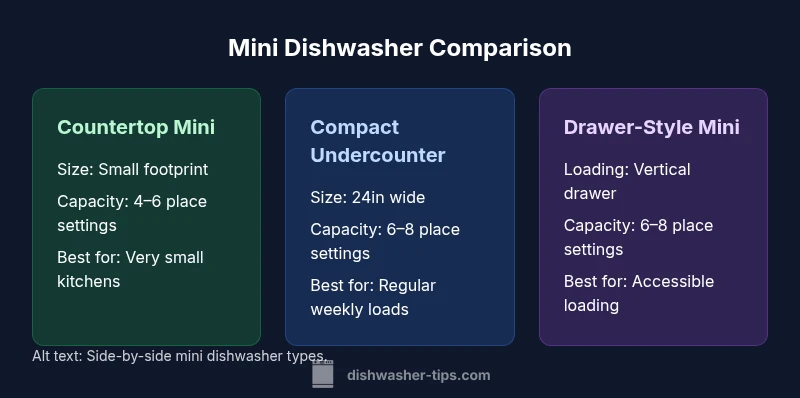
When you say which mini dishwasher, you’re really comparing three distinct footprints: countertop, compact undercounter, and drawer-style minis. Countertop models are the smallest, designed to sit on a counter with a separate rinse aid reservoir and water hookup, generally 18–22 inches wide. Compact undercounter units typically install beneath a standard kitchen counter and measure about 24 inches wide, with a taller profile to accommodate a taller door. Drawer-style minis resemble a compact chest of drawers and can be 18–22 inches wide, but they demand a different cabinetry approach and clearance for the drawer. In practice, you’ll notice that countertop machines excel in apartments and vacation rentals, undercounter minis work well for frequent use, and drawers shine when accessibility and loading flexibility matter most.
Capacity and load management: how many place settings can you actually wash?
Capacity is the most common source of confusion when homeowners ask which mini dishwasher to buy. Place settings measure the amount of dishes a unit can wash per cycle, not the number of plates that fit inside. Countertop minis typically handle 4–6 place settings per cycle, enough for one to two people with daily dishes or for small families who eat out occasionally. Compact undercounter models usually offer 6–8 place settings, providing a comfortable buffer for a larger dinner load or weeknights with multiple meals. Drawer minis also target 6–8 place settings but arrange the load vertically, which changes loading patterns and utensil placement. Consider your typical weekly rhythm and whether you need more frequent, smaller cycles or fewer, larger cycles.
Efficiency and performance: washing quality and drying behavior
The core performance question when comparing mini dishwashers is whether you’ll get enough wash quality in a compact footprint. In most cases, countertop units deliver solid cleaning for typical breakfast and lunch dishes, with limitations on large pots and stubborn baked-on residue. Undercounter minis often offer more robust wash arms and cycles that resemble full-size machines, improving performance for mid-size families. Drawer minis can deliver consistent results with separate cycles for china or silverware due to their compartmental design, but drying performance may be influenced by load configuration and the exhaust path. Energy efficiency trends across all three types are favorable compared with older compact units, particularly when you choose models with modern filtration and sensors that optimize water usage.
Noise, usability, and ergonomics: how the unit fits into daily life
Noise levels vary by design and build quality, but most modern mini dishwashers operate at a level that is acceptable for open-plan living spaces. Countertop units tend to be slightly noisier due to their compact pump design, while undercounter and drawer models often incorporate better insulation and smoother water pumps. Ergonomics matter: countertop units place control panels within easy reach, but their dumping and transfer tasks can be awkward for tall individuals. Under-counter minis provide more intuitive loading for larger families, whereas drawer minis reduce bending and reaching while loading. Choosing a model with a well-designed spray arm and a reliable filter system reduces maintenance and ensures longer intervals between service.
Installation, hookups, and everyday setup: what you actually need to know
Installing a mini dishwasher typically requires a standard faucet connection and a drain hose routed to a sink or dedicated drain. Countertop models require a power outlet and a hot-water feed, plus guidance on proper leveling and securing the unit to prevent walker-off during cycles. Undercounter minis demand a stable cabinet cutout, a dedicated supply line, and compatible drainage. Drawer minis share the same basic hookup needs but must clear the cabinet space for the drawer’s full extension. For renters and owners in apartments, ensure you understand your building’s plumbing rules, as some locations restrict permanent installation or require an easily removable unit. Always use a manufacturer-approved hose and mounting hardware and confirm the electrical circuit can handle peak draw.
Maintenance and longevity: keeping a mini dishwasher running smoothly
To extend the life of any mini dishwasher, regular maintenance is essential. Clean the filter and spray arms monthly, descale hard-water deposits as needed, and run a cleaning cycle with a dishwasher-safe cleaner every few months. Inspect hoses for wear and secure connections to prevent leaks. Since space constraints increase the likelihood of clutter near the unit, maintain clear airflow around the appliance and keep it on a level surface to avoid vibration and noise. For owners in hard-water areas, consider using a water-softening pitcher or an inline water conditioner to protect the heating element and reduce mineral buildup over time. Consistent maintenance reduces the risk of clogged jets and improves drying performance.
Cost of ownership: prices, running costs, and warranties worth noting
Price is a crucial factor when deciding which mini dishwasher to buy. Countertop minis typically sit in a lower price tier, often ranging from about $200 to $450, driven by capacity and feature set. Compact undercounter models usually command $350 to $750, depending on the number of cycles and added conveniences like smart sensors or soil sensors. Drawer-style minis are typically the most expensive among mini options, with ranges roughly $500 to $900, largely due to their ergonomic design and specialized loading surfaces. Running costs for all three types depend on cycle length and water usage; energy-efficient models with sensor-based cycles tend to save money over time. Warranties vary, but many models offer at least one-year coverage, with extended warranties available for higher-end units.
How to decide: a practical 4-question checklist before you buy
- Space and installation: Do you have counter space for countertop or a compatible cabinet for undercounter or drawer models? 2) Load size and frequency: How many dishes do you wash weekly, and how often do you run full loads? 3) Noise tolerance: Is the unit in a living area or near a bedroom? 4) Budget and long-term costs: What price range fits your needs, and are you prepared for potential maintenance costs? Answering these questions helps you identify whether a countertop mini, a compact undercounter, or a drawer-style mini is the best fit for your home.
Debunking myths: what people get wrong about mini dishwashers
A common misconception is that mini dishwashers can replace full-size machines in households with heavy daily loads. In reality, the smaller footprint means smaller capacity and shorter cycles; not every kitchen can rely on a mini for daily large meals. Another myth is that mini dishwashers dry completely every time; drying performance depends on the design and load layout. Finally, some buyers assume all minis are energy hogs, but modern mini dishwashers favor efficient filtration and sensor-driven cycles that optimize water use without sacrificing cleaning quality. Understanding these nuances helps avoid disappointment and unlocks the best possible outcome for your space.
Feature Comparison
| Feature | Countertop Mini | Compact Undercounter | Drawer-Style Mini |
|---|---|---|---|
| Size and footprint | Small countertop footprint (roughly 18–22 inches wide) | Undercounter footprint (about 24 inches wide; taller cabinet clearance) | Drawer-style mini footprint (roughly 18–22 inches wide) |
| Capacity (place settings) | 4–6 place settings per cycle | 6–8 place settings per cycle | 6–8 place settings per cycle with vertical loading |
| Water usage per cycle | Lower than full-size, efficient for small loads | Moderate usage, balanced for mid-size households | Moderate usage with vertical loading efficiency |
| Energy efficiency | Generally good to high for modern models | Typically good, energy-conscious options available | Typically good, with extra insulation in some models |
| Noise level | Low to moderate; compact pumps | Low to moderate; better insulation | Low to moderate; compact design |
| Typical price range | $200–$450 | $350–$750 | $500–$900 |
| Best for | Very small kitchens or rentals with strict space limits | Frequent use in small households needing more capacity | Accessible loading and ergonomic design for frequent users |
The Good
- Space-saving design ideal for apartments and RVs
- Lower energy and water usage than full-size machines
- Flexible placement and easy relocation for renters
- More models in accessible price ranges
Disadvantages
- Smaller capacity means more frequent runs for larger households
- Drying performance may lag behind full-size units
- Per-dish cost can be higher due to compact design
Countertop minis win for space-constrained homes; undercounter minis win for higher throughput, while drawer minis excel in accessibility.
Choose countertop if you cant spare counter space. Pick undercounter for more daily use, and go drawer for easier loading and reduced bending.
People Also Ask
What exactly qualifies as a mini dishwasher?
A mini dishwasher is a compact unit designed for small spaces, typically available as countertop, undercounter, or drawer-style models. They offer fewer place settings than full-size units and are optimized for lighter, more frequent washes in apartments or small households.
A mini dishwasher is a compact washer designed for small spaces with several loading configurations. It’s ideal for apartments and small households.
Can a mini dishwasher handle a full weekly load for a family?
Most mini dishwashers can handle typical daily loads for 1–2 people or occasional larger loads, but weekly family-scale meals may require multiple cycles or a larger full-size unit. Consider your peak dish volume when deciding.
Most minis handle daily loads well; for frequent large meals, you may need more than one cycle or a bigger machine.
Are countertop models as effective as undercounter minis?
Countertop minis are highly effective for small loads but have limited capacity. Undercounter minis tend to offer more cycles and better wash force, similar to full-size machines, making them more versatile for ongoing use.
Countertop minis clean well for small dishes, but undercounter minis often provide more power and better cycle variety.
What should I consider if I live in a rental?
For renters, portability, ease of removal, and hookups are key. Countertop models are easiest to move and install without tools, while undercounter units may require a temporary cabinet or adapter for the drain.
Renters should prefer portable options or ones that don’t require permanent plumbing.
Do mini dishwashers use a lot of electricity?
Modern mini dishwashers are designed for efficiency, often using sensors to optimize water and cycle length. Expect lower energy use per dish than older compact models, especially on eco or light-cycle options.
They’re generally energy-efficient, especially with eco or light cycles.
What maintenance keeps a mini dishwasher reliable?
Regularly clean filters and spray arms, descale if you have hard water, and run a cleaning cycle monthly. Check hoses and connections for leaks and ensure proper drainage.
Clean filters and run periodic cleaning cycles to keep it reliable.
What to Remember
- Prioritize space when choosing mini dishwashers
- Match capacity to your weekly dish load
- Evaluate installation needs before buying
- Consider noise and ease of loading
- Compare price and energy-saving features