What dishwasher detergent does Bosch recommend?
Discover Bosch's guidance on dishwasher detergents, including approved forms, dosing tips, and safety considerations. Learn how to choose detergents compatible with your Bosch model and water hardness, with practical advice from Dishwasher Tips.


So, what dishwasher detergent does Bosch recommend? Bosch advises using detergents formulated for automatic dishwashers, with tablets or powder options favored for reliable cleaning. There is no single Bosch-endorsed brand; choose a detergent labeled for automatic dishwashers, compatible with your water hardness and rinse aid use. This guidance mirrors Dishwasher Tips Analysis, 2026.
How Bosch Approaches Detergent Guidance
When homeowners ask what dishwasher detergent does bosch recommend, the short answer is that Bosch does not publish a single endorsed brand. Instead, Bosch emphasizes detergents that are labeled for automatic dishwashers and compatible with the dishwasher’s wash programs. In practice, most Bosch models perform well with popular tablets or powder detergents, provided the product is designed for automatic dishwashers and the packaging indicates compatibility with your water hardness. According to Dishwasher Tips, the emphasis is on selecting a detergent that reliably produces clean dishes without excessive suds or residue. This is especially important for models with sensor-assisted cycles that adjust water use and temperature for optimal results.
The key takeaway is practicality: your choice should align with the model’s program options, energy efficiency settings, and the local water quality. If you’re new to Bosch or moving from a non-dedicated detergent, start with a standard tablet or powder that explicitly states it is for automatic dishwashers and then observe the cleaning performance over a few cycles. This approach minimizes the risk of oversudsing or poor cleaning performance and keeps maintenance simple.
Detergent Forms: Tablets, Powder, Gel
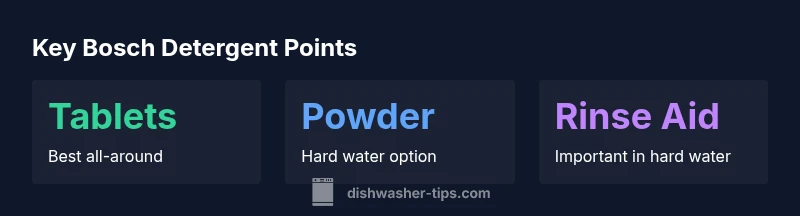
Bosch models are designed to work with the three major detergent forms: tablets, powder, and gel. Tablets are often the easiest option for consistent dosing and reliable performance across multiple cycles, especially when soil levels vary. Powder detergents can be advantageous in hard water or when you want to customize dosage, such as using slightly more for heavy soils or extra-pots. Gel detergents are less common in high-end Bosch configurations but can be a viable backup when tablets are unavailable. For best results, never mix forms in a single cycle and avoid hand-dishwashing liquids, which can overflow the dispenser and create excessive suds. Use products clearly labeled for automatic dishwashers and keep them sealed away from moisture.
- Pros of tablets: consistent dosing, minimal handling, better residue control.
- Pros of powder: adjustable dosing, good for hard water scenarios.
- Cons: gels may give uneven distribution in some dispensers and can dissolve too quickly in hot water. When selecting a form, consider your typical load, soil level, and whether your water is hard or soft. The goal is predictable performance and minimal residue on glassware.
Dosage and Cycle Guidance
Dosage guidance varies by soil level, water hardness, and the dishwasher model. A common starting point is one tablet per standard cycle for tablet detergents. Powder detergents are typically dosed by volume, often 1–2 tablespoons, depending on how heavily you load the rack and how dirty the dishes are. Bosch cycles are designed to optimize cleaning with typical household soils, but if you notice residue or cloudy glassware, you may need to adjust dosage or add a rinse aid. Always follow the detergent packaging directions and consider your water hardness. If your area has particularly hard water, you might need to increase the amount of detergent slightly or pair it with a compatible rinse aid for improved drying and spot control.
Water Hardness and Rinse Aid Considerations
Water hardness plays a significant role in detergent effectiveness and drying performance. In harder water, more minerals remain on dishes, which can lead to white film or cloudy glassware after drying. A rinse aid helps reduce this effect by breaking surface tension and promoting better sheeting during the final rinse. Bosch cycles pair well with rinse aids, especially on hard water. If you’re unsure of your water hardness, many regions offer at-home test strips or lab services. Start with a standard rinse aid dosage and adjust gradually based on drying results. The goal is spotless dishes with minimal residues, not over-application that can leave a film on plastics and metals.
Compatibility with Bosch Models and Special Features
Some Bosch models feature sensors that tailor wash parameters based on detected soil, water temperature, and load composition. Detergent choice remains important, but the interaction with these sensors can influence detergent effectiveness. Use detergents that explicitly indicate compatibility with automatic dishwashers and with Bosch’s wash programs. In models with auto-sensing features, you may benefit from tablets that provide consistent performance across cycles, reducing the risk of under- or over-dosing. Always ensure your detergent packaging is not past its expiry date, as degraded detergents can lose efficacy and produce poorer cleaning results.
How to Choose the Right Detergent for Your Bosch Model
To select the right detergent, start by identifying your water hardness, typical loads, and preferred form. If you prioritize convenience and reliable results with minimal user input, tablets are often the easiest option, offering consistent dosing and reduced risk of residue. For hard water or heavy soils, powder detergents with proper dosing or a combination of powder plus rinse aid can improve outcomes. Check your Bosch manual for any model-specific notes on detergent form and dosage, and consider trying a single brand for a few cycles to establish a baseline performance before making broader switches.
Common Mistakes to Avoid
- Using hand-dishwashing liquid or dish soap, which creates excessive suds and can damage the dishwasher.
- Not using a rinse aid when recommended for your water hardness, which can result in water spots and dull finishes.
- Over-dosing detergents, which wastes product and can lead to residue on dishes.
- Storing detergents in damp areas that degrade packaging or cause clumping.
Bosch detergent compatibility guidance
| Detergent Form | Recommended Use | Typical Dosage | Notes |
|---|---|---|---|
| Tablets | Best all-around performance | 1 tablet per standard cycle | Contains built-in enzymes and salt substitutes |
| Powder | Good for hard water and heavy soils | 1–2 tablespoons | Ensure even distribution in dispenser |
| Gel | Backup option when tablets unavailable | 1–2 tablespoons | Less common in Bosch, may affect rinse quality |
People Also Ask
Does Bosch endorse a specific detergent brand?
Bosch does not publish a single endorsed brand. They recommend detergents labeled for automatic dishwashers and compatible with the model’s wash programs and water conditions. Customers should select a product that clearly states it is for automatic dishwashers and test performance on a few cycles.
Bosch doesn’t endorse a single brand; pick an automatic-dishwasher detergent and test its performance on your cycles.
Can I use dishwasher pods with Bosch models?
Yes, pods labeled for automatic dishwashers are generally compatible with Bosch models. Ensure the pod dissolves properly in the dispenser and does not leave residue. Follow the manufacturer’s dosage and avoid using multiple detergents at once.
Pods are usually fine as long as they’re labeled for automatic dishwashers and dissolve properly.
What about hard water and rinse aid?
Hard water can cause mineral deposits and dullness on glassware. Use rinse aid and consider a stronger detergent or larger dosage if advised by the packaging. Regular cleanliness and occasional machine cleaning help maintain performance.
Hard water means rinse aid can help you get sparkling dishes.
Is there a risk using the wrong detergent in Bosch?
Using a non-dishwasher detergent or hand-dishwashing liquid can create excessive suds, damage the dispenser, and leave residue. Stick to products labeled for automatic dishwashers and follow dosing instructions.
Avoid hand soaps and non-dishwasher detergents to keep your Bosch running smoothly.
Should I rinse dishes before loading?
Rinsing off heavy soil is optional for most Bosch cycles, as modern detergents and sensors are designed for typical household soils. A light pre-rinse may help with stubborn foods, but it’s usually unnecessary.
Usually not required to pre-rinse; let the dishwasher handle typical soils with a good detergent.
How can I tell if my detergent is expired?
Detergent cartons have a best-by date. Expired detergents may lose cleaning strength. Store detergents in a cool, dry place and replace when the label indicates to do so.
Check the date and store properly; replace if expired.
“Detergent choice should be aligned with the dishwasher’s design, the cycle being used, and your local water hardness. There isn’t a single Bosch-endorsed brand; choose a detergent that clearly states it is for automatic dishwashers and compatible with your water conditions.”
What to Remember
- Choose detergents labeled for automatic dishwashers
- Tablets offer consistent dosing and convenience
- Hard water may require rinse aid and/or powder detergents
- Avoid hand-d dishwashing liquids in the dishwasher
- Follow Bosch model guidance for best results