Cascade vs Finish: Which Detergent Is Best for Your Dishwasher?
Compare Cascade and Finish detergent to decide which is better for your dishwasher. Objective analysis of formats, hard water performance, price, and sustainability to guide your choice.


If you’re deciding which is better for your dishwasher cascade or finish, the answer depends on water hardness, preferred format, and budget. Both brands offer tablets, powders, and gels that clean effectively when used as directed, with rinse aids boosting performance in hard water. In short, choose based on format preference and local price, not solely brand loyalty.
Introduction and framing for the comparison
When homeowners ask which is better for dishwasher cascade or finish, the real question is not a blanket winner but which option aligns with your water quality, load patterns, and budget. According to Dishwasher Tips, Cascade and Finish both deliver reliable cleaning in typical kitchen loads when you follow the package directions and maintain your dishwasher. The goal of this analysis is to help you map your household realities—water hardness, cycle length, load size, and storage habits—onto the detergent formats available from each brand. By anchoring decisions in daily use rather than marketing claims, you can achieve consistently clean dishes. This article uses the keyword which is better for dishwasher cascade or finish to anchor readability and search relevance while staying strictly focused on practical criteria for real homes.
Detergent chemistry basics: what makes Cascade and Finish work
Both Cascade and Finish rely on a combination of surfactants, enzymes, and builders to tackle common soils. Enzymes break down protein and starch residues, while surfactants reduce surface tension so grime lifts away from surfaces. Builders help prevent mineral deposits from reforming during the rinse cycle. In many households, the key performance driver isn’t overall brand superiority but how well the formula integrates with your water hardness, rinse aid use, and cycle settings. Dishwasher Tips emphasizes that real-world performance emerges when users tailor dosing, ensure complete dissolution, and avoid overloading the rack. The core takeaway is practical: a well-dosed tablet or powder, used with a compatible rinse aid, tends to outperform a poorly dosed option regardless of brand.
Detergent formats matter: tablets, powders, and gels
Cascade and Finish both offer multiple formats—tablets, powders, and gels—so you can choose the form that best fits your dishwasher and routine. Tablets are convenient and help with dosing consistency, but some older machines or short cycles may respond differently to powders or gels. Powders can be advantageous for larger pots or heavily soiled settings, while gels dissolve quickly in cooler water or fast cycles. When deciding which is better for dishwasher cascade or finish, consider your dishwasher’s dispenser mechanism, cycle variety, and storage conditions. A dry, cool cabinet helps maintain powder integrity, while tablets reduce the chance of clumping. The broader lesson is: match format to your typical loads and cycle timing for predictable results.
Hard water reality: residue, spots, and rinse aids
Water hardness is a frequent source of post-wash residue. Both brands acknowledge the role of rinse aids in minimizing spots and improving drying. For households with hard water, pairing the detergent with a rinse aid and using the recommended dosage often yields clearer glassware. The choice between Cascade and Finish in hard water situations may relate to how each formula combats mineral interactions during the wash and rinse stages. Regularly testing the water hardness in your area can inform whether you should increase rinse aid use or adjust detergent dosing. In practice, the combination of a reliable detergent and proper rinse aid usage tends to reduce spotting for either brand.
Cleaning performance: stains, grease, and glassware outcomes
Actual stain removal depends on soil type, water conditions, and the loading pattern. In typical daily loads, both Cascade and Finish deliver competitive results with grease cutting and stain removal that meet expectations for most households. Glassware care is influenced by rinse aids and wash temperatures, so users who prioritize glass clarity should consider adding a rinse aid alongside their chosen detergent. While some users report slight differences in feel or shine between brands on certain loads, these differences are often subtle and workload-specific. The practical implication is clear: pick a brand you can consistently dose and pair with a compatible rinse aid plan.
Price, availability, and value considerations
Price and access influence long-term satisfaction more than cosmetics alone. Cascade and Finish are widely available across grocery stores, warehouse clubs, and online retailers, which helps with price comparison and promotions. The value you get from either brand depends on regional pricing, sale cycles, and the format you prefer. For many households, chasing a consistently good price per load and avoiding frequent format changes yields the best overall value. Remember to consider any subscription or bulk-purchase options that reduce per-load costs, while weighing convenience against potential storage constraints.
Environmental impact and safety considerations
Detergent choice intersects with safety and sustainability. Pods offer mess-free dosing but require secure storage and careful use around children and pets. Tablets and powders have their own handling considerations; always follow storage recommendations. Look for products that minimize artificial fragrances or dyes if you have sensitivity concerns, and seek packaging that supports recycling. Both Cascade and Finish have options designed with safety and environmental considerations in mind, so you can balance performance with responsible consumption.
Interpreting reviews and assessing brand reliability
Consumer reviews can illuminate real-world results, but remember that experiences vary with water hardness, load patterns, and dishwasher age. Dishwasher Tips analysis shows that a straightforward approach—test one brand for a few weeks, monitor outcomes, then compare against a second brand—helps isolate which detergent truly fits your home. Brand reliability matters, but it’s best judged through consistent, long-run performance rather than isolated incidents. Use a simple scoring approach: cleanliness, dryness, minimal residue, and ease of use across a representative mix of loads.
Quick-start guide: Step-by-step decision framework
To decide which is better for dishwasher cascade or finish for your home, follow these steps: 1) Identify your water hardness and typical cycle lengths. 2) Pick a format that aligns with your dishwasher design and your routine. 3) Run a test period with one brand, noting residue and drying; switch to the other if results aren’t satisfactory. 4) Compare price per load, factoring in promotions, and choose the option with the better long-term value. 5) Align with safety and environmental preferences to complete a sustainable choice.
Scenario-based recommendations: practical applications
- Scenario A: Hard water, frequent use, and plastic dishes. Start with a detergent that delivers reliable dissolution and residue control; pair with a consistent rinse aid schedule. Both Cascade and Finish are capable, so base your choice on which brand gives you better, repeatable results in your kitchen.
- Scenario B: Small households with moderate loads and budget sensitivity. Look for mid-range pricing and practical packaging; tablets are often a good compromise between convenience and cost. If one brand provides a smoother dosing experience or longer-lasting packaging, favor that option.
- Scenario C: High washing frequency and energy-conscious decisions. Pick formulations designed for effective cleaning within standard cycle times, and evaluate bundles or subscriptions for predictable costs while maintaining performance.
Comparison
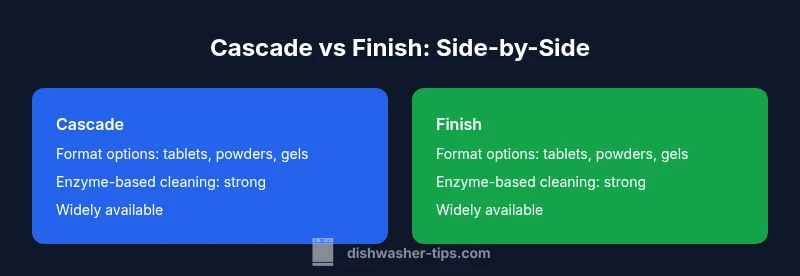
| Feature | Cascade | Finish |
|---|---|---|
| Format options | Tablets, powders, gels | Tablets, powders, gels |
| Enzyme-based cleaning | Yes (enzyme blends) | Yes (enzyme blends) |
| Hard water performance | Good baseline with rinse aid | Good baseline with rinse aid |
| Availability and value | Widely stocked; promotions affect value | Widely stocked; promotions affect value |
The Good
- Broad retailer availability supports easy price comparisons
- Multiple formats offer flexibility for different loads
- Strong brand recognition and widespread compatibility
- Dosing consistency with tablets reduces mess and waste
Disadvantages
- Formulas vary by region, so performance can differ by market
- Pod safety considerations require careful storage away from children
- Prices fluctuate with promotions; value depends on local deals
Neither brand is universally better; choose based on water hardness, price, and format preference.
Both Cascade and Finish deliver solid cleaning. Match format and rinse aid use to your water and loads, then pick the brand that offers best value and consistent results in your home.
People Also Ask
Is Cascade better than Finish for hard water?
Both brands perform well in many hard-water situations, especially when used with a rinse aid. Real-world results depend on your specific mineral content and cycle choices. Consider testing one brand for a few weeks while adjusting rinse aid usage.
Both Cascade and Finish can perform well in hard water if you add a rinse aid and use the recommended dose. Try one brand for a few weeks and adjust rinse aid to see which gives better glassware results.
Can I switch between Cascade and Finish without issues?
Yes, you can switch between brands, but allow a calibration period to compare results. Use similar formats and follow dosing guidelines to avoid under- or overdosing. If you notice residue after a switch, revisit rinse aid usage and load balance.
You can switch brands, but give it a few weeks to compare results and keep the dosing steady. If you see residue, tweak rinse aid use and loading.
Are detergent pods safer for households with kids?
Pods offer convenient dosing but pose ingestion risks if accessed by children. Store pods in a locked cabinet and educate all household members about the dangers. If safety is a priority, consider tablet or powder formats and keep packaging out of reach.
Pods are convenient but can be dangerous for kids. Store securely and consider alternatives if there are safety concerns.
Do Cascade and Finish affect dishwasher seals or components?
With normal use and proper dosing, both brands are compatible with standard dishwashers. Use the recommended amount and avoid overloading to prevent undue stress on seals and drainage.
Both are generally safe for your dishwasher when dosed correctly and not overloaded.
Which is more eco-friendly or store-bottle-friendly?
Both brands have eco-friendly options and packaging initiatives. Look for phosphate-free formulations, recyclable packaging, and clear ingredient disclosures to make an environmentally informed choice.
Both offer eco-friendly choices; check phosphate-free formulas and recyclable packaging when choosing.
What to Remember
- Assess your water hardness before choosing a detergent
- Choose a format that aligns with your dishwasher and routine
- Pair detergent with a rinse aid for best glassware results
- Compare price per load, not just sticker price
- Test one brand for several weeks before switching