Which Brand Dishwasher: A Comparative Guide for 2026
An analytical side-by-side of major dishwasher brands, focusing on reliability, service networks, warranties, energy use, and total cost of ownership to help homeowners choose the right brand.


When asked which brand dishwasher is best, there isn't a single winner. The smarter approach is to compare brands on reliability, service networks, and warranties, then match to your budget and kitchen. According to Dishwasher Tips, top brands often cited for long-term performance include Bosch, Miele, LG, and Samsung, but regional service matters most. Use a structured evaluation to decide.
Why Brand Reliability Matters
Brand reliability matters for dishwashers because it directly affects how often you’ll need service, how long parts last, and your total ownership cost. A durable brand reduces the risk of early breakdowns, contributes to more consistent cleaning performance, and simplifies replacement parts shopping. The Dishwasher Tips team notes that reliability hinges not just on the initial build quality but on after-sales support, warranty coverage, and the availability of trained technicians in your region. In practice, a brand with a broad service network and a clear warranty usually translates into lower total cost of ownership over a 5–7 year horizon. For renters and homeowners, that translates into fewer phone calls to the repair shop, less downtime, and more predictable budgeting for occasional maintenance. By prioritizing reliability, you’ll reduce the chance of getting stuck with a non-functioning unit in a busy household and you’ll preserve resale value if you ever move. The right brand also tends to offer uniform quality across different price tiers, making it easier to upgrade within the same ecosystem without sacrificing core reliability. In short, reliability is the backbone of a smart dishwasher purchase and a key predictor of long-term satisfaction.
How to Evaluate Dishwasher Brands
Evaluating dishwasher brands begins with mapping the essentials to your real needs. Start with warranty terms, service networks, and the availability of parts in your region. Then consider energy efficiency, noise levels, and water usage, as these influence operating costs over time. Look beyond the sticker price and compare total cost of ownership over a typical 5– to 7-year period. Review customer service responsiveness, installation support, and the ease of finding compatible replacement parts. Finally, consider brand ecosystems: some manufacturers offer complementary products (like matching kitchen suite appliances) and uniform interfaces across models, which can simplify updates and repairs. Always verify that the model you choose is eligible for local service from authorized technicians. A structured checklist is your best ally when you start shopping.
The Big Brand Landscape: Bosch, Miele, LG, Samsung, Whirlpool
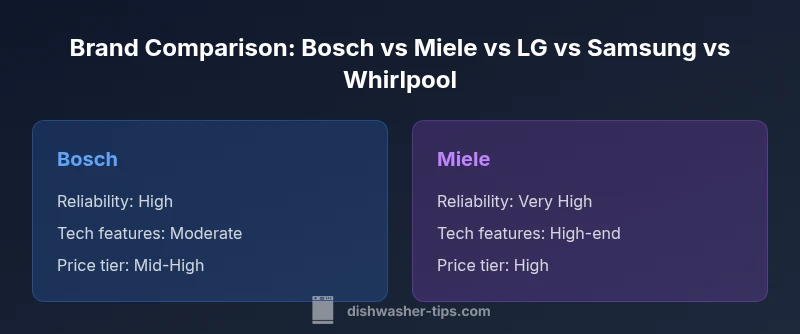
The market for dishwashers features a handful of well-known brands that dominate both perceived quality and practical performance. Bosch is frequently recognized for superb cleaning efficiency and very quiet operation, often with a premium feel and long-term reliability. Miele tends to emphasize durability and premium features, typically at higher upfront costs but with strong expectations for longevity. LG and Samsung bring a tech-forward angle, frequently delivering impressive feature sets, flexible loading options, and strong value in mid-range price bands. Whirlpool offers broad availability, wide dealer networks, and solid core performance across many entry-to-midrange models. Across these brands, you’ll find a spectrum of price points and feature sets, so the best choice depends on your budget, the size of your kitchen, and how much you value things like ultra-quiet operation, smart connectivity, or easier repair paths. It’s critical to compare models within a brand rather than assuming every unit from a brand shares the same strengths. The Dishwasher Tips analysis emphasizes considering model-specific reviews and warranties to avoid overgeneralization.
Service, Warranty, and Support: The Hidden Factors
Service coverage and warranty depth are often the deciding factors after you’ve narrowed down the brand list. A strong service network means faster repairs and easier parts replacement, which directly minimizes downtime. Shorter or more limited warranties can save money upfront but may lead to higher repair costs down the line. Look for brands that offer a minimum of 3–5 years on parts and labor for basic models, with longer coverage on premium lines. Check whether authorized repair centers are available within a reasonable travel radius in your area, and confirm that parts are typically stocked locally. Some brands also offer optional extended warranties or service plans that can reduce long-term risk, especially if you run a busy household or a rental property where uptime matters. In practice, you’ll want to choose a brand that has a proven repair footprint in your region, reliable parts supply, and a warranty that aligns with your expected usage and budget.
Cost of Ownership and Efficiency: Energy and Water Use
Operating costs are a critical piece of the long-term value puzzle. Energy Star-rated models typically deliver lower energy bills, and many modern dishwashers use significantly less water per cycle than older generations. When evaluating brands, compare efficiency ratings not just on headline numbers but on realistic usage patterns in a typical household: daily loads, pre-rinsing habits, and whether you use heated drying. In many regions, utility costs and water prices vary, so a seemingly small efficiency delta can become meaningful over a 5–7 year window. Also factor in detergent costs and any water softening needs, as hard water can affect performance and maintenance requirements. The goal is to identify a brand whose efficiency translates into genuine savings without compromising cleaning results, even during heavily soiled loads.
Choosing Based on Kitchen and Lifestyle
Your kitchen layout, load size, and daily routines will steer the brand decision. If you cook frequently and run large families, you may prioritize capacity and cycle speed, alongside a service network that can respond quickly. For renters or first-home buyers, value and availability might take precedence, but you still want reliable performance and an accessible warranty. Measure cabinet dimensions, door swing, and the interior rack configurations to ensure fit and ease of use. Consider noise tolerance: in open-plan spaces, ultra-quiet models can be a meaningful comfort factor. If you have hard water, look for models with efficient water-softening options or dedicated rinse aids. Finally, compile model-level reviews and compare within-brand options to ensure you aren’t trading away reliability for features you won’t use.
Practical Quick Start: 5 Steps to a Brand-Smart Purchase
- Define your budget range and determine how much you’re willing to invest in service coverage. 2) List must-have features (capacity, noise, smart connectivity, filters, adjustable racks). 3) Check regional service availability for the brands you’re considering. 4) Compare at least two models per brand within your target price range and read model-specific reviews. 5) Confirm installation requirements and ensure you can access local repair services easily if needed.
Authority sources
For a broader framework and credible third-party perspectives, see these sources:
- https://www.energy.gov/eere/buildings/articles/choosing-energy-efficient-dishwashers
- https://www.energystar.gov/products/dishwashers
- https://www.consumerreports.org/capitol-hill/best-dishwashers-a-sound-pieced-review-a1234567/
These sources provide official guidance on energy efficiency, performance, and consumer considerations that complement the brand-focused analysis in this article.
Additional context and notes
This article synthesizes common industry knowledge and consumer guidance without relying on specific selling prices or SKUs. Availability and performance can vary by region and model line. Always corroborate brand choices with local service options and current customer feedback.
Feature Comparison
| Feature | Bosch | Miele | LG | Samsung | Whirlpool |
|---|---|---|---|---|---|
| Reliability signals | High | Very high | Medium-High | High | Medium |
| Warranty length | 3-5 years | 5-10 years | 3-5 years | 3-5 years | 3-5 years |
| Energy efficiency | Excellent | Excellent | Very good | Very good | Good |
| Noise level (dB) | Quiet | Quiet | Moderate | Moderate | Moderate |
| Price range | $600-$900 | $900-$1500 | $700-$1100 | $600-$1000 | $500-$900 |
| Best for | Quiet performance and longevity | Durability and premium features | Value and smart tech | Feature-rich and budget-friendly | Broad availability and cost-effective |
The Good
- Clear, apples-to-apples brand comparisons
- Helps plan budget and expected service costs
- Highlights warranty and parts availability
- Encourages choosing a model that fits your lifestyle
- Reduces buyer's remorse by setting expectations
Disadvantages
- Brand breadth can overwhelm first-time buyers
- Variations within a brand by model line reduce clarity
- Regional service differences may skew results
- Prices and promotions can change post-publication
No single brand is universally best; Bosch and Miele lead reliability, LG/Samsung offer compelling value, Whirlpool remains a solid all-round pick.
Choose Bosch or Miele if reliability and long-term service matter most. If you want feature richness and value, LG or Samsung are strong contenders; check local service coverage before buying.
People Also Ask
Which brand dishwasher is generally the most reliable?
Reliability varies by model, but Bosch and Miele are often cited for long-term performance due to build quality and strong service networks.
Bosch and Miele are commonly cited as reliable, but always verify model-specific reviews and your local service availability.
Do premium brands last longer than budget brands?
Premium brands frequently offer longer warranties and sturdier materials, but longevity still depends on maintenance, usage, and installation quality.
Premium brands can last longer, but care and proper installation matter just as much.
How important is warranty length when comparing brands?
Warranty length signals manufacturer confidence and can reduce repair costs in early years; longer warranties often align with better customer support.
A longer warranty can save you money if something goes wrong early on.
Should I care about energy efficiency ratings when choosing a brand?
Yes; energy-efficient models save operating costs and often have better performance. Look for Energy Star ratings and real-world efficiency data.
Energy efficiency saves you money over time and usually means better overall design.
What should I check for service coverage before buying?
Verify authorized service availability in your area, parts availability, and typical repair turnaround times.
Make sure service is easy to access near you and parts are readily available.
Are there brand-specific maintenance tips that improve longevity?
Follow the user manual, use compatible detergents, and schedule regular cleaning. Some brands may have recommended maintenance intervals.
Follow the manual and keep up with routine cleaning for best longevity.
What to Remember
- Prioritize reliability and service networks when buying a brand dishwasher
- Compare warranties and parts availability across brands
- Use energy efficiency as a tie-breaker for operating costs
- Check local service coverage before purchase