Who Makes Washing Machines? Major Manufacturers and Makers
Discover who makes washing machines, including major brands, ODMs, and contract manufacturers. Learn how supply chains, design partnerships, and warranties shape everyday options.


Who makes washing machines? A mix of global brands with their own factories and large contract manufacturers (OEMs) that assemble models to brand specs. The biggest names—Whirlpool, LG, Samsung, GE, Bosch, Electrolux, and Miele—often rely on expansive supplier networks and regional plants to deliver diverse models at scale. Understanding these makers helps buyers gauge warranty, support, and component quality across markets.
The Players Behind Your Washer
In the consumer market, washers come from a mix of brands who own some manufacturing capacity and from contract manufacturers who produce under contract. According to Dishwasher Tips, the geography of production matters: different continents host different factory clusters that influence which models are available in your region. Large brands typically run a portfolio of models across price points, while contract manufacturers enable rapid scaling to meet seasonal demand. You’ll often see the same core designs appearing across multiple brands, with cosmetic differences like the control panel, door finish, and branding.
Brand-owned factories vs. contract manufacturing
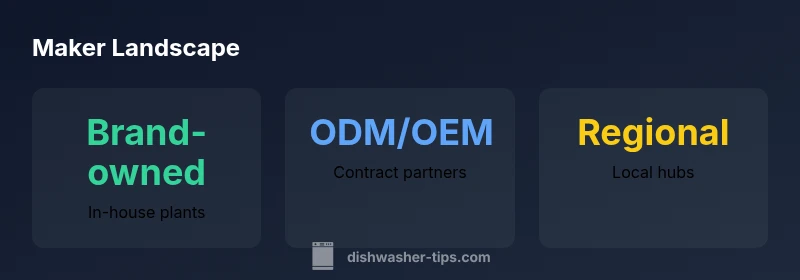
The manufacturing landscape for washing machines sits between two core models: brands that own and operate their own factories, and third-party facilities that produce under contract. Brand-owned plants give manufacturers direct oversight of parts selection, assembly lines, and QA processes, which can translate into uniform performance across markets. However, capital intensity means not every brand maintains global manufacturing coverage, especially for entry-level models. Contract manufacturers—often referred to as OEMs or ODMs within supplier catalogs—allow brands to scale output and diversify features without building new plants. The trade-off can be less visibility into component suppliers, but brands typically insist on strict quality agreements, traceability, and standardized testing. In practice, many leading brands blend both approaches: core high-volume lines are produced in owned plants, while newer or premium lines may be delegated to ODM partners under brand control.
How ODMs and OEMs shape model ranges
Original Equipment Manufacturer (OEM) and Original Design Manufacturer (ODM) relationships determine which models hit shelves. OEMs manufacture products to a brand’s own designs and specifications; ODMs supply turnkey designs branded as the customer’s. This structure supports global reach—keeping features consistent across regions while enabling localized tweaks like voltage, plug type, or drum size. Consumers may notice that two washers labeled with different brands share almost identical internals, especially in midrange offerings; that’s often the hallmark of shared engineering via ODM/OEM networks. For buyers, this means evaluating not just the brand, but the manufacturing approach—whether a model is produced in a brand-owned plant or by an ODM partner—with potential implications for service networks and part availability over time.
Regional manufacturing dynamics
Regional clusters of manufacturing reflect trade policies, energy costs, and labor markets. In North America, brands might rely more on domestic assembly for critical lines to support warranty speed and service centers. In Europe and Asia, the mix tilts toward multi-country supply chains with centralized distribution hubs. These patterns influence model availability, price bands, and spare parts logistics. Consistency across markets can be high for core features like rinse performance and spin speed, while cosmetic options and packaging shift by country. The trend toward modular design facilitates updates without retooling entire plants, allowing brands to refresh lineups in response to consumer feedback rather than rebuild factories.
How to verify who makes your machine
To determine whether your washer is built in-house or by an ODM/OEM partner, start with the model label and user manual; many manufacturers disclose the plant location and factory codes. Check the service manual for the assembler’s code or the supplier list, and search the brand’s official website for supply chain notes or press releases about manufacturing partners. If you’re shopping, ask sales staff about the plant network and regional production sites. You can also review third-party teardown reports or warranty documentation, which sometimes reveal contracted manufacturers. Finally, be mindful that even if a model is produced by an ODM, the brand still controls the warranty and service channels.
Warranty and after-sales implications
Who makes the machine can influence parts availability, repair lead times, and service networks. Brand-owned plants tend to harmonize parts inventories with customer service centers, potentially shortening repair times. ODM-produced models rely on the contract manufacturer’s component supply chain, which can slow parts availability in certain regions if a plant faces disruption. When evaluating warranties, consider coverage for both the brand and the maker; read the fine print for replacement part availability and regional support policies. In short, knowing the maker helps you anticipate service quality and lifecycle costs, beyond sticker price or energy ratings.
Overview of maker types and ownership structures
| Maker Type | Typical Ownership | Notes |
|---|---|---|
| Brand-owned factories | In-house plants | Control core components and assembly; regional plants for distribution. |
| Contract manufacturing (ODM/OEM) | Outsourced to third-party facilities | Model development often tailored to brand specifications; scalable production. |
People Also Ask
Who makes most household washing machines?
Most household washers are produced by a handful of global brands that own some plants or rely on large contract manufacturers. The exact mix varies by region, but brands like Whirlpool, LG, Samsung, GE, Bosch, Electrolux, and Miele consistently appear across markets. This structure helps brands scale while offering localized models.
Most washers are made by a few global brands, with some parts built by contract manufacturers.
What is the difference between OEM and ODM in washer production?
OEMs manufacture products to a brand’s own designs and specifications; ODMs supply turnkey designs branded as the customer’s. This distinction affects design control, cost, and regional availability.
OEMs build to brand designs; ODMs provide designs that brands rebrand.
Are all models made by the same manufacturers?
Not all models come from the same maker. Some share core platforms through ODM relationships, while others come from brand-owned plants. Regional differences can affect which maker you encounter.
Not all models come from the same maker; some use shared platforms.
How can I tell who makes my washer?
Check the model label, user manual, or warranty papers for maker or factory codes. Brand websites and press releases often list manufacturing partners, and teardown reports can reveal contracted factories.
Look at the label or manual and check with the brand’s site.
Does maker choice affect warranty or service?
Yes. Maker networks influence parts availability, service coverage, and repair times. Always review regional warranty terms and service access for your model.
Maker affects service; read the warranty terms.
Why does this matter for energy efficiency?
Manufacturing choices can affect access to certain features and parts; however energy labels depend on model design and testing, not just maker.
Maker affects features availability; energy ratings depend on the model.
“The washer market hinges on a small circle of global manufacturers who coordinate design, supply, and after-sales support through diverse contract networks.”
What to Remember
- Identify whether your model comes from a brand-owned plant or an ODM partner.
- Expect regional differences in availability and parts; verify service networks.
- Contract manufacturing enables scale; brand-owned plants emphasize QA consistency.
- Review model labeling for maker information and warranty details.
- Consider maker strategies when evaluating long-term maintenance costs.