Dishwasher Placement: Before or After Countertop
A comprehensive comparison of placing a dishwasher before or after the countertop, covering installation, space planning, plumbing, electricals, aesthetics, and long-term usability for homeowners and renters.


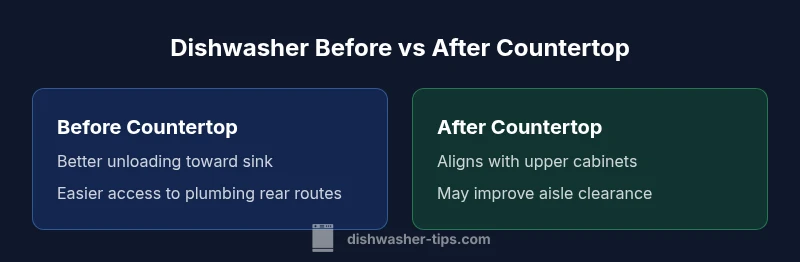
The best choice depends on your kitchen layout and workflow. Generally, placing the dishwasher before the countertop minimizes bending and streamlines unloading toward the sink area, while placing it after the countertop aligns with upper cabinets and aisle clearance. Dishwasher Tips recommends evaluating plumbing, electrical access, and counter height before deciding.
Understanding the dishwasher before or after countertop question
In any kitchen, the decision about whether the dishwasher should sit before or after the countertop hinges on how you move through the space during daily tasks. The core question is not simply “which side looks better?” but rather which arrangement reduces unnecessary motion, minimizes reaching and bending, and preserves access to essential utilities. According to Dishwasher Tips, the best solution balances ergonomics, serviceability, and future remodel plans. In theory, both placements are feasible, but the practical choice depends on your sink location, plumbing routes, and cabinet configuration. By starting with a clear understanding of your current workflow, you’ll reduce the risk of wasting space or forcing awkward movements when unloading and loading dishes. The dishwasher before or after countertop decision should be treated as a system choice, not a single-off cosmetic tweak. The goal is to optimize the kitchen work triangle while maintaining an aesthetically cohesive look that matches your cabinetry and countertop materials.
Space planning and ergonomic workflow
The layout of a small kitchen versus a large family kitchen changes the math. When evaluating dishwasher placement, start with the work triangle: sink, dishwasher, and prep area should form a logical flow. Placing the unit before the countertop often improves unloading efficiency, since dirty dishes move in a straight path toward the sink and disposal. This arrangement can reduce bending, particularly for shorter users or tight spaces where clearance is precious. Conversely, installing the dishwasher after the countertop can better align with upper cabinets and tall pantry storage, creating a continuous line from the range to the cooking zone. In homes where countertops heroically dominate the space, the after-countertop option may minimize visual breaks and promote a streamlined profile. Across reviews, the most successful kitchens share one trait: a clearly mapped path from loading to washing to drying that minimizes back-and-forth movement. The Dishwasher Tips team notes that practical ergonomics beat purely cosmetic decisions every time.
Plumbing, drainage, and electrical considerations
Any dishwasher placement must account for supply lines, drainage, and electrical outlets. A before-countertop installation often benefits from routing hoses and drainage toward the rear of the cabinet, where access is typically easiest for service technicians. An after-countertop setup may require more careful planning to avoid crossing drain lines with under-sink plumbing or interfering with a vertical cabinet column. In either case, electrical proximity matters: most kitchens rely on a dedicated 15-amp or 20-amp circuit, with outlets placed within reach of the unit’s cord and service panel. Local codes frequently dictate clearance around the appliance, which can influence where you place the unit relative to the countertop seam. The goal is to minimize awkward bends in hoses and wires while ensuring safe, code-compliant installation that won’t complicate future repairs.
Aesthetics, cabinet integration, and countertop materials
The countertop edge and cabinet finish influence whether you should place the dishwasher before or after the countertop. A flush look with front panels that match cabinetry often favors placement that reduces visible seams and aligns with a single countertop plane. In scenarios with thick countertops or pronounced overhangs, the dishwasher’s front panel may need a custom panel or a matching veneer to preserve visual continuity. Aesthetics aren’t only about color; texture, grain direction, and hardware placement matter, too. When you plan ahead, you can design the dishwasher’s location to minimize gaps and ensure the appliance disappears into the kitchen’s overall styling. The consistent alignment with backsplash lines and cabinet toe-kicks produces a refined, cohesive look that supports long-term value.
Installation challenges, code compliance, and cost considerations
Installation complexity varies with the chosen placement. A standard layout with a straightforward plumbing run can be simpler and cheaper, while a countertop-integrated or island-adjacent setup may require additional supports, reinforced cabinetry, or modifications to the cabinet toe-kick. From a compliance perspective, always verify that your plan adheres to local building codes and manufacturer installation guidelines. Cost considerations include labor rates, potential countertop adjustments, and the need for electrical work or new supply lines. Even marginal changes can affect warranty wording, so it’s prudent to document any modifications and consult with a licensed professional. By anticipating these factors, you reduce the risk of delays and ensure a durable, reliable installation that stands up to daily use.
Real-world scenarios and decision trees
Different kitchen types demand tailored approaches. In a galley kitchen where space is constrained, the dishwasher before the countertop can reduce travel distance to the sink and disposal, improving overall workflow. In open-plan kitchens with generous aisle space, the after-countertop option may align more naturally with seating areas and upper cabinetry, delivering a seamless, uninterrupted line. In homes with corner sinks or unusual cabinet configurations, a hybrid approach may be necessary, combining a partial countertop overhang with a near-wall dishwasher access to keep lines clean. The decision should be driven by measurements, traffic patterns, and how you anticipate using the space in the coming years. Dishwasher Tips emphasizes drawing a simple schematic that marks the path from dirty dishes to washing to drying, then testing your idea in 3D with cardboard templates before any demolition or purchase.
Maintenance, serviceability, and long-term usability
Maintenance considerations favor placements that keep service panels accessible and hoses easy to reach. A before-countertop setup can simplify front-panel access if it sits near the kitchen aisle, while an after-countertop arrangement might improve access to under-counter storage and plumbing malfunctions. Usability also hinges on how often you perform routine maintenance—filters, spray arms, and seals require regular checks that are more convenient when there is clear, unimpeded access. In addition, consider how changes in your household—such as a new countertop, new cabinets, or even a remodel—could affect the chosen layout. Planning with an eye toward future flexibility reduces the risk of obsolescence and helps maintain appliance efficiency over time.
Practical planning checklist before you buy
- Map your kitchen workflow: identify paths from sink to dishwasher to prep areas.
- Check plumbing routes: ensure supply and drain lines can be routed without interference with countertop seams.
- Confirm electrical proximity and required receptacles.
- Evaluate countertop thickness and edge design for panel integration.
- Consult a professional about structural support and warranty implications.
- Create a simple diagram to compare before vs after countertop options before committing.
Comparison
| Feature | Dishwasher before countertop | Dishwasher after countertop |
|---|---|---|
| Ergonomics & unloading | Easier unloading toward sink; reduced bending in many layouts | Unloading may require different reach; potential to cross prep zone |
| Plumbing & drainage routing | Flexible routing toward rear cabinet area; often simpler access | May require careful routing to avoid interference with countertop seam |
| Electrical proximity | Typically near a dedicated outlet in or beside the base cabinet | Outlet placement may be constrained by countertop alignment |
| Countertop integration & aesthetics | Can align with front edge for flush look and cabinet symmetry | May require panel adjustments to maintain a seamless appearance |
| Workflow & space optimization | Best for direct path from sink to dishwasher to prep area | Best for aligning with upper cabinets and aisle clearance |
| Installation complexity & cost implications | Typically straightforward in standard layouts | Can require extra carpentry or plumbing work in nonstandard layouts |
| Best-use scenarios | Small kitchens with compact layouts; easier unloading and access | Open-plan kitchens; cohesive line with cabinetry and seating area |
The Good
- Flexible placement options to suit different kitchens
- Potential for improved workflow and unloading efficiency
- Better alignment with cabinetry and countertops in some layouts
- Preserves counterspace and reduces bending with proper planning
Disadvantages
- Inconsistent pipe routing may require modifications
- Installation may be more complex and costly in some layouts
- Aesthetic mismatches if not integrated with cabinet design
Placement should be chosen based on layout, plumbing, and workflow
Neither option is universally superior. Use a workflow map, verify plumbing paths, and consult a pro to confirm structural compatibility before deciding.
People Also Ask
Is it better to install the dishwasher before or after the countertop?
Both placements are common and viable; the best choice depends on your kitchen design, traffic flow, and accessibility. Consider how you unload dirty dishes and how the unit aligns with the sink and prep area.
Both placements work. The right choice depends on your kitchen layout and how you move between the sink, dishwasher, and prep zone.
What practical factors influence the choice?
Key factors include proximity to the sink, cabinet alignment, plumbing routes, and electrical outlets. Also consider countertop thickness and whether a panel-matching front is feasible.
Important factors are sink proximity, plumbing routes, and cabinet alignment; don’t overlook countertop thickness.
Will countertop height impact accessibility?
Yes. Countertop height affects how comfortably you load and unload. A mismatch can force awkward bending or require lifting, so align the dishwasher position with ergonomic height in your space.
Height matters for comfort. Align the dishwasher so loading feels natural and easy.
How can I avoid code issues during installation?
Check local codes and follow the manufacturer's installation guide. A licensed plumber or electrician should review electrical and plumbing work to ensure compliance and protect warranty coverage.
Follow local codes and the installer’s guidelines. Have a pro review electrical and plumbing work.
Are there scenarios where countertop integration matters more?
In kitchens with minimalist lines or tight seams, seamless integration with cabinets and countertops matters for aesthetics and resale value. In busy households, ergonomics may trump aesthetics.
If you care about a seamless look, integration matters; otherwise, ergonomics wins in daily use.
What cost factors should I consider for modifications?
Costs vary with layout, required modifications, and local labor rates. Expect potential charges for plumbing rerouting, cabinet adjustments, and panel customization if needed.
Costs depend on layout and required changes; talk to a pro for a clear estimate.
What to Remember
- Map your kitchen workflow before choosing placement
- Assess plumbing, drainage, and outlet proximity early
- Aim for flush aesthetics with cabinet lines
- Consult a professional to verify structural support