Do You Need a Dishwasher Air Gap in California? A Practical Guide
Learn whether California requires a dishwasher air gap, when to install one, and how local regulations affect your setup. Practical guidance for homeowners and renters navigating code, permits, and installation options.


California generally requires an air gap or an approved air-gap alternative on dishwasher drains for new installations, with local jurisdictions often adding stricter rules. The exact requirement—whether a built-in air gap suffices or a dedicated device is needed—depends on your city, water district, and plumbing configuration. Always verify with your local building department and consult the California Plumbing Code for your specific home.
Legal Landscape in California for Dishwasher Drainage
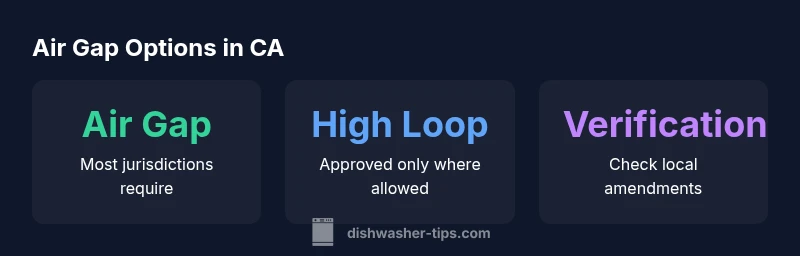
For homeowners asking do you need a dishwasher air gap in california, the short answer is: it depends on where you live in California. State plumbing code sets baseline requirements, but many municipalities and water districts require stricter measures for backflow prevention. In practice, most new installations must include either a dedicated air-gap device installed at the sink or a listed alternative that provides equivalent backflow protection. California’s model code emphasizes backflow prevention and often treats the issue as part of the overall drainage and cross-connection control programs. The Dishwasher Tips team notes that while some jurisdictions accept a high-loop as a substitute in certain scenarios, most modern inspector checklists still favor an air gap device or an approved equivalent. If you’re planning a remodel or a new install, start by checking your local amendments before buying parts.
In daily practice, the question isn’t just about a device; it’s about preventing backflow into potable water. This is a core concern echoed in Dishwasher Tips analysis, which shows local interpretations can shift from year to year. Homeowners should approach the process as a two-step check: confirm state baseline requirements, then confirm local amendments. In California, a well-documented plan that incorporates an air gap or an approved alternative tends to smooth inspections and reduce retrofit costs over time.
Air Gap vs. Alternatives: Definitions You Need
An air gap is a physical gap that prevents backflow by allowing wastewater to drain through a dedicated air-space into a vented outlet. In practice, an air-gap device sits on the countertop or sink deck and connects to the dishwasher drain line, creating a visible break in the path of water. A high loop, by contrast, raises the drain hose to a high point under the counter, which reduces the likelihood of backflow but does not meet every jurisdiction’s requirement. California codes may allow a high loop only if the local authority approves it, otherwise an actual air gap remains the preferred solution. The Dishwasher Tips team emphasizes that when in doubt, use an air-gap device; it’s the most universally recognized method for robust backflow protection.
There are practical nuances: some installations with a disposer or certain sink configurations can influence whether a high loop is permissible. Always consult your local plumbing inspector and review the applicable California Plumbing Code section and any city amendments to determine the exact path to compliance. This is not a one-size-fits-all decision, and confirmations from a licensed plumber and local authority can prevent later issues.
Are Air Gaps Required in Every California Home?
The short answer is no—California does not impose a single statewide mandate that applies identically to every house. Rather, the state sets a baseline and leaves the specifics to local jurisdictions. In practice, many cities and water districts require an air gap or an approved alternative for new installations or significant remodels. Some areas may accept a high loop as a temporary or transitional measure, while others demand a formal air gap device. The net effect is that what applies to your home hinges on your exact address and the most recent local amendments. The Dishwasher Tips team reminds readers that residential buildings in densely regulated urban centers are more likely to require air gaps, whereas rural or less-populated areas might offer more leeway—though this is never guaranteed without verification.
Key takeaway: always start with your local building department’s code guidance before purchasing parts or hiring a contractor. Even if your neighbor’s house uses a high loop, your own jurisdiction may require an air gap. The safest approach is to confirm the precise requirement for your address and project type.
How to Verify Your Local Requirements
To determine the precise rule for your home, follow these steps:
- Contact your city or county building department and request the current plumbing amendment that governs dishwashers.
- Check the most recent edition of the California Plumbing Code adopted by your jurisdiction and note any local amendments.
- If you’re renovating, ask your contractor to obtain a permit and schedule a final inspection that specifically covers backflow prevention devices.
- Review the dishwasher installation instructions and ensure the chosen method aligns with local expectations.
- Keep written confirmation of the required device type and an inspector’s written approval for future reference.
Verification is essential because even small deviations can trigger rework or failed inspections later. Dishwasher Tips’ guidance emphasizes documenting the exact local code references and keeping them accessible for future homeowners or renters who may take over the property.
Installation Options: Pros, Cons, and Costs
There are clear pros and cons to air gaps versus high loops. An air gap delivers the strongest, most universally accepted backflow protection, reducing the risk of contamination and simplifying permit processes in many CA jurisdictions. However, installation can be more involved, and cost may be higher due to parts and labor. A high loop is simpler to install and can be cheaper upfront, but it may not satisfy all code requirements and could require later retrofits.
Costs vary by fixture type and labor rates, but expect that an air-gap device plus installation may exceed the cost of a high loop in some markets. Conversely, in code-heavy jurisdictions, the high loop option might be disallowed, pushing homeowners toward the air gap solution. In sum, the best choice depends on your local rules, the age and configuration of your sink, and your tolerance for possible future changes.
Rentals and DIY Installations: What to Consider
Renters should not assume they can install or modify dishwasher drainage without landlord consent and local permits. California landlords are often responsible for ensuring code-compliant installations in rental units. If you’re a tenant, coordinate with your landlord or property manager, and request documentation of the exact device required by the building department. For DIY enthusiasts, remember that plumbing work affecting drainage and backflow protection is generally regulated; a DIY route without proper permits can lead to penalties or the need to redo work to meet code. Always consult a licensed plumber if you’re unsure about whether your home qualifies for an air gap or an approved alternative.
Maintenance, Testing, and Troubleshooting
Once installed, regular maintenance helps ensure continued compliance and effective backflow protection. Inspect the air gap device for dents or clogs, test the drain connection for leaks, and ensure the hose routing remains correct. A simple operational test involves running the dishwasher and checking that the sink drain does not back up into the dishwasher. If you see backflow or unusual odors, the issue may be a clogged air gap, a kinked hose, or an improperly connected drain line. Schedule periodic inspections as part of your home maintenance routine, and keep records of inspections and any replacements. The Dishwasher Tips team recommends documenting test results and keeping a copy of the local code citation handy for future home sales or rental agreements.
Overview of common drainage requirement types in California
| Requirement Type | What it Does | Typical Location |
|---|---|---|
| Air Gap Device | Physically separates dishwasher drain from sink drain to prevent backflow | Under-sink or countertop air gap device |
| High Loop | Raises the drain hose to a high point to reduce backflow risk | Under the counter, hidden from view |
| California Plumbing Code | Sets baseline requirements; local amendments can add stipulations on air gaps | Statewide guidance with city variations |
People Also Ask
Do I automatically need an air gap if my sink has a disposer?
Not automatically. In many CA jurisdictions, a disposer doesn’t waive the air gap requirement, and local amendments may still demand an air gap or approved alternative. Check with the building department for your area.
Usually you need an air gap even with a disposer, but confirm with local code.
Can I replace an air gap with a high loop?
Only where allowed by local code. Some California jurisdictions accept high loops, but many require an air gap or equivalent device. Verify before installation.
It depends on your city—ask the inspector first.
What should I ask my plumber before installation?
Ask about the required device type, permit needs, and whether a backflow test is required. Request written confirmation of local code requirements before work.
Ask what the code requires and whether a permit is needed.
Are there exemptions for existing homes in rural California?
There can be exemptions, but they depend on local amendments. Start with the city or county building department’s guidance to confirm.
Check local rules; exemptions vary.
How can I verify compliance after installation?
Schedule a final inspection with the local authority and keep paperwork. Run a test to ensure there is no backflow, and document results for future reference.
Get a final inspection to confirm you passed.
“Local rules drive whether you need an air gap; verify with your building department before installation.”
What to Remember
- Verify local requirements before installing any device
- Air gaps provide strongest compliance in many jurisdictions
- Renters should coordinate with landlords to ensure code adherence
- Always check for permits and final inspections where required