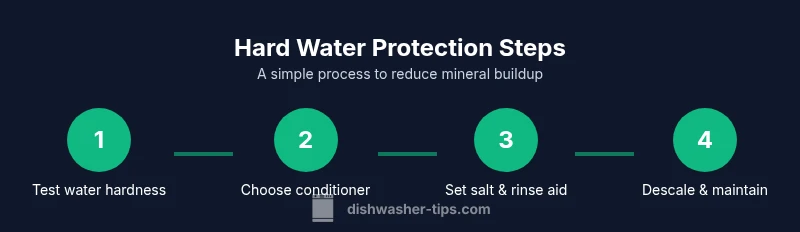
How to Protect Your Dishwasher from Hard Water
Learn how to protect your dishwasher from hard water with practical steps: salt placement, rinse aid use, descaling routines, and product choices for cleaner dishes and longer appliance life.


Here's the quick answer: to protect your dishwasher from hard water, install a water conditioner or use a dedicated salt-based water softener, adjust detergent and rinse aid, run periodic descaling, and choose products designed for hard-water conditions. This approach reduces mineral buildup, improves cleaning, and extends the appliance's life. If you can't soften the water, target the dishwasher's spray arms and filters for regular cleaning.
What hard water does to your dishwasher and dishes
According to Dishwasher Tips, hard water carries minerals like calcium and magnesium that can accumulate on heating elements, interior pipes, and spray arms. This mineral buildup, or limescale, reduces heating efficiency and water flow, which means dishes may come out with spots, a cloudy film, or mineral streaks. Over time, scale can clog nozzles, restrict spray patterns, and force the dishwasher to work harder to achieve the same level of cleanliness. You may notice longer wash cycles and higher energy consumption as a result. In addition, film and residue from minerals can adhere to glassware, plastics, and chrome, dulling finishes and reducing overall dish appearance. Regular maintenance helps minimize these effects and keeps the machine operating smoothly.
Why water hardness varies and what to measure
Water hardness isn’t the same everywhere. It depends on the source and plumbing, and it can fluctuate seasonally. The easiest first step is to check your municipal water report or contact your water utility for the current hardness level. If a report isn’t readily available, you can use a home water hardness test strip. Record the reading and compare it to the softening needs of your dishwasher. High mineral content generally means you’ll benefit from conditioning solutions, more consistent rinse aid usage, and a careful eye on salt levels. Keep a simple maintenance log to watch for patterns in buildup tied to weather or usage.
Core strategies: conditioning, salt, and rinse aid
Protecting a dishwasher in hard-water regions hinges on three pillars: water conditioning, salt-based softening where applicable, and optimized dosing of detergent and rinse aid. A countertop or whole-home water conditioner can reduce mineral content before it enters the appliance. If your system uses salt-based regeneration, refill the salt as directed and keep the salt container sealed to the required level. Rinse aid helps water sheet off surfaces more completely, reducing droplets that dry with mineral residues. Use the detergent recommended for hard water and consider a descaler occasionally to preempt scale buildup on critical components like spray arms and filters.
Salt placement and detergent dosing for hard water
Proper salt placement is essential when your dishwasher uses a built-in water softener or has a dedicated reservoir. Refill this reservoir according to the manufacturer’s instructions and adjust the salt level as your water hardness changes. Pair salt with a suitable rinse aid, which reduces water droplets and mineral deposits on dishes. Be mindful not to over-dose detergent, as excess foam can trap mineral particles and leave behind residue. When loading dishes, place tall items in the back and avoid blocking spray arms to maintain effective rinsing in hard water.
Regular descaling and maintenance routines
Descaling removes mineral buildup that can impair efficiency. In regions with hard water, descaling every few months is a prudent practice; in very hard conditions, more frequent cycles may be warranted. Use a descaler designed for dishwashers or a citric-acid-based product, following the label directions. Run an empty hot cycle with the descaler to maximize mineral removal from heating elements and internal channels. Do not mix descalers with bleach or ammonia, and never use straight vinegar in the washer, as harsh acids can corrode seals and gaskets over time.
Practical loading and cleaning habits to minimize buildup
Good loading habits and routine interior cleaning go a long way toward reducing mineral deposits. Regularly inspect and clean filters, screens, and spray arms to prevent scale from forming in small crevices. After each cycle, wipe the door gasket and seals; these areas can trap mineral deposits that contribute to leaks or inefficiency. Leave space between items to promote even water distribution and rinse. Finally, a quick monthly check of salt, rinse aid, and descaler supplies helps maintain consistent protection against hard-water buildup.
When to consider a home conditioner or professional help
If mineral scaling persists despite routine maintenance, it may be time to consider a whole-home water conditioner or a professionally installed solution. A more permanent treatment can reduce the mineral load entering the dishwasher and other appliances, offering broader protection. For renters or cases where installation isn’t feasible, prioritize a robust descaling and cleaning routine, and use high-quality rinse aids and detergents designed for hard water. Always follow appliance manuals for model-specific guidance and consult a professional if you notice persistent leaks or electrical concerns.
Tools & Materials
- Water conditioner or salt-based softener(Choose a unit compatible with your home water supply; follow installation instructions.)
- Dishwasher salt (if required by softener)(Refill according to the device or manual guidelines; test levels monthly.)
- Rinse aid(Select a formula suited for hard water; refill often to maintain effectiveness.)
- Descaler designed for dishwashers(Citric acid-based or manufacturer-approved descaler; avoid mixing with bleach.)
- Water hardness test strips(Optional tool to monitor changes in your water quality over time.)
- Measuring cup or scoop(Use for accurate salt and detergent dosing as needed.)
Steps
Estimated time: 1-2 hours
- 1
Assess water hardness
Check your local water report or use a test strip to gauge mineral content. Document the reading to guide future maintenance decisions.
Tip: If you rent, ask the landlord or building manager about any installed water conditioning equipment. - 2
Choose a conditioning approach
Decide between a whole-home conditioner or a local conditioner for the dishwasher. Your choice depends on water hardness, budget, and whether you own or rent.
Tip: A whole-home system benefits all taps, not just the dishwasher, for broader protection. - 3
Install or configure the conditioner
Follow the manufacturer’s instructions for installation or activation. If you’re unsure, hire a qualified technician to ensure proper setup and safety.
Tip: Keep a maintenance log with installation date and settings to track changes over time. - 4
Refill salt and set the reservoir
If your system uses salt, refill the reservoir as required and adjust the level to match your hardness reading. This helps regenerate the softener effectively.
Tip: Use the measuring cup to avoid overfilling and waste. - 5
Adjust detergent and rinse aid
Select detergent appropriate for hard water and ensure rinse aid is set to a higher level to improve drying and reduce mineral residues.
Tip: Do not exceed recommended dosing; excess detergent can interfere with rinsing in hard water. - 6
Run a descaling cycle
Run a hot empty cycle with a dishwasher-safe descaler or citric-acid product to remove mineral buildup in critical components.
Tip: Never mix descalers with bleach or ammonia; follow label directions closely. - 7
Clean filters and spray arms
Remove and rinse filters, jets, and spray arms to dislodge trapped minerals and improve wash efficiency.
Tip: Use a soft brush to avoid scratching surfaces while cleaning. - 8
Maintain a regular schedule
Set reminders for salt refill, rinse aid checks, and descaling intervals based on your water hardness and usage.
Tip: Document results to refine future intervals and maintain performance.
People Also Ask
What is hard water and how does it affect my dishwasher?
Hard water contains minerals like calcium and magnesium that can form mineral deposits inside the dishwasher. These deposits reduce efficiency, leave spots on dishes, and may clog spray arms over time.
Hard water has minerals that can build up inside your dishwasher, reducing cleaning efficiency and causing spots on dishes.
Salt or softener: which is better for hard water?
Both salt-based softeners and whole-home conditioners can help, depending on your water hardness and setup. Salt-based systems are often easier to implement for individual units, while whole-home conditioners provide broader protection.
A salt-based softener is common for appliances, but a whole-home conditioner can offer broader protection depending on your situation.
How often should I descale my dishwasher?
Descale according to your water hardness and usage. In moderately hard water, a descaling cycle every 2-3 months is reasonable; in very hard water, you may need monthly cycles.
If your water is very hard, aim to descale every month or two to keep things running smoothly.
Is using vinegar safe in a dishwasher?
Straight vinegar is not recommended for dishwasher use, as its acidity can damage seals over time. Use purpose-made descalers or citric acid products instead.
Avoid straight vinegar in the dishwasher; use descalers designed for dishwashers instead.
Will a home water conditioner solve hard-water problems?
A home water conditioner can significantly reduce mineral content for all fixtures, which helps appliances over time. Effectiveness depends on the system and regional water hardness.
A water conditioner can help, but effectiveness depends on your specific water hardness and system.
What should renters do if they can't install a softener?
Renters can rely on external descalers, rinse aids, and careful loading to reduce buildup. Regular maintenance and occasional descaling cycles become even more important when a softener isn’t installed.
If you can't install a softener, focus on regular descaling and proper rinse aid use to limit mineral buildup.
Watch Video
What to Remember
- Know your water hardness and adjust accordingly
- Use salt and rinse aid properly
- Descale regularly to prevent mineral buildup
- Keep filters and spray arms clean and clear
- Choose products designed for hard-water conditions