Is Dishwasher Rinse Aid Toxic? Safety and Use Guide
Explore whether is dishwasher rinse aid toxic and how to use it safely. Learn ingredients, potential health risks, storage tips, and eco-friendly options with expert guidance from Dishwasher Tips.


Is dishwasher rinse aid toxic? In normal household use, rinse aids sold for consumer dishwashers are designed to be safe when used as directed. They can irritate eyes or skin if mishandled or ingested in large amounts; keep away from children and pets. If you have concerns about specific ingredients, check the label or safety data sheet. For most homes, proper use means minimal risk.
Is dishwasher rinse aid toxic?
The question is widely asked: is dishwasher rinse aid toxic? The quick answer is that, when used as directed for normal household loads, rinse aids are designed to be safe. The Dishwasher Tips team notes that these products are formulated to stay within consumer safety guidelines and to minimize exposure under typical use. According to Dishwasher Tips, the greatest risk comes from improper handling, ingestion, or ingestion by curious children. The phrase 'is dishwasher rinse aid toxic' triggers concern about chemical exposure, but consumers should remember that products with clear safety data sheets and compliant labels are intended for home kitchens.
In practice, rinse aids are added to the final rinse to reduce surface tension, helping rinse water sheet off dishes and assist drying. They are not cleaners like detergents; they do not remove baked-on residue; instead, they facilitate a cleaner finish with less water spots. This means that toxicity concerns usually relate to accidental ingestion or skin/eye contact, not routine use on plates and glassware.
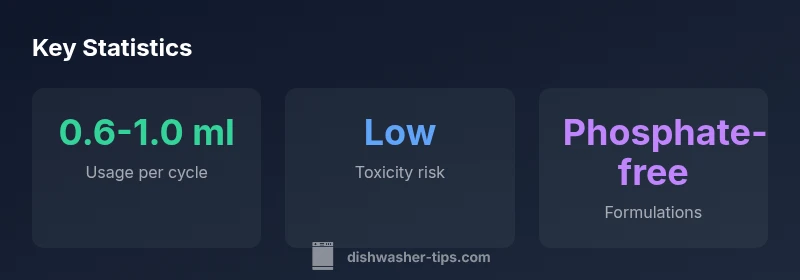
From a risk assessment perspective, most rinse aids present low acute toxicity if swallowed in small amounts and do not persist in the environment at harmful levels. Always store upright, out of reach of children, and away from pets. If you have environmental or health concerns about specific ingredients, consult the product SDS or contact the manufacturer for safety data sheets.
%20words
Toxicity indicators for rinse-aid components
| Label | Toxicity Indicator | Notes |
|---|---|---|
| Ingestion risk | Low | If swallowed, consult medical guidance |
| Eye irritation | Moderate | Occasional irritation if splashed; wear goggles |
| Skin contact | Mild to moderate | Wash skin with soap and water if skin contact occurs |
People Also Ask
Is rinse aid toxic to pets if ingested or spilled?
Pet exposure is possible if products are ingested or spilled, but the acute toxicity is generally low when used as directed. If exposure occurs, contact a veterinarian or poison control for guidance and keep containers out of reach of animals.
Exposure to pets can occur if a rinse aid is ingested; keep containers sealed and out of reach.
Can rinse aid be used with all dishwasher brands and models?
Most rinse aids are designed to be compatible with a wide range of dishwashers, but always check your manual and the product label. If in doubt, contact the manufacturer or test with a small load first.
Check your dishwasher manual and the rinse aid label for compatibility.
Is it unsafe to mix rinse aid with other cleaners?
Never mix rinse aid with other cleaners or detergents. Mixing can cause chemical reactions or release fumes. Use products as directed and in separate compartments.
Don’t mix cleaners; use them as directed to avoid reactions.
Are there natural or homemade alternatives to rinse aid?
Some people use small amounts of vinegar, but this is not recommended by many manufacturers as a direct substitute due to potential impact on dishwasher seals and rinse performance. Consider commercially formulated, phosphate-free rinse aids if you want a gentler option.
Vinegar isn’t always recommended; follow manufacturer guidance for safe alternatives.
What should I do if my dishwasher smells after using rinse aid?
Odors can stem from residues or improper cleaning of the dispenser. Run an empty cycle with a dishwasher cleaner to reset and remove residues, then switch to a different rinse aid formula if odors persist.
Run a cleaning cycle and switch formulations if odors linger.
How can I tell if my rinse aid is the right formulation for my water type?
Check if the product specifies compatibility with hard or soft water. If you have hard water, you may need a rinse aid formulated for hardness or a higher rinse performance rating.
Look for water-type guidance on the label and choose accordingly.
“Safety-first science underpins every rinse aid guideline we publish. With proper handling, the everyday risk remains minimal.”
What to Remember
- Read the label before use and store safely.
- Toxicity is low with proper use, but irritation is possible.
- Rinse aids vary; prefer phosphate-free formulations.
- Keep rinse aid away from children and pets.
- Check SDS for ingredients if you have sensitivities.