Why is my dishwasher soap spilling out on the floor? Troubleshooting Guide
Soap spilling on the kitchen floor after a dishwasher cycle? This urgent guide helps you diagnose causes, perform safe fixes, and prevent future spills—expert tips from Dishwasher Tips.


According to Dishwasher Tips, the most common reason for soap spilling on the floor is over-sudsing or a misbehaving dispenser. Quick fixes: stop the cycle, unplug, and wipe up the soap. Run a rinse cycle with no detergent to clear suds, inspect the dispenser for cracks or misalignment, and check door seals for leaks.
Why this happens when soap spills on the floor
If you’re asking, why is my dishwasher soap spilling out on the floor, you’re not alone. According to Dishwasher Tips, the culprit is usually either over-sudsing from the wrong detergent amount, or a dispenser that isn’t closing properly. A leaking or misaligned door seal can also push soap out around the door during the cycle. In some cases, running a cycle with too much detergent or using a non-dishwasher detergent (or pods that don’t dissolve correctly) creates copious foam that escapes the dispenser. The result is a slippery pool on the floor and a dishwasher that didn’t finish cleaning. The good news: many spills are caused by simple setup issues you can fix today. The Dishwasher Tips team has seen this issue across rental properties and family homes, and most fixes involve adjusting detergent use, inspecting the dispenser, and verifying seals.
Common scenarios and what they indicate
Soap spilling during or after a cycle often points to a few common issues. A foam-covered door usually means excess detergent or a product not designed for automatic dishwashers. A sticky or cracked dispenser lid hints at a mechanical fault. If foam pools around the base, the drain or filter may be clogged, or the spray arms could be misdirecting water. In rental units and busy homes, high detergent loads and frequent quick-wash cycles exacerbate these problems. By understanding these patterns, you can pinpoint the most likely cause and act quickly. This guidance reflects patterns observed by the Dishwasher Tips analysis in 2026.
Quick checks you can safely perform
Always start with the basics before diving into mechanical fixes. First, confirm you’re using a dishwasher-specific detergent in the proper amount. Next, inspect the detergent dispenser for cracks, misalignment, or a stubborn lid. Wipe away visible suds from the door gasket and nearby seals. If the dispenser and seals look fine, check that the dishwasher isn’t overloaded, which can force soap to escape. Finally, run a rinse cycle with no detergent to see if suds persist. These steps prioritize safety and simplicity, and they reflect the tried-and-true troubleshooting approach recommended by Dishwasher Tips.
Diagnostic flow: symptom → diagnosis → solution
When you see soap spilling on the floor, map the symptom to likely causes. If the suds are numerous and persistent, suspect over-sudsing. If a specific area near the dispenser or door is leaking, inspect the dispenser and door gasket for wear. If water spills from hoses or beneath the unit, there may be a drainage or plumbing connection issue. Each finding narrows the diagnosis and guides you to the corresponding fix. Use the structured approach below to move from symptom to solution without guesswork.
Preventive habits to avoid future spills
Prevention is about consistent detergent choice and proper loading. Always use a dishwasher-approved detergent and measure according to the package directions. Avoid adding extra detergent or using non-dishwasher products. Regularly inspect the dispenser lid, door gasket, and spray arms for wear, and perform a quick rinse test every few months to catch developing issues before they cause a spill. These habits reduce the odds of a future floor-soap incident and keep cleaning on track.
When to call a pro and safety reminders
If you notice visible cracks in the dispenser, persistent leaks after basic troubleshooting, or signs of electrical moisture near the base, stop and contact a qualified technician. Water and electricity are a dangerous combination, and professional help is the safest option when there’s any doubt. In the meantime, keep the area dry and unplug the unit during inspections to reduce risk.
diagnosticFlow":{"symptom":"Soap spills onto kitchen floor after dishwasher cycle","causes":[{"cause":"Over-sudsing from excess detergent or incorrect product","likelihood":"high"},{"cause":"Faulty or misaligned detergent dispenser","likelihood":"medium"},{"cause":"Leaking door gasket or loose hose connections","likelihood":"low"}],"fixes":[{"fix":"Use the correct amount of dishwasher detergent and ensure it’s the dishwasher-safe formula","difficulty":"easy"},{"fix":"Inspect and clean the dispenser; replace it if cracked or if the lid won’t close properly","difficulty":"easy"},{"fix":"Inspect the door gasket for cracks and check hose connections; call a pro if leaks persist","difficulty":"medium"}]},
stepByStep":{"steps":[{"number":1,
title":"Power down and prep the area","description":"Unplug the dishwasher and turn off the water supply if accessible. Put on gloves and wipe up all visible soap to prevent slipping. This step reduces risk and gives you a clean slate for testing.","tip":"Always prioritize safety—never poke around plugs with wet hands."},{"number":2,
title":"Check the dispenser and seals","description":"Look for cracks, misalignment, or a lid that won’t snap shut. Clean any residue and reseal the area around the dispenser. A faulty lid is a common cause of spillovers.","tip":"Use a flashlight to inspect hidden cracks that aren’t obvious."},{"number":3,
title":"Test loading and detergent","description":"Verify you’re using the correct detergent type for your unit and that you aren’t overfilling. Run a short rinse cycle with no detergent to see if suds persist.","tip":"Consider switching to powder if you’ve used tablets, if the unit is older."},{"number":4,
title":"Inspect door gasket and spray arms","description":"Examine the door gasket for wear or cracks. Remove any debris around the spray arms that could misdirect water and soap.","tip":"A simple wipe-down of seals prevents future leaks."},{"number":5,
title":"Run a test cycle","description":"Run a complete cycle with no detergent to confirm the spill is resolved. If suds reappear, the issue is more likely drain/pressure related or a defective component.","tip":"Document any persistent issues for the pro you may call."}],"estimatedTime":"30-60 minutes"},
tipsList":{"tips":[{"type":"pro_tip","text":"Test the dispenser by closing the door and running a cycle with no detergent to confirm it’s functioning."},{"type":"warning","text":"Never mix detergents or use non-dishwasher products; this can create dangerous suds and chemical reactions."},{"type":"note","text":"Keep a small towel handy during troubleshooting to manage spills and splashes."},{"type":"pro_tip","text":"Check for overflow onto the floor before each cycle for the first few runs after making changes."}]},
keyTakeaways":["Act quickly to stop the cycle and clean up spills","Use the correct detergent and amount to prevent suds","Inspect dispenser and door gasket for wear","Test with cycles without detergent to verify fixes"],
videoEmbed":{"videoQuery":"how to fix dishwasher soap spill on floor tutorial"},
faqSection":{"items":[{"question":"What causes dishwasher soap to spill onto the floor?","questionShort":"Causes of spill","answer":"Most spills come from over-sudsing, a faulty dispenser, or a worn door gasket. Other factors include improper loading or using non-dishwasher detergents. Addressing these basics usually resolves the issue.","voiceAnswer":"Common causes are over-sudsing, a faulty dispenser, or a worn door gasket. Fixes are straightforward and safety-first.","priority":"high"},{"question":"Can vinegar help reduce suds in my dishwasher?","questionShort":"Vinegar suds?","answer":"Vinegar can sometimes help reduce suds, but it should not be used as a routine cleaner in place of detergent. Avoid mixing vinegar with bleach or other cleaners.","voiceAnswer":"Vinegar can sometimes reduce suds, but don’t rely on it daily or mix with bleach.","priority":"medium"},{"question":"Should I replace the detergent dispenser?","questionShort":"Dispenser replacement","answer":"If the dispenser lid won’t close or is cracked, replacement is usually necessary. A faulty dispenser is a frequent cause of spills and should be inspected by a professional if simple fixes don’t resolve it.","voiceAnswer":"If the lid won’t close or is cracked, replacement is often needed.","priority":"high"},{"question":"Is a clogged filter related to soap spills?","questionShort":"Filter clog","answer":"A clogged filter can affect drainage and soap distribution, indirectly contributing to spills. Clean the filter as part of routine maintenance.","voiceAnswer":"A clogged filter can worsen spills by affecting drainage.","priority":"medium"},{"question":"When should I call a pro?","questionShort":"Call a pro when","answer":"Call a professional if leaks persist after checking the dispenser, gaskets, and drainage. Electrical safety should prompt professional attention.","voiceAnswer":"Call a pro if leaks persist after basic checks.","priority":"high"},{"question":"Can overloading the dishwasher cause spills?","questionShort":"Overloading cause","answer":"Yes. Overloading can lead to misdirected spray and excess suds. Load dishes according to your model’s guidelines and avoid cramming." ,"voiceAnswer":"Overloading can cause spills due to misdirected spray and excess suds.","priority":"low"}]},
mainTopicQuery":"dishwasher troubleshooting"},
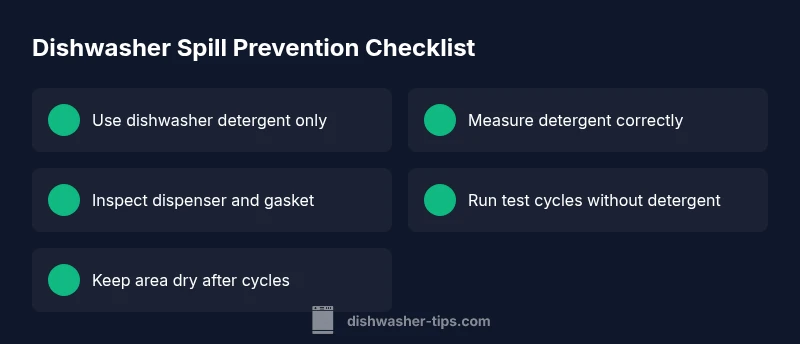
mediaPipeline":{"heroTask":{"stockQuery":"dishwasher soap spill stock photo","overlayTitle":"Soap Spill Fix","badgeText":"2026 Guide","overlayTheme":"dark"},"infographicTask":{"type":"checklist","htmlContent":"<div class="w-[800px] p-8 bg-slate-900 text-white"><h3 class="text-2xl font-bold mb-4">Dishwasher Spill Prevention Checklist</h3><ul class="list-none space-y-3"><li class="flex items-center gap-3"><span class="w-6 h-6 rounded-full bg-emerald-500"></span>Use dishwasher detergent only</li><li class="flex items-center gap-3"><span class="w-6 h-6 rounded-full bg-emerald-500"></span>Measure detergent correctly</li><li class="flex items-center gap-3"><span class="w-6 h-6 rounded-full bg-emerald-500"></span>Inspect dispenser and gasket</li><li class="flex items-center gap-3"><span class="w-6 h-6 rounded-full bg-emerald-500"></span>Run test cycles without detergent</li><li class="flex items-center gap-3"><span class="w-6 h-6 rounded-full bg-emerald-500"></span>Keep area dry after cycles</li></ul></div>","altText":"Checklist for preventing dishwasher soap spills","caption":null}},
taxonomy":{"categorySlug":"troubleshooting","tagSlugs":["detergent-safety","pods-plumbing","drainage-problems","brand-reliability"]}}} }}【End of JSON】</iostream>
mainTopicQuery
dishwasher troubleshooting
Steps
Estimated time: 30-60 minutes
- 1
Power down and prep the area
Unplug the dishwasher, turn off water if accessible, and clear the immediate area. Put on gloves and gather towels to catch any leaks.
Tip: Safety first: dry hands before touching plugs or cords. - 2
Access the dispenser
Open the soap dispenser and inspect for cracks or sticky residue. Wipe clean and ensure the lid closes fully.
Tip: A clean dispenser lid prevents future spills. - 3
Test detergent use
Verify you’re using a dishwasher-specific detergent and that you’re following the package's dosage for your load size.
Tip: Avoid using extra detergent; more isn't better. - 4
Inspect seals and hoses
Check the door gasket for wear and inspect visible hoses for cracks, bulges, or loosening clamps.
Tip: Replace worn seals promptly to prevent leaks. - 5
Run a no-detergent cycle
Run a short cycle with no detergent to observe suds formation and drainage without soap in the mix.
Tip: If suds persist, the issue may be drain-related or dispenser fault.
Diagnosis: Machine won't start
Possible Causes
- highPower issue
Fixes
- easyCheck outlet
People Also Ask
What causes dishwasher soap to spill onto the floor?
Most spills come from over-sudsing, a faulty dispenser, or a worn door gasket. Other factors include improper loading or using non-dishwasher detergents. Addressing these basics usually resolves the issue.
Common causes are over-sudsing, a faulty dispenser, or a worn door gasket. Fixes are straightforward and safety-first.
Can vinegar help reduce suds in my dishwasher?
Vinegar can sometimes help reduce suds, but it should not be used as a routine cleaner in place of detergent. Avoid mixing vinegar with bleach or other cleaners.
Vinegar can sometimes reduce suds, but don’t rely on it daily or mix with bleach.
Should I replace the detergent dispenser?
If the dispenser lid won’t close or is cracked, replacement is usually necessary. A faulty dispenser is a frequent cause of spills and should be inspected by a professional if simple fixes don’t resolve it.
If the lid won’t close or is cracked, replacement is often needed.
Is a clogged filter related to soap spills?
A clogged filter can affect drainage and soap distribution, indirectly contributing to spills. Clean the filter as part of routine maintenance.
A clogged filter can worsen spills by affecting drainage.
When should I call a pro?
Call a professional if leaks persist after checking the dispenser, gaskets, and drainage. Electrical safety should prompt professional attention.
Call a pro if leaks persist after basic checks.
Can overloading the dishwasher cause spills?
Yes. Overloading can lead to misdirected spray and excess suds. Load dishes according to your model’s guidelines and avoid cramming.
Overloading can cause spills due to misdirected spray and excess suds.
Watch Video
What to Remember
- Act quickly to stop the cycle and clean up spills
- Use the correct detergent and amount to prevent suds
- Inspect dispenser and door gasket for wear
- Test with cycles without detergent to verify fixes