Best Restaurant Dishwashers for 2026: A Comprehensive Buying Guide
Analytical guide comparing undercounter vs door-type commercial dishwashers for restaurants. Explore throughput, space, costs, maintenance, and ROI to pick the right dishwasher for restaurant operations in 2026.


This guide helps you pick the right dishwasher for restaurant operations. In practice, two commercial designs dominate: undercounter units for tight kitchens and door-type machines for high-volume service. The choice hinges on expected throughput, water and energy costs, and maintenance needs. This TL;DR helps operators estimate annual operating costs and downtime risk.
Commercial-grade dishwashers for restaurant environments
In many restaurant settings, the built-in logic of choosing a dishwasher for restaurant operations begins with understanding two broad families: compact, undercounter machines and full-size, door-type units. Undercounter models are designed to fit through standard doorways and into tight back-of-house layouts, offering reasonable throughput with minimal disruption to workflow. Door-type dishwashers, by contrast, prioritize throughput and speed, enabling rapid turns during peak service. For operators, the decision is not just about the number of dishes washed per hour, but about how these machines integrate with prep areas, waitstaff cadence, and the kitchen’s plumbing and electrical footprint. The Dishwasher Tips team notes that alignment with service patterns is more important than raw capacity alone, and that reliability should guide long-term planning.
In this guide we compare the two mainstream options—Undercounter Commercial Dishwashers and Door-Type Commercial Dishwashers—to help you map equipment to your menu, service style, and space. We’ll cover throughput concepts, water and energy implications, installation considerations, and total cost of ownership, so you can make a confident choice for your restaurant. According to Dishwasher Tips, the right fit balances performance with maintainability, ensuring a consistent, high-quality cleanup routine each shift.
The goal is to match equipment to usage patterns rather than default to the largest model. By examining typical workflows—prep, service, and post-service cleanup—you’ll identify where bottlenecks occur and how each machine design can address them. This chapter sets the framework for your decision, including practical checks for utilities, drainage, and space before committing to a purchase.
Comparison
| Feature | Undercounter Commercial Dishwasher | Door-Type Commercial Dishwasher |
|---|---|---|
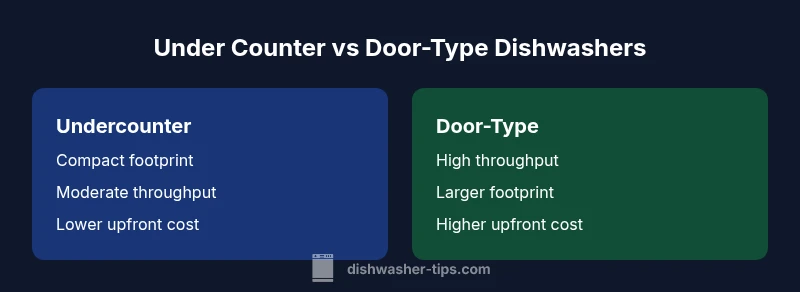
| Typical throughput | Moderate throughput suitable for small to mid-volume venues | Very high throughput for high-volume service lines |
| Water usage | Moderate water usage aligned with compact models | Higher water usage aligned with high-capacity models |
| Space requirements | Compact footprint fits tight kitchens | Larger footprint requires dedicated space and clearances |
| Upfront cost range | Lower upfront cost for compact models | Higher upfront cost for industrial-scale models |
| Maintenance needs | Easier maintenance with widely available parts | More complex maintenance needing specialized service |
| Best for | Small cafes and compact kitchens | High-volume restaurants and multi-kitchen operations |
The Good
- Slender footprint enables placement in tight back-of-house areas
- Adequate throughput for small to mid-size operations
- Lower upfront cost compared to high-capacity models
- Easier serviceability with common spare parts
Disadvantages
- Limited maximum throughput may bottleneck peak hours
- Longer dish turnaround if schedules are misaligned with cycles
- Smaller basins may necessitate more frequent loading checks
Door-Type is best for high-volume restaurants; undercounter is best for compact spaces yet still solid for smaller operations
Choose door-type for peak-hour throughput and multi-line kitchens; opt for undercounter when space and upfront cost are the main constraints. Reliability and serviceability should guide long-term ROI.
People Also Ask
What is the main difference between undercounter and door-type dishwashers?
Undercounter dishwashers are compact and cheaper upfront, suitable for smaller venues. Door-type machines offer higher throughput for busy service periods but require more space and a larger upfront investment. The choice depends on service volume and space constraints.
Undercounter units save space and cost, while door-type machines handle bigger crowds in peak hours.
How do I estimate my kitchen's total throughput needs?
Review average daily covers, peak service times, and dish load per cycle. Map dishes per hour to the machine’s demonstrated cycles-per-hour capability, then add a safety margin for peak weekends.
Look at your busiest hours and estimate how many cycles you’ll need per hour.
What factors influence total cost of ownership for restaurant dishwashers?
Initial price, installation, energy and water use, maintenance parts, and expected machine lifespan all influence total cost. Don’t forget downtime costs if the unit isn’t reliable.
Think beyond sticker price—energy, water, maintenance, and uptime matter too.
Is a conveyor/flight dishwasher necessary for a busy restaurant?
Conveyor or flight-type machines offer extremely high throughput but are most practical for large kitchens with continuous service. For many mid-sized restaurants, undercounter or door-type machines provide sufficient capacity with easier space planning.
Conveyor models are great for high-volume needs, but they’re not always the best fit.
What maintenance tasks should I plan for after purchase?
Regular cleaning, filter checks, physical inspection of seals and gaskets, and periodic professional servicing keep performance steady. Wear parts should be readily available from common suppliers.
Keep filters clean and schedule routine service to avoid downtime.
What warranty considerations matter when buying a restaurant dishwasher?
Look for comprehensive coverage on major components, clarify response times, and confirm whether on-site service is included. Longer warranties can reduce risk over the life of the machine.
Check what the warranty covers and how quickly service responds.
What to Remember
- Assess throughput needs relative to service volume
- Measure kitchen space before selecting models
- Prioritize total cost of ownership, not just sticker price
- Plan for installation with proper plumbing, drainage, and electrical capacity
- Choose reliable equipment with accessible service and parts