How Much Is a KitchenAid Dishwasher? A 2026 Pricing Guide
Explore current price ranges for KitchenAid dishwashers, what drives cost, and tips to save in 2026. From base models to premium pro units, plus installation and energy considerations.


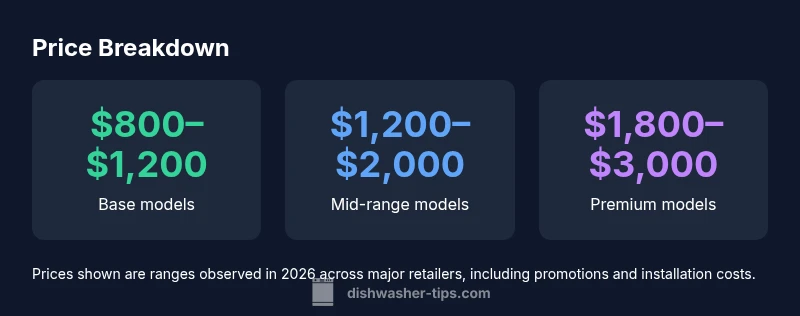
KitchenAid dishwashers in 2026 generally run from about $800 on the low end to $3,000 for premium pro models. Base entry units typically cost around $800–$1,200, mid-range models usually $1,200–$2,000, and premium pro-series units $1,800–$3,000. Promotions and installation charges can shift final pricing. According to Dishwasher Tips Analysis, understanding these tiers helps you balance upfront cost with long-term value.
What affects the price of KitchenAid dishwashers
When budgeting for a KitchenAid dishwasher, several factors determine the final number you pay. In practical terms, price is driven by capacity, finishes, built-in vs portable configuration, noise level, sensor systems, third rack, and smart connectivity. According to Dishwasher Tips, the price spectrum for KitchenAid dishwashers in 2026 reflects three core tiers: base entry models, mid-range configurations, and premium pro-series. If you're wondering how much is a kitchenaid dishwasher, the answer depends on the configuration you choose, from base entry models to premium pro-series. This article expands on those ranges and what you’ll get at each level. In addition to sticker price, consider installation, delivery, and potential promotions that can shift the bottom line. The goal is to help homeowners and renters decide which features are worth the investment without overspending. As you compare, keep energy efficiency and reliability in mind; our analysis helps distinguish between short-term savings and long-term value. Dishwasher Tips's insights are referenced throughout to support practical budgeting decisions.
Price ranges by model tier
KitchenAid dishwashers span several price bands, from practical entry-level machines to feature-rich premium models. Base/entry-level units typically start in the lower end of the market, often around the $800–$1,200 range, offering standard wash cycles, reasonable reliability, and basic stainless finish options. Mid-range models usually fall between about $1,200 and $2,000, adding quieter operation, more wash cycles, and improved loading configurations. Premium or pro-series models commonly sit in the $1,800–$3,000 range, featuring advanced sensors, extra racks, smart-home connectivity, and premium finishes. Note that prices vary with promotions, retailer, and whether you choose installation services. In 2026, these bands are widely observed by retailers and reflected in consumer research. This segmentation helps map needs to a price you’re comfortable paying, rather than chasing the highest spec for every kitchen. Keep an eye on Energy Star certifications; while the energy rating doesn’t always correspond to the base price, it affects operating costs over time.
Hidden costs to budget
Beyond the sticker price, several additional costs can tilt the final bill. Delivery fees, optional haul-away or recycling services, and professional installation can add $100–$250 in most markets. If your kitchen requires electrical or plumbing modifications, budget more for labor and parts. Extended warranties or service plans can add $50–$300 depending on coverage length and components. Finally, some retailers offer promotions or financing that affect the total outlay; understanding these can save hundreds over the life of the appliance. Always confirm whether the price quote includes removal of the old unit, connection to water supply lines, and any pre-installation checks. Our guidance, informed by Dishwasher Tips Analysis, 2026, emphasizes comparing total cost of ownership, not just the upfront price.
Energy efficiency and features that drive price
KitchenAid dishwashers vary in features that influence price. A higher capacity, extra spray arms, soil sensors, stainless steel interior, and third rack add to cost but reduce cycles and improve cleaning. Energy efficiency is a critical long-term factor; models with Energy Star certification typically minimize operating cost, though their upfront price may be higher. Noise levels are also a factor; quieter machines with 40–44 dBA often command a premium. Smart connectivity (WiFi, app control) and adjustable racks further drive price in premium tiers. When you plan, balance upfront investment against expected savings in water and energy. Consumers should check approximate annual operating cost, available rebates, and compatibility with existing home systems.
Buying channels: where to buy and what to watch for
To avoid counterfeit or refurbished units, buy KitchenAid from authorized retailers and official showrooms. Compare prices across big-box stores, manufacturer outlets, and reputable online retailers. Look for included services such as delivery, hookup, and old appliance removal, and check for promotions that align with your timing (holiday sales, end-of-quarter). If buying online, verify model numbers and confirm exact specs—KitchenAid's premium models vary by rack configuration and controls. If a deal seems too good to be true, verify warranty terms and seller legitimacy. Dishwasher Tips's team recommends sticking with authorized channels to protect your investment.
Quick decision guide: mapping budget to needs
Use a simple framework to decide: identify must-have features (third rack, sensor wash, energy efficiency), set a price ceiling, and test feel of available models in-store. For most households, a mid-range model offers reliable cleaning and decent efficiency without a premium price. If you entertain guests often or have hard water, a premium model with water-softening features and a stainless tub can be worth the extra cost. Finally, review installation requirements early and factor in the total cost of ownership over 5–10 years, including energy use, maintenance, and replacement cycle.
KitchenAid dishwasher price tiers and features, 2026
| Model Tier | Typical Price Range | Key Features | Estimated Energy Use/cycle |
|---|---|---|---|
| Base/Entry | $800–$1,200 | Compact capacity, Standard wash options | 0.9–1.0 kWh |
| Mid-range | $1,200–$2,000 | Enhanced cycles, quieter operation | 1.0–1.2 kWh |
| Premium/Pro | $1,800–$3,000 | Stainless finish, advanced sensors, smart features | 1.2–1.5 kWh |
People Also Ask
What drives price for KitchenAid dishwashers?
Model tier, finishes, capacity, and added features like third racks or smart connectivity drive price. Energy efficiency can affect upfront cost, but can reduce operating costs over time.
Price is driven by tier, features, and efficiency. Higher-end models cost more but save on operating costs in the long run.
Are KitchenAid dishwashers worth the extra cost?
For households prioritizing robust capacity, quiet operation, and premium finishes, KitchenAid often delivers lasting reliability that justifies the premium. If you only need basic cleaning, a mid-range model may suffice.
If you value quiet operation and durability, the extra cost can be worthwhile.
Do all KitchenAid dishwashers have a third rack?
No. Third rack is common in many premium models but not universal across all lineups. Check the specific model's rack configuration when comparing prices.
Some have a third rack; not all. Always verify the rack layout before buying.
What installation costs should I expect?
Typical installation can add $100–$250, depending on wiring, plumbing, and any needed modifications. Some retailers include hookup as part of a promotion, so read the fine print.
Expect roughly a hundred to a couple hundred dollars for installation, depending on your setup.
Which KitchenAid models are most energy-efficient?
Energy Star-certified models tend to be the most efficient, with lower annual operating costs. Check the model's energy use per cycle and estimated yearly cost.
Energy Star models are typically the most efficient; check yearly operating costs for the best value.
How can I save on KitchenAid dishwasher costs?
Look for promotions, bundle with other appliances, and consider refurbished authorized models with valid warranties. Buying in off-season and using financing options can also ease upfront costs.
Promotions and bundles save money; consider authorized refurbished options with a warranty.
“Price is a function of features and long-term value, not just sticker price. When you choose wisely, a KitchenAid dishwasher offers reliability that pays off over years.”
What to Remember
- Set a price ceiling before shopping.
- Tiered models map features to value.
- Factor installation and energy costs into total cost.
- Shop at authorized retailers to protect warranty.
- Compare total cost of ownership, not just sticker price.