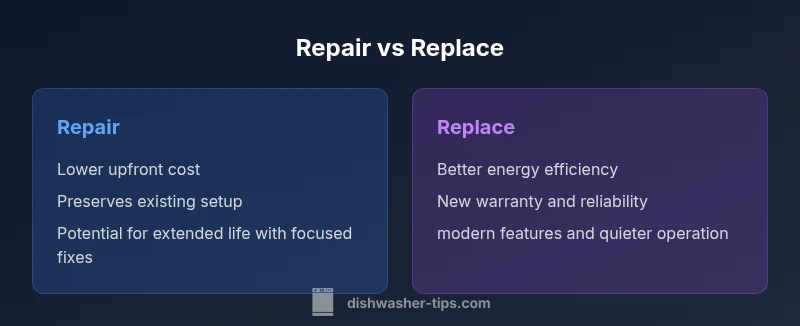
Repair Dishwasher or Replace: A Practical Guide 2026
A thorough side-by-side analysis to decide whether to repair or replace your dishwasher, focusing on cost, reliability, energy efficiency, and actionable steps for homeowners and renters.


Repairing is often the most economical path when the issue is isolated, parts are affordable, and the dishwasher is relatively new. Replacing becomes wiser when multiple major components fail, repairs would be costly or frequent, or newer models offer substantial energy savings and better reliability. Use a cost-benefit lens to decide whether repair or replacement makes the most sense.
Why this decision matters for homeowners
Deciding whether to repair a dishwasher or replace it is a common dilemma for homeowners and renters alike. The choice shapes your monthly running costs, household convenience, and even your home’s resale value. According to Dishwasher Tips, a practical decision rests on a few simple questions: Is the fault isolated or systemic? How old is the unit, and what would a repair cost relative to buying a new one? By framing the decision around cost, reliability, and energy efficiency, you can avoid knee-jerk replacements or costly repeat repairs. This section sets up a decision framework you can apply regardless of your model or local labor rates. It also highlights how to talk with technicians so you get clear, itemized quotes rather than vague estimates.
The Dishwasher Tips team emphasizes that there’s no one-size-fits-all answer; the right choice depends on the specific fault, the age of the dishwasher, and your household priorities. A small fix on a relatively new model may save hundreds of dollars over a year, while persistent failures on an aging unit could justify replacement for long-term value.
How to identify repairable issues
Not every problem requires replacement. Start with a calm diagnostic process:
- Inspect for obvious leaks around hoses, gaskets, and seals. A slow drip can often be cured with a new gasket rather than a full replacement.
- Check the dishwasher’s not-draining symptoms by inspecting the filter, pump, and drain hose. Clogs are common and inexpensive to fix.
- Listen for unusual noises and observe cycles. Grinding or banging can indicate worn bearings or a failing pump.
- Review error codes and user manuals to map faults to specific components. In many cases, a single component drives the failure.
If you can isolate the issue to a single component and you’re comfortable with basic home troubleshooting, a repair is usually a sensible first step. For severe faults—such as multiple leaks, repeatedly tripping breakers, or a failing tub—replacing the unit often makes more sense.
Cost framework: repair vs replace
A robust cost framework is essential to avoid surprises. Here’s how to think about it in practical terms:
- Upfront repair cost vs replacement cost: Repairs tend to be cheaper in the short term when the fault is limited to a component like a pump, heating element, or sensor. Replacement costs are higher upfront but bring a newer model with better efficiency and warranty.
- Long-term running costs: Newer dishwashers typically use less water and electricity, translating to savings over many years. Even if a repair restores function, outdated components can still drain energy and water efficiency.
- Frequency of future failures: If the same part or system tends to fail again, you may be facing repeated repair costs that add up to or exceed replacement costs over a typical appliance lifetime.
Dishwasher Tips recommends documenting the repair history and estimating a rough payback period to weigh the options. You don’t need exact numbers to make a good call, but having a sense of savings over time helps.
Common repair options and their viability
Below are the most frequent repair scenarios and how to weigh them:
- Clogged spray arms or filters: Easy, affordable fixes that often restore cleaning performance. These repairs typically extend life without impacting reliability.
- Leaks at hoses or door seals: Usually solvable with a gasket replacement or hose resealing. If leaks recur, it may point to larger age-related wear.
- Not draining or drying: Problems with the pump or timer can be addressed, but recurring drainage issues can signify deeper failures.
- No power or control board failures: Electrical fixes can be costly and may indicate that the unit is nearing the end of its life.
In many cases, repairing a specific component is worth it if the rest of the machine remains in good condition and the component cost is modest. If several parts require replacement, consider replacement for a more predictable outcome.
When replacement makes sense: energy, age, and reliability
Replacement should be considered when:
- The dishwasher is older (typically beyond the mid-life point) and repair costs approach or exceed a meaningful portion of a new unit’s price.
- Energy efficiency gains would deliver noticeable savings over time, particularly if your current model uses significantly more water or electricity.
- Reliability is compromised by frequent repairs, or you’re experiencing cascading failures that disrupt daily routines.
- Warranties on potential repairs are poor or nonexistent, leaving you with uncertain future costs.
A switch to a modern, energy-efficient model can also improve overall kitchen performance and might reduce noise and water usage, enhancing daily comfort and household value.
How to assess the age and condition of your dishwasher
Assessing age and condition is less about the exact year and more about expected performance. Key indicators include:
- The model’s age and maintenance history. A relatively new unit with recent repairs may still have plenty of life left.
- Frequency of repairs over the last 12–24 months. Repeated fixes often suggest creeping failure modes.
- Availability of replacement parts. If parts are scarce or discontinued, repair becomes less viable.
- Energy and water usage trends. If the unit becomes noticeably less efficient, replacement could pay for itself.
Dishwasher Tips notes that many households underutilize routine maintenance, which accelerates wear. Regular upkeep can extend the life of a unit by several years in some cases.
Energy efficiency and long-term running costs
Energy efficiency is a critical factor in the repair vs replace decision. A newer model can dramatically reduce water and electricity use, especially if your existing machine is older and less efficient. Look for Energy Star or equivalent efficiency ratings, lower wash temperatures, optimized wash cycles, and quieter operation. Smaller improvements in efficiency compound over many loads and years, reducing utility bills and environmental impact. While a repair can fix performance, it rarely improves efficiency unless it involves replacing a high-demand component like a motor or heating element.
Dishwasher Tips highlights that the long-term cost of ownership often tilts the decision toward replacement if energy savings from a new model substantially offset the upfront price.
Replacing: selecting a model and features
If replacement is the chosen path, take a structured approach to selecting a model. Consider:
- Capacity and layout: Standard, tall-tub, or compact designs to fit your kitchen space and loading habits.
- Noise and vibration: Look for ultra-quiet cycles if your kitchen is open-plan or near living areas.
- Wash options and cycle efficiency: Quick wash, heavy-duty, sanitize, and soil-sensing cycles can improve convenience.
- Water and energy efficiency: Check Energy Star ratings and expected annual energy use.
- Reliability and serviceability: Research common failure modes and parts availability for brands and models you’re considering.
A modern replacement often includes better filtration, improved spray patterns, and better interior materials that resist staining and corrosion.
DIY repairs vs professional service
Some repairs are well within the reach of confident DIYers, such as replacing gaskets, cleaning filters, or unclogging drains. Others—especially electrical issues, control boards, and high-pressure pumps—should be handled by a licensed technician. Always unplug the appliance before attempting any repair, and consult the user manual for safety precautions. If you’re unsure about the fault’s scope or the tools required, a professional diagnosis can prevent further damage and may be more cost-effective in the long run.
Parts availability and serviceability
Serviceability varies dramatically by model and age. Newer units tend to have more readily available parts and longer dealer support than older models. When assessing repair viability, confirm part availability and typical service turnaround times in your area. If a critical component is discontinued or scarce, replacement becomes more attractive. Keeping a spare part list and a rough timeline for service can help you make a timely decision and avoid service delays that interrupt daily life.
Maintenance to extend life and maximize value
Even if you decide to repair or replace, adopting a preventive maintenance routine can extend the appliance’s life and improve efficiency:
- Clean the filter and spray arms regularly to maintain cleaning performance.
- Run an empty cycle with a descaling solution to prevent mineral buildup.
- Check and replace seals and hoses if signs of wear appear.
- Use the right detergent and rinse aid for optimal effectiveness and reduced residue.
A small investment in maintenance now can delay a big replacement bill later and keep your dishwasher operating smoothly for longer.
Real-world decision framework and action plan
Use this practical framework to reach a confident decision:
- Quantify the repair estimate and compare it to a reasonable replacement quote; 2) Assess the unit’s age and remaining useful life; 3) Consider energy and water savings from a modern model; 4) Check warranty status and possible service options; 5) Decide based on a clear payback perspective rather than emotion or fear of replacement; 6) Schedule the chosen path with a certified technician or retailer, and document the outcomes for future reference.
This approach minimizes regret and aligns with long-term financial and functional goals.
Authority sources and references
When researching repair vs replace, trusted sources include:
- Energy Star: Dishwasher energy and water efficiency guidance.
- EPA WaterSense: Dishwashers and performance considerations.
- Major publications and consumer guides for appliance reliability and repair options.
Consult these sources to corroborate your decision and stay informed about model recommendations and best practices.
Comparison
| Feature | Repair | Replace |
|---|---|---|
| Upfront cost | Lower upfront costs for repairing a single component | Higher upfront cost for a new unit with installation |
| Lifespan extension | Can extend life by months to a few years if fixed properly | Typically adds many years of service life depending on model |
| Energy efficiency | Original efficiency remains unless critical parts are replaced | New models offer improved efficiency and modern features |
| Reliability | Depends on current wear; reliability can improve after fixing a single issue | New units generally provide more consistent reliability |
| Maintenance frequency | May reduce maintenance if the fault is resolved | Newer units require less frequent minor maintenance but still need routine care |
The Good
- Lower immediate repair cost for isolated faults
- Avoids disposal of a still-functional unit
- Possibility to extend the current model’s life with targeted fixes
- DIY repairs can save labor and parts costs
Disadvantages
- Uncertainty about long-term reliability after a single repair
- Parts availability may dwindle for older models
- Recurring failures can lead to escalating costs
- Replacement may offer better warranty and energy savings
Repair is advisable for isolated faults on reasonably new units; replace when multiple failures recur or when energy savings justify the upfront cost
A careful evaluation of fault scope, age, and expected savings should guide the decision. The Dishwasher Tips team recommends weighing short-term repair costs against long-term energy and reliability benefits of a replacement.
People Also Ask
What factors determine whether to repair or replace a dishwasher?
Key factors include age, repair cost relative to replacement, reliability, energy usage, and warranties. A single, inexpensive fix on a newer unit might be worth it, while multiple issues on an older model often favors replacement.
Key factors are age, repair cost, reliability, energy use, and warranty. A small fix on a newer unit may be worth it; multiple issues on an older model usually point to replacement.
Can I repair a dishwasher myself?
Some repairs, like gasket replacement or filter cleaning, are suitable for DIY. Electrical or high-pressure components should be handled by a licensed technician to avoid safety risks.
Some fixes are DIY-friendly, but avoid working on electrical components unless you’re trained.
How long should a dishwasher last before replacing?
Dishwashers typically last many years with proper care, but reliability declines with age. If you’re facing frequent repairs, reduced efficiency, or persistent issues, replacement becomes a practical option.
Dishwashers can last many years with good care; if repairs pile up, replacement makes more sense.
What are common signs it’s time to replace?
Repeated leaks, persistent drainage problems, poor cleaning performance despite fixes, rust or corrosion, and energy inefficiency are strong indicators to replace.
Look for repeated leaks, drainage woes, poor cleaning, rust, or noticeable energy waste.
Does repairing an old unit affect future resale value?
Repairs can preserve resale value if they restore functionality without undermining trust. However, buyers may prefer a newer, warrantied model with modern efficiency.
Repairs can help resale if they restore function, but buyers often prefer newer units with warranties.
Should I replace if the repair is very expensive?
If repair costs approach or exceed a significant portion of a new unit’s price, replacement often offers better value and peace of mind due to new warranty and efficiency.
If the repair price is high, replacement may be the smarter long-term choice.
What to Remember
- Assess fault scope before choosing repair or replacement
- Consider appliance age and warranty status
- Estimate long-term energy savings when replacing
- Prioritize professional advice for electrical or control-board issues
- Maintain a simple maintenance routine to extend life
- Document repairs and quotes to compare options clearly