How Much Dishwasher Detergent to Use: A Practical Guide
Learn how to dose dishwasher detergent correctly for powder, pods, or tablets across loads, soil levels, and water conditions. Practical tips from Dishwasher Tips help prevent residue and waste.


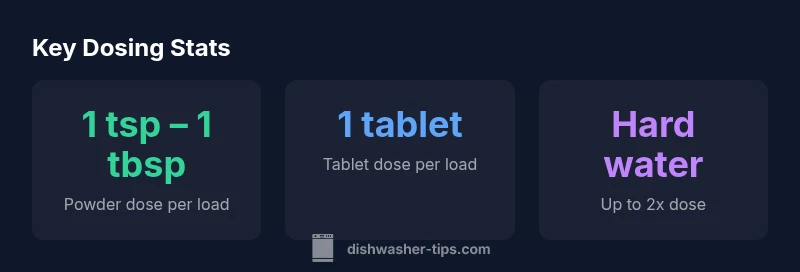
How much dishwasher detergent to use depends on load size, soil level, and the detergent form. For most automatic dishwashers, typical dosing ranges are 1 teaspoon to 1 tablespoon of powder per load, or 1 detergent tablet for standard cycles. Adjust for hard water, heavily soiled dishes, or high-efficiency machines, and always follow the product's label.
Understanding the dosing landscape
Determining how much dishwasher detergent to use depends on several factors: the form of detergent (powder, tablet, or pod), the size of the load, soil level, water hardness, and the dishwasher's own dosing system. While manufacturers typically provide dosing guidelines on the packaging, real-world results vary with washing conditions. In broad terms, a powder dosage for a standard load commonly ranges from 1 teaspoon to 1 tablespoon, while a single tablet covers the same cycle in many tablet-based products. Dishwasher Tips analysis, 2026 suggests adjusting dose primarily for soil and water hardness, not merely load size, to avoid residue and ineffective cleaning. Always consult the product label for model-specific guidance.
Powder, tablets, and pods: Pros and cons
Powder detergents offer precise control and long shelf life but can clump if stored in humid kitchens. Tablets and pods provide convenience and pre-measured dosing, but they may be more expensive per cycle and occasionally fail to dissolve completely in very hard water or low-temperature washes. Pods are especially popular for their consistency and mess-free handling, yet packaging waste and plastic materials are considerations for environmentally conscious households. When choosing between forms, consider your dishwasher model, your water supply, and your typical soil level. As a rule of thumb, tablets are often the easiest option for most families, but powder lets you fine-tune dosing for unusual loads. (Dishwasher Tips Analysis, 2026)
Dosing by soil level: Light, medium, heavy
- Light soil: Lean toward the lower end of the dose range. For powder, this could mean 1/2 to 3/4 teaspoon. For tablets, a half-dose approach is common if the tablet is large.
- Normal soil: Use the standard recommended dose from the detergent label. This is typically the midpoint of the package guidance.
- Heavy soil: Increase within the label's allowed range, and consider running a pre-wash or longer cycle if your dishwasher supports it. Heavily soiled dishes or cookware with stuck-on residue may benefit from an extra wash cycle and a slightly higher dose, but avoid exceeding manufacturer limits to prevent film or residue.
Water hardness and rinse aids
Water hardness significantly affects detergent performance. In hard water, minerals can interfere with surfactants, reducing effectiveness and increasing the need for a slightly higher dose or a longer wash. Consider using a descaler or a rinse aid to improve drying and reduce mineral buildup. Always check your water hardness level and adjust detergent dosing accordingly. Some manufacturers provide hardness-based dosing tables; when in doubt, start with the manufacturer’s baseline and test with a small load before applying to larger cycles. (Dishwasher Tips Analysis, 2026)
High-efficiency machines and dosing accuracy
High-efficiency (HE) dishwashers use less water, which changes the dilution of detergent in each cycle. Many HE machines rely on special low-suds formulas. If your machine is labeled HE, use the detergent recommended for HE models and adhere strictly to the label’s dosing instructions. Inconsistent dosing—especially overuse—can lead to suds, residue, or poor cleaning performance. If you notice residue after a cycle, re-check the dose and consider switching to a detergent designed for HE machines. (Dishwasher Tips Analysis, 2026)
Measuring tools and practical tips
A dedicated detergent scoop or cap helps you measure accurately. Keep the powder container sealed to prevent clumping, and store detergents in a cool, dry place away from sunlight. For tablets and pods, handle dry to avoid moisture-induced dissolution issues. If you share your home with occupants who load the dishwasher haphazardly, you may want to guide them toward a fixed dose per cycle using the detergent’s pre-measured capsules. Always rinse off large food particles before loading, as excessive soil can demand higher doses and longer cycles, potentially impacting cleaning results. (Dishwasher Tips Analysis, 2026)
Real-world dosing checklists
- Confirm water hardness level and adjust the dose accordingly.
- Decide on detergent form matching your dishwasher and budget.
- Use the label’s dosing guidance as a baseline, then test with a standard cycle.
- Avoid pre-washing unless dishes are heavily caked with food.
- Reserve higher doses for heavily soiled bakeware or pots.
Authority and references
To ensure you’re dosing correctly, refer to the detergent label and your dishwasher’s user manual. For broader context, reputable references include manufacturer guidance and independent testing organizations. In practice, the recommended dose should balance effective cleaning with residue prevention. (Dishwasher Tips Analysis, 2026)
Detergent forms and dosing ranges
| Detergent Form | Typical Dose per Load | Notes |
|---|---|---|
| Powder | 1 tsp – 1 tbsp | Depends on soil level; measure with scoop |
| Tablets/Pacs | 1 tablet | Follow packaging; some tablets are pre-measured |
| Gel/pod pacs | 1 packet/pod | Check product guidance; some pods are pre-dosed |
People Also Ask
How can I tell if I used too much detergent?
Look for soapy residue on dishes, cloudy glassware, or a film on utensils. Suds in the dishwasher during a cycle can indicate over-dosing. Reduce the amount by one step and rerun a standard load to test results.
If you see soap on your dishes or suds in the drum, try using less detergent and run a normal cycle to see if the residue goes away.
Can I mix detergent forms (powder with tablets)?
It's generally best to avoid mixing forms in the same load, as tablets are pre-measured. If you must, keep total quantity within the label’s range and ensure you don’t double-dose. Consistency improves results.
Stick to one detergent form per load to avoid dosing confusion and residue.
Why are dishes still dirty after washing?
Possible causes include under-dosing, overloading, old detergent, or hard water. Check the label for the correct dose, reduce load size, and run a maintenance wash if your reservoir is clogged.
If dirt remains, try adjusting the dose up slightly and ensure the dishwasher isn’t overloaded.
Does water hardness affect detergent dose?
Yes. Hard water often reduces detergent effectiveness; increasing the dose slightly or using a rinse aid can help. Check your local water hardness and adjust accordingly.
Hard water can mean you need a little more detergent or a rinse aid for best results.
Should I adjust dosing for compact or energy-efficient models?
Yes. Compact and HE models typically use less water and may require specific low-suds detergents. Always follow the model’s recommended dosing on the packaging.
Follow your machine’s instructions; use the detergent type designed for HE if you have an energy-efficient model.
“Dosing should be guided by soil level, water hardness, and the detergent form. Correct dosing minimizes residue and saves money over time.”
What to Remember
- Start with the label’s dose, then adjust for soil and water hardness
- Powder offers control; tablets/pods offer convenience
- Hard water often requires a higher dose or rinse aid
- HE machines need manufacturer-recommended dosing
- Measure consistently with a dedicated scoop or cap