Samsung dishwasher vs Bosch: A Thorough Brand Comparison
A rigorous, non-biased comparison of Samsung vs Bosch dishwashers, focusing on cleaning performance, efficiency, reliability, and total value to help homeowners decide which brand fits their kitchen and budget.


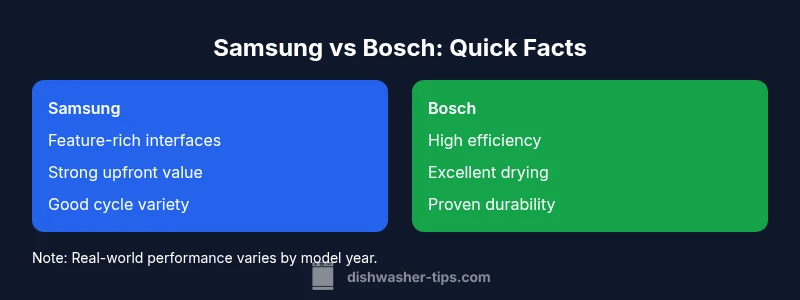
Samsung dishwasher vs Bosch: Bosch generally emphasizes reliability and efficient drying, while Samsung leans into feature-rich models and upfront value. In most homes, Bosch edges ahead for long-term cost of ownership and consistent cleaning, especially on heavy soils; Samsung remains compelling for budget buyers and tech enthusiasts seeking modern interfaces and larger capacity options. The best pick depends on your priorities and kitchen layout.
Market Context and Definitions
The ongoing Samsung dishwasher vs Bosch comparison sits at the crossroads of two storied brands that command two distinct segments of the modern dishwasher market. According to Dishwasher Tips, both brands deliver reliable cleaning and practical features, yet their design philosophies diverge. Samsung often prioritizes feature-rich experiences, flexible loading, and smart connectivity, while Bosch emphasizes efficiency, quiet operation, and durable mechanics. For a homeowner evaluating models, it helps to define what you value most: a broad cycle roster for versatile daily use, or compact design with strong energy savings in regular cycles. Framing the decision this way keeps the evaluation grounded even as you navigate year-to-year model changes within the Samsung and Bosch lines. The core question isn’t which brand is perfect for everyone, but which one aligns with your household’s routines, space, and budget.
Brand Philosophies and Design Priorities
Samsung’s brand philosophy for dishwashers tends to emphasize versatility, contemporary aesthetics, and feature density. You’ll often find wide racks, flexible tines, responsive touch controls, and smart features that integrate with home ecosystems. The goal is to make daily dishwashing feel more convenient and connected, appealing to tech-savvy buyers who want customization and quick-cycle options. Bosch, by contrast, centers on efficiency, quiet operation, and long-term durability. Their interiors typically emphasize optimized spray patterns, efficient filtration, and reliable motors. The Bosch approach aims to deliver dependable performance with minimal maintenance, even after many cycles. When comparing, think about whether you want high-tech convenience and flexible loading (Samsung) or proven efficiency and lasting practicality (Bosch).
Performance and Cleaning Approach
Cleaning performance is a major deciding factor in the Samsung vs Bosch discussion. Bosch models often demonstrate consistent soil removal across a variety of loads, with a focus on the high-efficiency wash programs and thorough rinsing that minimize residue on glassware and plastics. Samsung models typically offer strong performance across common dishes, with some lines designed to target quick cycles and heavy-duty options for stubborn soils. The actual outcome will depend on the specific model year and the chosen cycle. In general, Bosch tends to deliver more uniform results on everyday loads, while Samsung may excel in scenarios that benefit from quick, feature-rich cycles. Both brands, when paired with proper detergent usage and loading practices, deliver solid cleaning.
Drying Methods and Energy Use
Drying performance and energy use are often the deciding factors for households prioritizing efficiency and kitchen comfort. Bosch dishes are frequently lauded for efficient drying and condensation-based or heat-assisted finishes that minimize moisture on plastics. Samsung, while typically offering competitive energy use, may rely more on fan-assisted or varied drying methods depending on the model. In practical terms, expect Bosch to deliver more consistent dryness on mixed loads, particularly with taller items and plasticware. Samsung models can match or approach this depending on the cycle selection and interior configuration, but performance can vary with newer AI-enabled features.
Noise, Capacity, and Handling Large Loads
Noise levels are a key consideration for open-plan kitchens or apartments. Bosch models are widely recognized for quiet operation, often staying at lower decibel levels across their range. Samsung also builds quiet models, but the degree of noise suppression can vary by line and cycle. Capacity considerations go beyond cubic feet and rack counts; user-friendly rack systems, adjustable tines, and semi-integrated controls influence everyday usability. When you anticipate heavy cooking nights or frequent entertaining, look for models with flexible loading and dedicated racks for lids, utensils, and tall glasses. Both brands offer options that balance capacity with efficiency, so prioritize features that complement your actual dishwashing rhythms.
Reliability, Warranty, and Service Networks
Reliability and service access are critical in long-term ownership. Bosch has a longstanding reputation for durability and a robust service network in many regions, which often translates to favorable maintenance experiences and readily available parts. Samsung also provides solid support and warranty options, with a broader global footprint and sometimes shorter wait times for service due to widespread parts availability. The choice here may hinge on your local service availability and the specific model’s warranty terms. If longevity and predictable maintenance matter most, Bosch frequently has the edge; if you anticipate needing quick service or prefer more flexible warranty packages, Samsung can be attractive.
User Experience: Interfaces, Controls, and Smart Features
Samsung’s dishwashers are known for their modern interfaces, touch controls, and smart features that let you monitor cycles from a phone or tablet. This can be a strong selling point for households that value convenience and integration with other smart devices. Bosch focuses on intuitive controls and dependable performance, with fewer flashy features and more emphasis on reliability and straightforward operation. If your priority is a streamlined user experience with smart connectivity, Samsung may fit better; if you want a simpler, consistently reliable control system with fewer potential points of failure, Bosch is a strong contender.
Detergents, Pods, and Maintenance
detergent compatibility and maintenance routines can influence long-term results. Samsung and Bosch both support common dishwasher detergents, but you’ll see subtle differences in how they respond to rinse aids, pod formulations, and recommended loading techniques. Bosch interiors are often designed to optimize spray patterns and filtration, contributing to reliable results with standard detergents. Samsung models may accommodate newer pod formats and detergents that emphasize energy efficiency and quick-clean cycles. Following manufacturer recommendations and staying on a regular cleaning schedule will maximize performance for either brand.
Price Range and Total Cost of Ownership
Initial price is just one part of total ownership. Samsung dishwashers typically offer compelling features at a lower upfront price point in many models, appealing to budget-minded shoppers and tech enthusiasts alike. Bosch models commonly come at a higher upfront cost but may deliver improved energy efficiency, stronger durability, and better resale or long-term value. When evaluating price, consider installation costs, energy usage over time, potential repair expenses, and the availability of extended warranties. A thorough TCO assessment often reveals Bosch as a longer-term value proposition in households with heavy use and strict energy targets, while Samsung can shine for buyers seeking value and feature density in the near term.
Real-World Scenarios: When One Brand Shines
For small kitchens or renters prioritizing upfront value and modern features, Samsung’s lineup can be highly appealing, especially when smart features and flexible loading are desirable. In multi-person households with frequent heavy loads and a focus on energy efficiency, Bosch tends to deliver more consistent results and lower long-term operating costs. Families seeking quiet operation and dependable performance in a busy household may find Bosch a better fit, while households that want rapid cycles and connectivity may lean toward Samsung. Consider your typical dish load, meal patterns, and how often you replace appliances to determine which brand aligns with your life.
How to Choose: A Step-by-Step Guide
- List your top priorities: energy efficiency, noise, cycle variety, or smart features. 2) Check local service coverage and warranty terms for both brands in your area. 3) Compare at least two models from each brand that fit your budget and kitchen size. 4) Inspect interior layouts, rack adjustability, and door clearance to ensure fit in your space. 5) Read user reviews focused on the specific models you’re considering to gauge reliability and real-world performance. 6) If possible, see the models in-store to test the interface and loading options. 7) Decide based on a balance of cleaning performance, efficiency, and long-term value rather than upfront cost alone.
Common Pitfalls and Beginner Mistakes
Avoid focusing solely on the advertised energy star rating without considering real-world usage patterns. Don’t neglect installation requirements, such as water hardness and drainage compatibility, which can affect performance. Be wary of models with flashy features that don’t address your primary needs, since extra functions can complicate maintenance and increase costs. Finally, resist comparing only price; a cheaper model with higher operating costs or shorter warranty periods can cost more over time. A measured, purpose-driven approach helps you avoid buyer’s remorse and ensures the chosen model aligns with your kitchen realities.
Comparison
| Feature | Samsung dishwasher | Bosch dishwasher |
|---|---|---|
| Wash-cycle variety | Broad range with quick and specialty cycles | Extensive, with emphasis on auto and intense options |
| Drying performance | Good overall drying, varies by model | Strong and consistent drying across loads |
| Energy efficiency | Good to very good depending on model | Excellent efficiency across lines |
| Noise level | Quiet in many models, varies by line | Typically among the quieter options in its class |
| Reliability and service | Solid reliability and broad service network | Renowned reliability and extensive service network |
| Upfront price range | Usually lower to mid-range for feature-rich models | Higher upfront cost in many high-efficiency models |
| Best for | Budget-conscious buyers who want modern tech | Long-term value with efficiency and durability |
The Good
- Strong feature packages at competitive prices (Samsung)
- Excellent energy efficiency across Bosch lines
- Quiet operation generally available from Bosch
- Broad service networks for both brands with regional variation
- Flexible interior layouts and modern controls in Samsung
Disadvantages
- Higher upfront cost for some Bosch models
- Samsung reliability can vary by model year
- Some Bosch models have longer cycle times depending on program
- Feature density in Samsung can complicate maintenance
Bosch generally leads in long-term efficiency and reliability; Samsung offers more upfront value and feature depth
If long-term efficiency and minimal maintenance are your priority, Bosch is the safer bet. If you want more tech features and a lower upfront cost, Samsung is compelling. Match the choice to your kitchen usage and budget, and verify model-specific reviews.
People Also Ask
Which dishwasher cleans better, Samsung or Bosch?
Both brands deliver solid cleaning performance. Bosch often provides more consistent soil removal on mixed loads, while Samsung can excel on quick cycles and heavy daily use depending on the model.
Both brands clean well, with Bosch often edge better on stubborn soils and Samsung offering strong performance on quick cycles.
Is Bosch more energy efficient than Samsung?
Bosch generally emphasizes efficiency across many models, while Samsung also offers efficient options, but results depend on the specific model and cycle choices.
Bosch tends to be more energy efficient overall, though Samsung has efficient models too.
Which brand is more reliable and easier to service?
Bosch has a long-standing reputation for reliability and a broad service network. Samsung is reliable too, but local service availability can vary.
Bosch usually has the edge in reliability and service availability.
Do Samsung or Bosch dishwashers have quieter operation?
Both brands offer quiet models; Bosch often leads the category in low noise, while Samsung models can also be very quiet in higher tiers.
Bosch is typically the quietest, though Samsung can be very quiet too.
Which brand offers better value for upfront cost?
Samsung usually provides strong feature sets at a lower upfront price; Bosch tends to cost more initially but may offer better long-term value through efficiency and durability.
Samsung is often cheaper upfront; Bosch can pay off later with efficiency and durability.
What should I consider when choosing between Samsung and Bosch?
Assess your kitchen size, cycle needs, noise tolerance, energy costs, warranty, and service coverage. Compare specific models side by side for cleaning performance and reliability.
Think about cycles, cost, and service in your area when choosing.
What to Remember
- Define your top priority: efficiency, reliability, or feature set
- Compare energy use and noise for your space
- Consider total cost of ownership, not just upfront price
- Check local service availability and warranty terms
- Use a side-by-side chart when shopping