Do You Need a Plumber to Install a Dishwasher? DIY Guide
Discover whether a plumber is needed to install a dishwasher, when DIY is feasible, essential steps, and safety tips. Learn how to decide between DIY and professional help with practical guidance from Dishwasher Tips.


Most homes don’t require a plumber to install a standard dishwasher. If you have a ready hot-water supply line, a compatible drain, and a nearby outlet, you can complete the hookup with the manufacturer’s install kit. Hire a pro if you must modify plumbing, drainage, or electrical circuits, or if gas lines are involved. According to Dishwasher Tips, this approach works for many DIY installers, provided you follow safety steps and the model’s instructions.
Is a Plumber Really Necessary? A Practical Answer
If you’re staring at a bare space where your dishwasher should live, you may wonder whether you must hire a plumber to install it. The short answer: not always. In most homes, a standard dishwasher can be hooked up using existing hot-water supply, a drain line, and a nearby 120-volt outlet, as long as the work aligns with the manufacturer’s instructions. The Dishwasher Tips team notes that many DIY installations succeed when you follow the model’s included install kit and take basic safety steps. However, there are scenarios where professional help makes sense: if you must alter water lines, relocate a drain, or upgrade electrical wiring, or if your kitchen has a complex layout, gas connections, or tight clearance. In those cases, a licensed plumber or electrician can save time and reduce the risk of leaks or code violations.
This guidance aligns with general best practices for appliance installation and helps homeowners weigh the cost and convenience of DIY against professional service. If you’re tackling your first appliance hookup, start with a thorough assessment of your current plumbing and electrical setup to determine whether DIY is truly feasible for your kitchen layout and local conditions.
Your Current Setup: How to Assess Plumbing and Electrical Readiness
Before you begin, take stock of what already exists in your kitchen. Check for a hot-water supply valve under the sink, inspect the sink drain and available space for the dishwasher’s drain hose, and locate a nearby 120-volt grounded outlet or a dedicated circuit. Confirm the dishwasher kit matches your model’s inlet size and drain connection. If you find odd pipe angles, corroded fittings, or an outlet that is far away or not on a dedicated circuit, you may want to reconsider a DIY install. A quick measurement of the opening, cabinet depth, and clearance to the wall will help you plan the layout and avoid surprises. Also verify that your countertop and cabinet openings will accommodate the dishwasher’s width and door swing without obstruction.
DIY vs Hiring a Pro: Decision Matrix
DIY is often feasible when you have standard hookups, clear access, and the installer kit matches your model. However, consider a pro if you encounter:
- Plumbing changes or relocation of the water line or drain
- Electrical work beyond the included plug-in option
- Gas lines or complex wiring in the area
- Tight clearance or unusual cabinet configurations
Use a decision matrix: if the kit covers your connections and you can safely shut off water and power, DIY is reasonable. If any changes require new pipes, vents, or circuits, or if you are unsure about code requirements, consult a licensed professional. This approach minimizes leaks, electrical faults, and warranty voids.
Planning and Safety: What to Check Before You Start
Safety is the foundation of any dishwasher installation. Start by turning off the circuit servicing the dishwasher outlet and closing the home water supply valve. Unplug or switch off power at the dedicated outlet, and relieve pressure by running a brief drainage cycle on the existing unit if you’re replacing it. Gather the necessary tools and read the manufacturer’s installation guide before touching any fittings. Check local codes for requirements such as an air gap or high-loop drain, and ensure your electrical outlet is grounded (GFCI-protected in many kitchen configurations). Keep a bucket and towels handy to manage leaks, and wear eye protection when loosening fittings. Following these steps reduces the risk of accidents and damage during setup.
Common Install Scenarios and Solutions
Scenario A: You have an existing hot-water line, a drain under the sink, and a nearby outlet. Solution: Use the included kit, connect the water supply, route the drain with a high loop or air gap, and plug into the outlet. Scenario B: The outlet is far or not on a dedicated circuit. Solution: Install a new outlet or use a qualified electrician to extend power legally and safely. Scenario C: Limited space behind the dishwasher. Solution: Choose a model with adjustable toe-kick height or slide-in dimensions that fit your cabinet depth, and plan hose routing to avoid kinks. In all cases, verify the drain clearance to prevent backflow and check for leaks after the first run.
Test, Troubleshoot, and Final Checks
Run a short test cycle (without dishes) to verify water fill, door latching, and drainage. Inspect all connections for leaks during the cycle and again after it cools. Check the drain hose for kinks and confirm the air-gap or high-loop is correctly installed if required. Listen for unusual noises that may indicate improper mounting or misaligned spray arms. If the dishwasher does not start, re-check the power and ensure the circuit breaker is on. Finally, document any issues and consult the installation manual for model-specific troubleshooting steps or contact customer support for guidance.
Tools & Materials
- Dishwasher installation kit (included with unit)(Includes water supply connector, drain hose, and hardware; verify compatibility with your model and local codes.)
- Adjustable wrench(For hose fittings and clamps.)
- Phillips and flathead screwdrivers(For mounting screws and access panels.)
- Teflon tape(Seal threaded connections on water lines.)
- Bucket and towels(Contain leaks and simplify cleanup.)
- Measuring tape(Ensure opening depth and cabinet clearance are adequate.)
- Level(Avoid tilting the dishwasher during installation.)
- Utility knife or scissors(For trimming packaging or hoses if needed.)
- Voltage tester (optional)(Verify power is OFF when wiring or checking outlets.)
Steps
Estimated time: 60-90 minutes
- 1
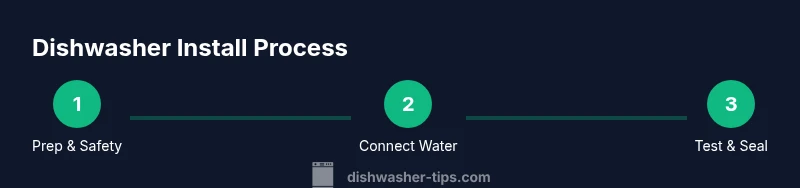
Prep the space and safety power
Turn off the dishwasher circuit at the breaker and shut off the home water supply. Unplug the non-working unit if replacing it. Clear space under the sink and inside the cabinet to allow hose routing and venting. This ensures you won’t encounter pressure shocks or accidental water spurts during setup.
Tip: Always double-check that the power is OFF with a voltage tester before touching wiring. - 2
Access and remove barriers
If you’re replacing an old dishwasher, disconnect and safely remove it. Remove any kick panel or screw covers as needed to gain access to the water valve, drain tee, and electrical connections. Keep a photo log of connections to reference during reassembly.
Tip: Take photos from multiple angles before disconnecting anything to simplify reassembly. - 3
Connect the water supply line
Attach the dishwasher’s water inlet hose to the hot-water shut-off valve using the appropriate connector. Wrap threads with teflon tape and tighten fittings securely. Avoid overtightening to prevent leaks or cracked fittings.
Tip: Hand-tighten first, then snug with a wrench to avoid over-tightening. - 4
Install the drain hose and air gap/high loop
Route the drain hose to the sink drain, securing it with clamps. If required by local code, install an air gap or ensure a high loop under the countertop to prevent back-siphon. Check for kinks and ensure the hose runs level.
Tip: Keep the drain hose above the trap level to prevent backflow. - 5
Make the electrical connection
If your model plugs into a nearby outlet, simply plug it in and ensure the cord is unobstructed and not stretched. If a hard-wired setup is required, follow the manufacturer’s instructions and local electrical codes, ideally using a dedicated circuit.
Tip: Use a dedicated 15–20 amp circuit for reliability and safety. - 6
Secure, level, and test
Slide the dishwasher into place, level it with shims if necessary, and secure it to the cabinet. Run a test cycle to check for leaks and proper operation. Keep towels handy to catch any initial drips during the test run.
Tip: Test with an empty load to prevent accidental damage from a misaligned spray arm.
People Also Ask
Do I need to hire a plumber to install a dishwasher?
Not necessarily. A standard installation can be DIY if you have a hot-water line, proper drain, and a nearby outlet. If you must modify plumbing, drainage, or electrical, or if there are gas lines involved, consider a licensed pro.
In most homes, a standard dishwasher can be installed without a plumber if the hookups are straightforward and you follow the manufacturer’s instructions.
Can a dishwasher be installed under a kitchen sink?
Yes, many configurations fit under a kitchen sink as long as there is adequate space, plumbing clearance, and access to a power outlet. Measure cabinet width and ensure proper routing for water and drain lines.
Yes—space and hookups are key; just measure to confirm clearance and access.
What tools are essential for installation?
Basic tools include an adjustable wrench, screwdrivers, tape measure, level, bucket, towels, and teflon tape. The manufacturer’s install kit is essential for connections.
Essential tools include wrenches, screwdrivers, and a level, plus the kit that comes with the dishwasher.
How long does installation typically take?
Most installations take about one to two hours, depending on existing hookups and space. If new electrical work or drainage is needed, it may take longer.
Around an hour or two for standard installs; longer if you need new wiring or drainage.
What if there’s no nearby outlet?
If there is no nearby outlet, you’ll likely need to install a dedicated outlet or have an electrician extend a circuit. Do not run a dishwasher on an improvised or shared outlet.
If there isn’t an outlet nearby, plan for a proper, dedicated circuit installed by a professional.
Is it safe to install a dishwasher on a shared circuit?
Dishwashers should typically be on their own dedicated circuit to avoid overloading. Check your breaker panel and local codes, and consider a dedicated outlet.
A dedicated circuit is safer and more reliable for a dishwasher.
What to Remember
- Assess your existing hookups before starting DIY,
- Follow manufacturer instructions precisely
- Secure and test all connections to prevent leaks
- Call a pro for complex plumbing or electrical work
- Verify local code requirements for air gaps and drainage