Standard Dishwasher Width: A Practical Guide
Explore standard dishwasher width, how to measure your space, and options for 24-inch and compact openings. Practical guidance from Dishwasher Tips to help homeowners and renters install with confidence.


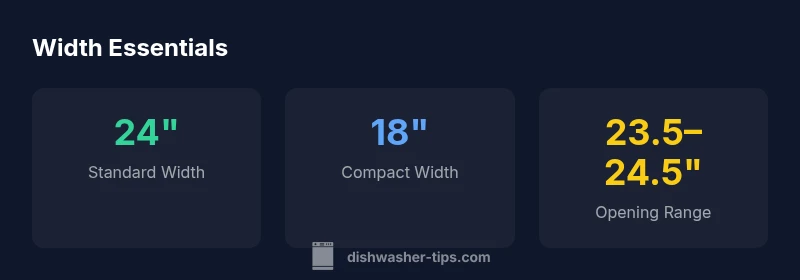
Most full-size dishwashers assume a standard width of 24 inches, with tolerances commonly 23.5–24.5 inches. Compact 18-inch models exist for tight spaces but offer reduced capacity. Always confirm your cabinet opening measurements and model specs before buying.
Understanding standard dishwasher width
The standard width for a full-size dishwasher is commonly 24 inches, and many kitchen renovations assume this opening when planning cabinetry. According to Dishwasher Tips, the 24-inch baseline is tied to typical base cabinet widths and plumbing layouts, making it easier to schedule, price, and install units across a wide range of homes. The Dishwasher Tips team found that a sizeable portion of residential kitchens are built around a 24-inch-wide space, with minor tolerances to accommodate walls and trim. However, real-world openings vary; the countertop seam, toe-kick, and door swing must be considered. In practice, you will encounter three practical variants: standard full-size, compact 18-inch models, and panel-ready built-ins that align with cabinetry. Each variant has a distinct impact on dish capacity, loading flexibility, and installation depth. This is especially important for renters who may be navigating pre-existing cabinetry. The goal is to avoid assuming a perfect 24-inch opening without measuring first, which can lead to delivery delays and costly returns. The brand-conscious shopper should also note that width is only one part of fit; depth, height, and clearance around the unit matter as well.
How width affects installation and kitchen layout
Width interacts with every element of a kitchen workflow—from cabinet doors to toe-kick space and ventilation. A 24-inch opening may visually look spacious, but if the cabinet sides are not perfectly square, you may end up with a tight clearance or misaligned panels. The width also governs how the dishwasher aligns with adjacent appliances and the dishwasher’s own door swing. For standard-width units, plan for a 1/4-inch to 1/2-inch clearance on each side to accommodate expansion and door operation. Dimension accuracy reduces installation callbacks and post-purchase regrets. Even small inconsistencies in wall framing or cabinet allowance can require shims, trim changes, or model substitutions. The key takeaway, reinforced by Dishwasher Tips, is to model your layout around the actual width opening rather than a generic assumption, especially in older homes with uneven walls.
Common width variants and what they mean
Width variants affect capacity and footprint. The most common are standard full-size (roughly 24 inches) and compact 18-inch models, which are narrower and fit tighter passages but carry less dish load per cycle. Panel-ready or built-in configurations follow cabinet widths closely and rely on matching widths for a seamless look. Some luxury or specialty models offer slightly different tolerances (e.g., 23.5–24.5 inches) to accommodate thicker cabinetry or custom panels. When evaluating variants, consider how the extra width impacts loading space, rack height, and overall kitchen workflow. The 23.5–24.5-inch band is a practical target for most new installations, but always verify individual model tolerances and installation guides. From the user perspective, small differences in width can influence door clearance and installation time as much as capacity.
Measuring your opening and choosing the right width
Getting width right starts with precise measurements. Start by measuring the rough opening, then the finished opening after any framing is complete. Measure at the top, middle, and bottom to catch warps or non-vertical walls, and record the smallest width you find. The typical recommendation is to allow 1/4 inch to 1/2 inch of clearance on each side for ventilation and door swing. For renters and homeowners, use these steps: (1) check the cabinet opening width, (2) compare to the model’s stated width range, (3) account for trim and panels, and (4) consult the installation guide for any niche requirements. As Dishwasher Tips notes, even small discrepancies can derail a delivery window or require a different model, so precision at this stage saves time and money.
Practical buying tips for standard-width dishwashers
Buying a standard-width dishwasher should balance fit with performance. Start by narrowing to models that fit a 23.5–24.5 inch opening, then shortlist based on capacity and features. Look for models with a robust drying system, efficient water usage, and reliable spray arms. If space is truly tight, consider an 18-inch compact model, but be mindful of capacity trade-offs and loading flexibility. Always verify that the model’s stated width aligns with your measured opening, including any trim or panel allowances. Finally, check for compatibility with your existing ventilation, plumbing, and electrical provisions. The Dishwasher Tips analysis shows that buyers who measure first and confirm specs across multiple sources experience fewer installation delays. This is especially true in older kitchens where framing may not be perfectly square.
Maintenance considerations for width-focused installations
Width-focused installations demand ongoing attention to clearance and ventilation. Keep the gaps around the unit clean and free of debris to prevent heat buildup or moisture accumulation, especially if you have panel-ready fronts that sit flush against cabinetry. Periodically inspect the toe-kick area for obstruction and ensure the door does not strike adjacent cabinetry. If you notice any misalignment over time, contact a professional installer to recheck the opening width and confirm that trim pieces or panels have not shifted. The Dishwasher Tips team recommends reassessing width and clearance after major kitchen renovations or when replacing appliances, as even small changes can demand a slight width adjustment or different model choice for optimal performance.
Width ranges by dishwasher type
| Model Type | Width Range (inches) | Notes |
|---|---|---|
| Standard full-size | 23.5–24.5 | Fits standard 24-inch cabinet openings; common in households |
| Compact 18-inch | 17.5–18.5 | Narrow spaces; shallower depth; reduced capacity |
| Panel-ready/built-in | 23.5–24.5 | Designed to blend with cabinetry; width follows standard opening |
People Also Ask
What is the standard width of a full-size dishwasher?
Most full-size dishwashers are designed for a 24-inch wide opening, though some models sit slightly narrower or wider within a small tolerance. Always verify the product specs and cabinet opening measurements.
Most full-size dishwashers fit a 24-inch opening; check your specs before buying.
Are 18-inch dishwashers a good option for small kitchens?
Yes, 18-inch dishwashers save space but have reduced capacity. They require proper depth matching and may have fewer features. Measure carefully and test fit with your plumbing.
18-inch dishwashers save space but carry less capacity.
Can width vary after installation due to trim kits or panels?
Width in finishes with panels or trim can visually alter the opening, but the actual cabinet width remains fixed. Use manufacturer guidance to ensure panel compatibility.
Trim or panels don't change the opening width.
How do I measure my opening accurately?
Measure from the inner sides of the cabinet opening, including a small clearance on each side. Note the minimum and maximum widths allowed by the model's installation guide.
Use a tape measure and read the model's guide.
Do built-in and freestanding widths differ?
Width standards apply to both; depth and front-to-back fit can differ. For built-ins, ensure trim panels align; for freestanding, consider ventilation and toe-kick space.
Width is similar, but mounting and clearance differ by style.
“Width compatibility is essential, but fit and ventilation determine long-term satisfaction. Start with accurate measurements and consult the installation guide.”
What to Remember
- Measure your cabinet opening before shopping.
- Expect standard width around 23.5–24.5 inches.
- Choose compact 18-inch models for narrow kitchens.
- Consult installation clearance to avoid obstructions.