Dishwasher Dimensions Guide: Understanding Size, Fit, and Installation
Understand standard dishwasher dimensions: widths, heights, and depths. Compare 18" compact vs 24" full-size models and learn how to measure space for a precise install.


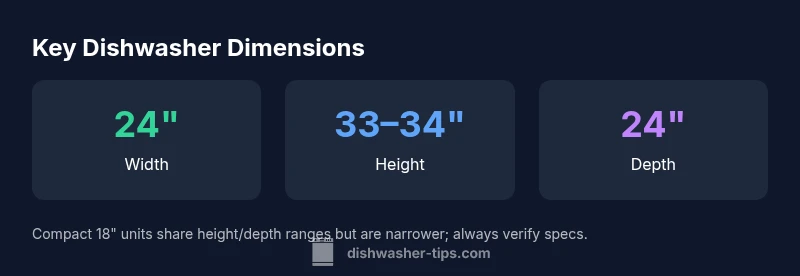
Dishwashers come in several core sizes. The standard full-size width is about 24 inches, with a height around 33-34 inches and depth near 24 inches. Compact models are typically 18 inches wide, with similar height and slightly different depths. Always verify the exact dimensions from the model's spec sheet and account for door clearance, cabinetry, and ventilation.
Understanding Standard Dimensions
When you ask what are the dimensions of a dishwasher, you’re typically dealing with three measurements: width, height, and depth. The most common full-size model is 24 inches wide, about 33–34 inches tall, and around 24 inches deep. These dimensions align with standard U.S. base cabinetry and countertop heights, which helps create a seamless kitchen look. Many manufacturers provide a precise spec sheet for each model, but the general rule of thumb remains: plan for a 24"-wide opening and a rough opening height that accommodates 33–34" of vertical space. If your kitchen uses a different cabinet layout, allow extra clearance for doors and handle protrusions. For homeowners exploring the question, what are the dimensions of a dishwasher, remember that dimension ranges exist due to toe-kick adjustments, adjustable feet, and panel-ready fronts. According to Dishwasher Tips, anticipating these variances ahead of time can prevent install delays.
Compact vs Full-Size: What Fits Your Kitchen?
The 18-inch compact dishwasher is the next most common size, used in smaller kitchens, apartments, or spaces with limited width. While the width is narrower, most compact models retain a similar height to standard units—typically around 32–34 inches—and depth near 24 inches. This makes them a good fit for shallower cabinets or kitchens with restricted floor space. In terms of capacity, compact models usually handle roughly 6 place settings, while standard 24-inch units often accommodate 8–10 settings. If your goal is to maximize utensil and plate capacity, a 24-inch model is usually the better bet, provided you have the space.
How to Measure Your Space for a Dishwasher
Before buying, measure three critical dimensions: the width of the opening, the height from floor to the bottom of the countertop, and the depth from the front of the cabinet to the back wall. Don’t rely on rough estimates; use a tape measure and note the minimum and maximum clearance values. Check for obstructions such as pipes, electrical cables, or plumbing vents that could reduce usable space. Some kitchens require a toe-kick modification or a slight cabinet inset to ensure the door clears the countertop when opened. Record the opening height at multiple points (left, center, right) to catch any uneven floor. The goal is to confirm that the chosen model’s dimensions fit within your measured space plus required clearances, and that the door can swing fully without hitting nearby cabinets.
Real-World Installation Variations and How They Matter
Even within standard widths or heights, installation can vary. Some dishwashers offer adjustable legs and anti-tip features to fine-tune height by half an inch or more. Panel-ready fronts can add depth when you account for flush mounting; if you plan a fully seamless look, calculate the panel thickness and door overlay. If your kitchen has custom cabinetry, you may encounter deeper or shallower openings than the typical 24" footprint. In this case, confirm the model’s specified depth and whether adjustable rear spacers or toe-kick height changes are available. Finally, consider ducting and ventilation clearance around the unit; improper ventilation can affect performance and longevity.
Choosing Based on Space: Practical Scenarios
In a narrow galley kitchen, an 18" compact model may be the only feasible option. If you have an open-concept kitchen with higher countertops, a standard 24" unit generally integrates better with the counter line and cabinet height. For kitchens upgrading to energy-efficient appliances, dimensions matter alongside energy ratings and water usage; a slightly taller unit may still fit if you have extra ceiling clearance. When in doubt, consult the product’s official spec sheet, compare it to your measured opening, and choose a model that leaves at least 1/2 inch to 3/4 inch clearance on both sides. This precaution reduces door binding and ensures even gap alignment with cabinetry.
Dimension comparison by model type
| Model Type | Width | Height | Depth | Notes |
|---|---|---|---|---|
| Compact 18-inch | 18 inches | 32–34 inches | 24 inches | Suitable for small kitchens; capacity ~6 place settings |
| Standard 24-inch | 24 inches | 33–34 inches | 24 inches | Most common size; fits standard cabinetry |
| Tall-tube/adjustable | 24 inches | 34–35 inches | 24 inches | Higher clearance for tall items or custom panels |
| Freestanding panel-ready | 24 inches | 33–34 inches | 24 inches | Can be integrated with cabinetry for seamless look |
People Also Ask
What is the standard width of a dishwasher?
The standard width is typically 24 inches for full-size models. Compact 18-inch models are available for small kitchens. Always confirm the exact width in the model’s spec sheet to ensure it matches your opening.
Most dishwashers are 24 inches wide, with 18 inches for compact models. Check the model specs to be sure.
Can I replace a 24-inch dishwasher with an 18-inch model in the same opening?
Swapping a 24-inch unit for an 18-inch model usually requires cabinet adjustments because the opening is narrower. If space must be retained, you may need to modify the cabinetry or choose a compact unit that still fits.
Swapping from 24 to 18 inches often needs cabinet changes or a different model that fits the opening.
Are there height-adjustable dishwashers?
Many dishwashers have adjustable feet or toe-kick spacers to tune height by about half an inch or more. This helps align the unit with countertop height and ensures a balanced door gap.
Yes, most offer adjustable feet to fine-tune height.
Do flush-mounted or panel-ready dishwashers affect dimensions?
Panel-ready and flush-mounted fronts can add depth. Be sure to account for panel thickness and overlay so the door clears surrounding cabinetry when opened.
Panel-ready fronts may change the overall depth; plan for extra depth if using panels.
What should I measure to ensure fit?
Measure the cabinet opening width, the height clearance under the countertop, and the depth from front to back including toe-kick space. Record any obstructions and verify there’s room for the door swing.
Measure width, height, and depth; check for obstructions and door swing.
Do installation dimensions affect warranty?
Installation guidelines are typically covered by the manufacturer’s warranty, as long as you follow the provided specs. Modifications or improper fit that violate guidelines can affect warranty claims.
Warranty is usually fine if you follow the manual; avoid improper modifications.
“Dimensions are the first checkpoint you should perform before selecting a dishwasher. A precise fit saves installation time and prevents costly cabinet modifications.”
What to Remember
- Measure before you buy to avoid fit issues
- Know standard sizes: 18" compact vs 24" full-size
- Account for door clearance and cabinet panels
- Check depth and toe-kick clearance for adjustments
- Verify model specs from the official sheet