Integrated vs Freestanding Dishwashers: A Practical Comparison
Compare integrated and freestanding dishwashers on installation, aesthetics, performance, and cost. Learn which option fits your kitchen and budget with expert insights from Dishwasher Tips.


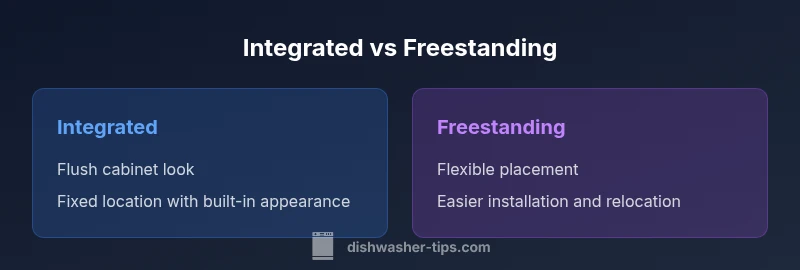
Integrated dishwashers are designed to be installed flush with cabinetry for a seamless kitchen look, while freestanding models sit freely with visible sides for flexible placement. According to Dishwasher Tips, the choice primarily affects aesthetics, installation complexity, and resale value more than cleaning performance. Both types clean comparably when properly sized and loaded, so pick based on cabinetry integration and future flexibility.
What is an integrated dishwasher vs freestanding?
Integrated dishwashers are designed to be installed flush with surrounding cabinetry, hiding the appliance behind a cabinet panel. Freestanding dishwashers have finished sides and can stand alone in any compatible space. This article explores how these two types compare in installation, aesthetics, and ongoing use. According to Dishwasher Tips, the key differences are mostly about design and placement rather than dishwashing performance. The KPI that often guides buyers is how well the unit fits the kitchen footprint and how easily it can be upgraded in the future. We'll work through practical criteria so you can decide which type best suits your home and budget.
Installation implications and space planning
Choosing between an integrated and a freestanding dishwasher has immediate consequences for how your kitchen is laid out. Integrated units require an undersink cabinet opening of a standard width and space for plumbing, electrical, and drainage within the cabinet cavity. In practice, this may mean modifying cabinetry or adding filler panels to achieve a flush, seamless look. Freestanding units can usually slip into existing spaces with less cabinetry work, but you still need to account for counter height, toe-kick clearance, and access to water and waste lines. For renters or temporary setups, freestanding is often the more flexible option, while homeowners pursuing a polished, built-in aesthetic may opt for integrated models. Professional installation is frequently advisable for integrated models to ensure proper alignment, seal integrity, and warranty coverage. The following checklist will help you confirm feasibility before purchasing.
Performance and efficiency considerations
Performance is primarily a function of capacity, cycle options, and loading discipline rather than the appliance type. Integrated and freestanding models with comparable capacities tend to deliver similar cleaning results when they are properly sized and loaded. However, some built-in designs emphasize solid door sealing and tighter cabinet integration, which can affect perceived noise and vibration if not installed correctly. The door panel on an integrated unit must align with cabinet gaps to avoid rattling and misalignment, while freestanding models rely on their own frame and toe-kick for stability. In real-world use, user habits—how you arrange dishes, what detergents you use, and how you load bowls—often explain more variation in results than whether the machine is integrated or freestanding. Dishwasher Tips analysis shows that core wash performance remains largely equivalent across versions when installation and loading are optimized.
Aesthetics, cabinetry, and resale value
Aesthetics play a central role in the integrated vs freestanding decision. Integrated models disappear behind cabinet panels, creating a flush, monochrome kitchen that many buyers associate with higher-end, cohesive design. This can translate to stronger resale value and fewer visual distractions at a glance. Freestanding units, by contrast, offer immediate impact with less cabinet modification—ideal for renters or for kitchens where a quick remodel is prioritized. While performance is important, most buyers weigh the look and feel of the kitchen heavily when evaluating newer appliances. The Dishwasher Tips team notes that the value proposition of integration lies in the long-term kitchen narrative rather than short-term cost savings.
Costs, warranties, and maintenance considerations
Upfront cost and installation effort are common differentiators. Integrated dishwashers typically command higher installation costs due to cabinetry work, paneling, and potential cabinet modifications. Freestanding units tend to be cheaper to purchase and install because they fit into existing spaces with minimal cabinetry changes. Maintenance considerations also differ: integrated units may require panel-removal or panel alignment for service, while freestanding units usually allow easier access for routine maintenance without removing cabinetry. Warranty terms can reflect the installed nature of integrated units, so read the fine print and ensure the installer records the configuration. Dishwasher Tips emphasizes evaluating total ownership costs, including installation, potential cabinetry updates, and future resale value when weighing options.
Size standards, accessibility, and kitchen configurations
Most built-in or integrated models fit under-counter openings that are 24 inches wide, with height and depth conforming to standard kitchen cabinetry. Freestanding dishwashers offer more placement flexibility, which can be valuable in non-traditional layouts or small spaces where cabinetry is irregular. If you’re working in a compact kitchen, measure the available width, height, and depth, and check the alignment with the sink and garbage disposal. Accessibility considerations—like door swing clearance and reach to controls—differ slightly between styles; integrated panels push controls toward the inside of the cabinet, while freestanding units typically expose the control panel more prominently. Understanding your space constraints will help you avoid costly redesigns or awkward fits during installation.
Use-case scenarios: renters, homeowners, and remodels
For renters and short-term dwellings, freestanding units offer the most practical flexibility: easier replacement, relocation, and less risk of altering the existing cabinetry. Homeowners planning a kitchen remodel or a full integration project may prefer an integrated unit to achieve a seamless look and potentially improve long-term resale value. In new construction or major remodels, an integrated approach can be easier to coordinate with plumbing and electrical rough-ins, while existing homes with tight budgets and limited wall space may benefit from the modular convenience of a freestanding model. The decision should factor in how long you expect to stay in the space, your remodeling appetite, and your tolerance for cabinet modification.
How to measure space and plan installation: a practical checklist
Before buying, gather measurements for the width, height, and depth of the available opening, as well as the distance to water supply and drainage connections. Create a mock footprint on the floor to visualize clearance for door swing and toe-kick. If you’re leaning toward an integrated unit, confirm that your cabinet structure can support panel mounting and that there is an accessible route for service work. For freestanding models, verify that there is a clean path for delivery and installation, plus a stable, level floor. Finally, consider future remodeling plans; if changes are likely, a freestanding option may preserve flexibility while an integrated option locks in a particular footprint.
Common pitfalls and a quick-start checklist
Common mistakes include mismeasuring the opening, underestimating the need for professional paneling, and assuming identical performance across brands and models. A practical quick-start checklist includes: verify opening width, confirm panel compatibility, check plumbing and electrical clearances, verify available height for door clearance, and plan for service access. The Dishwasher Tips approach recommends involving a licensed installer for integrated configurations to minimize warranty challenges and ensure a proper seal against leaks. A careful, documented measurement and installation plan can save time and prevent costly retrofits later on.
Comparison
| Feature | Integrated dishwasher | Freestanding dishwasher |
|---|---|---|
| Installation philosophy | Built-in, cabinet-flush with paneling | Can stand alone with finished sides and feet |
| Aesthetics | Seamless, integrated look | Visible sides; flexible styling |
| Placement flexibility | Fixed under-counter or cabinet-aligned | Easily movable within hard-wired space constraints |
| Replacement complexity | Potentially more complex; may require paneling | Easier to swap or relocate with less cabinetry work |
| Maintenance access | Panel access may require panel removal | Front-panel access; usually easier service |
| Cost considerations | Higher upfront cost due to installation/panels | Lower upfront cost; simpler installation |
| Resale impact | Often valued for a modern, cohesive kitchen | Value depends on overall kitchen design; less integrated |
The Good
- Creates a cohesive, built-in kitchen aesthetic and potential resale boost
- Hides dishwasher hardware behind cabinetry, reducing visual clutter
- Often integrates more cleanly with custom countertops and islands
- Provides long-term stability for fixed kitchen layouts
Disadvantages
- Higher upfront installation cost and potential cabinetry modifications
- Less flexibility if you want to rearrange or move the appliance
- Replacement can be more complex if the footprint or cabinet needs updating
Integrated dishwashers are best for a permanent, polished kitchen look; freestanding units win on flexibility and cost for renters or frequent remodels
If you want a seamless, built-in appearance and you’re committing to the cabinet layout, an integrated unit is usually worth the investment. If you prioritize adaptability, lower upfront costs, and easier relocation, a freestanding model is typically the smarter choice.
People Also Ask
What is the difference between integrated and freestanding dishwashers?
Integrated dishwashers blend with cabinetry and are panel-ready for a seamless look, while freestanding units have finished sides and can be placed anywhere within plumbing constraints. Both styles typically wash dishes with similar effectiveness when properly sized and loaded.
Integrated units hide behind cabinet panels; freestanding ones stay visible and movable. Both clean well when correctly installed.
Are integrated dishwashers worth the extra cost?
That depends on your priorities. If you value a seamless kitchen design and potential resale value, the extra cost may be justified. If flexibility and lower upfront costs matter more, a freestanding model could be the better choice.
Worth it if you want a built-in look and long-term value; otherwise, a freestanding unit saves money now.
Can I convert a freestanding dishwasher to integrated later?
Converting a freestanding unit to integrated typically requires cabinetry work and may not be feasible with all models. It’s usually better to choose the installation type upfront based on your kitchen design and future plans.
Conversion is rarely simple; plan ahead to avoid costly retrofits.
Do integrated and freestanding dishwashers differ in cleaning performance?
In standard conditions, cleaning performance is similar if the units have equivalent capacity and features. Differences usually stem from load method, water pressure, and detergent usage rather than the installation type.
No big difference in cleaning—focus on capacity and features instead.
What should I measure before buying?
Measure the width of the opening (usually around 24 inches), height clearance, and depth. Check plumbing and electrical clearances, door swing, and toe-kick space to avoid installation problems.
Measure width, height, depth, and pipes; plan for service access.
What is the typical size for built-in vs freestanding dishwashers?
Most built-in or integrated units fit a standard 24-inch-wide opening, with height and depth following cabinet standards. Freestanding units come in similar overall sizes but offer more placement flexibility.
Most built-in units are about 24 inches wide; always verify your space before buying.
What to Remember
- Choose integrated for a seamless kitchen and potential resale value
- Choose freestanding for budget flexibility and easy installation
- Measure the opening carefully and involve a professional for integrated installs
- Consider your long-term plans—remodels favor integrated, rentals favor freestanding