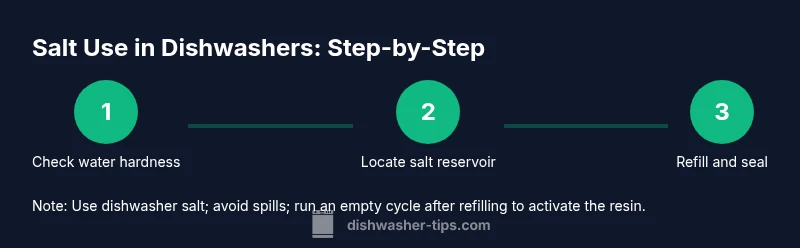
When to Use Dishwasher Salt: A Practical Guide
Learn when to use dishwasher salt, why it matters in hard water, and how to refill the reservoir safely. A comprehensive, expert guide from Dishwasher Tips to keep dishes clean and appliances running smoothly.


This guide shows when to use dishwasher salt, why it's essential for mineral-softening in hard-water homes, and how to refill the reservoir correctly. You’ll learn the telltale signs that salt is needed, step-by-step filling instructions, common mistakes to avoid, and maintenance tips to prevent limescale and cloudy dishes in different program modes.
What dishwasher salt is and how it works
Dishwasher salt is not added to the wash cycle itself. Instead, it feeds the dishwasher's built-in water softener, a small resin bed inside the machine that exchanges minerals in the water for sodium ions. In hard-water areas, minerals like calcium and magnesium can leave behind spots, white film, and scale on glassware and the interior of the dishwasher. When you add dishwasher salt, you’re regenerating that resin so it can continue to soften incoming water. Most models require salt only if you live in a hard-water region or if your appliance’s indicator shows low salt. In areas with naturally soft water, you may not need to use salt regularly; always check your user manual. By understanding this mechanism, you’ll see why salt is a maintenance task, not a detergent substitute, and how it complements rinse aid and detergent to improve overall performance.
- Core idea: salt supports the resin’s regeneration, which keeps water soft and parts free from mineral buildup.
- Common misconception: salt changes the actual wash water directly. In reality, it powers the resin that softens water before it reaches the wash chamber.
- Practical note: your dishwasher may have different indicators or reservoir locations based on model, so consult the manual for precise instructions.
note
Tools & Materials
- Dishwasher salt(Specially designed for dishwashers; avoid table salt.)
- Funnel or salt pour lid(Helpful to pour salt into the reservoir without spilling.)
- Soft cloth or towel(Wipe spills to prevent corrosion on seals and surrounding surfaces.)
- Gloves (optional)(Keep hands clean and prevent salt from irritating skin.)
- Owner’s manual or model-specific guide(Check reservoir location and salt type for your unit.)
Steps
Estimated time: 10-15 minutes
- 1
Locate the salt reservoir
Open the dishwasher door and remove the bottom rack if needed. Locate the salt reservoir, which is usually a small container with a screw cap near the bottom of the interior or behind a panel in the door. Consult your manual if you aren’t sure where it is.
Tip: If you can’t locate it, search the model name in the manual’s maintenance section or check the manufacturer’s website. - 2
Open the cap and inspect
Turn the cap counterclockwise to remove it. Check for cracks, residue, or a buildup of old salt. A clean opening makes pouring easier and reduces spills.
Tip: If you see pooled water in the reservoir, it means it’s already reached capacity; do not add more salt until you drain or refill per the manual. - 3
Pour dishwasher salt
Place a funnel at the opening and slowly pour dishwasher salt into the reservoir until the level indicator shows full or until you stop seeing a clear flow of salt from the opening. Do not overfill.
Tip: Pour slowly to avoid splashing and keep spills off the door and floor. - 4
Tighten the cap and wipe spills
Replace and tighten the cap firmly. Wipe away any spilled salt from the outer area and door to prevent corrosion or damage to the door seal.
Tip: A snug cap prevents leaks during cycles and preserves a clean work area. - 5
Run a test cycle
Run a short, empty cycle or a normal wash to flush the resin and activate the softening process. This helps ensure the resin is regenerating properly after refilling.
Tip: Check for any unusual noises or salt residue and stop the cycle if you see a leak. - 6
Check the reservoir level again
After the cycle completes, recheck the reservoir level. If you notice it’s very low, plan for an earlier refill next time based on your water hardness and model guidance.
Tip: Keep track of refill frequency to prevent mineral buildup before it starts.
People Also Ask
What is dishwasher salt used for?
Dishwasher salt is used to soften hard water by regenerating the resin in the dishwasher's built-in water-softening system. This reduces mineral deposits on dishes and inside the appliance. Use salt as directed by your model's manual.
Dishwasher salt softens hard water by refreshing the softener inside your machine, helping you avoid spots and buildup.
When should I refill the salt reservoir?
Refill when the reservoir indicator shows low or empty, or after you begin to notice mineral buildup on dishes. In areas with harder water, you may need to refill more often.
Check the salt indicator and refill when it's low to keep the softener working.
Can I use table salt in my dishwasher?
No. Table salt contains additives that can clog the resin and cause corrosion. Use only dishwasher salt recommended by the manufacturer.
Avoid table salt—use dishwasher salt meant for your appliance.
What happens if I don’t use salt in a hard-water area?
Without salt, the resin cannot recharge effectively, leading to more mineral buildup, reduced cleaning performance, and potential scale inside the machine.
Without salt, you’ll see more spots and scale over time.
Is salt the same as rinse aid?
No. Salt softens water; rinse aid helps drying and reduces water spots. They serve different roles, and many models require both for best results.
Salt and rinse aid do different jobs—salt softens water, rinse aid helps drying.
How can I tell if my dishwasher needs salt?
Look for a salt level indicator on your display or refer to the reservoir guide in your manual. If there’s no indicator, watch for mineral buildup or poorer cleaning performance.
Check the indicator or watch for spots and scale as a sign you need to refill.
Watch Video
What to Remember
- Check water hardness and model guidance.
- Refill with dishwasher salt only when needed.
- Wipe spills promptly to prevent corrosion.
- Run a test cycle after refilling to activate the resin.
- Monitor salt indicators or mineral buildup for maintenance.