No Power in Your Dishwasher: Quick Troubleshooting Guide
Diagnose and fix a dishwasher with no power quickly and safely, from outlet checks to door latch fixes, and learn when professional help is needed to protect your appliance.


When your dishwasher has no power, start with the basics: check the outlet and circuit breaker, ensure the door latch is fully engaged, and reset the dishwasher if possible. The most common causes are a tripped breaker, blown fuse, or a faulty door switch. If lights or displays still fail to power on after these checks, proceed with deeper diagnostics.
Immediate Safety and Quick Power Check
Safety first: before you touch any wires or panels, unplug the dishwasher or switch off the circuit at the breaker. If you sense any burning smell or sparking, do not continue and call a licensed electrician. A dishwasher that seems dead is usually a simple electrical issue rather than a failed pump. When you begin troubleshooting, start with the easiest checks and move to more involved steps only as needed. If your model has a visible display, note any error codes, which can guide your next actions. The keyword for this guide is dishwasher has no power, and you’ll see many of the same checks across brands. First, confirm there is power entering the unit by testing the outlet with a lamp or phone charger. If the outlet is dead, you’ll need to reset the circuit or replace a faulty outlet. If power is present but the dishwasher remains dark, the problem is likely internal or related to the door switch. Keep a log of each test to avoid repeating steps.
Common Causes of No Power in a Dishwasher
Dishwashers that won’t power on usually point to one of a few root causes. Common culprits include a tripped circuit breaker or blown fuse, a dead outlet or GFCI, and a faulty door latch switch that prevents the unit from powering on for safety. Less common but possible are control board power supply faults or a damaged power cord. By understanding these possibilities, you can triage quickly without risking your safety or appliance. Always start with the simplest checks and document every test to prevent backtracking later.
How to Test the Power Supply Safely
Begin with the simplest test: determine whether power is reaching the dishwasher. Use a known-good device (like a lamp or phone charger) in the same outlet to confirm it has power. If the outlet is dead, reset the circuit breaker and inspect the fuse. If the outlet works, unplug the dishwasher and inspect its power cord for visible damage. Next, ensure the door is fully closed, as many models won’t power on if the latch isn’t engaged for safety. If you see an error code on the control panel after a reset, consult the user manual for that code.
Step-by-Step Fixes for the Most Likely Cause
If the outlet and circuit are fine but the dishwasher still has no power, the most likely causes are a tripped breaker or a faulty door switch. Step 1: Switch off the dishwasher at its power cord, then switch off the circuit breaker and wait 60 seconds before turning it back on. Step 2: Plug the dishwasher back in and test the power. Step 3: If light or displays still don’t come on, inspect the door latch for sticking or damage and replace if needed. Step 4: If you are comfortable, test the door switch with a multimeter to confirm continuity. Step 5: Reconnect and run a quick diagnostic cycle to verify power is restored. Tip: label your breaker so future trips are easier to locate.
Specific Checks: Door Latch and Control Board
A door latch that doesn’t fully engage can prevent power from reaching the internal electronics for safety. Inspect the latch for wear, cracks, or misalignment, and replace if necessary. If the latch seems fine, the issue might be the switch itself or the control board power supply. In these cases, testing with a multimeter or consulting the service manual for your model is advisable. Do not force the latch or bypass safety switches, as this can cause electrical hazards or further damage.
When to Call a Pro and What to Expect
If basic checks fail to restore power, or you discover damaged wiring, a loose connection in the terminal block, or a suspected control-board fault, it’s time to call a professional. A licensed technician will verify the power supply, check internal harnesses, and test the control board under load. Expect an initial diagnostic visit, followed by a repair plan and an itemized estimate. Always obtain a written estimate before costly replacements.
Prevention: How to Avoid Future Power Issues
To minimize future power problems, ensure the dishwasher’s plug or cord is undamaged and fits snugly in the outlet. Use a dedicated circuit for your dishwasher to prevent tripping caused by other appliances. Regularly inspect the power cord for wear and avoid water exposure at the plug or receptacle. Keep the area around the outlet dry and free of clutter to reduce contact risk. Finally, schedule periodic professional checkups if your model is older or shows intermittent power behavior.
Final Tips: Quick Reference Card
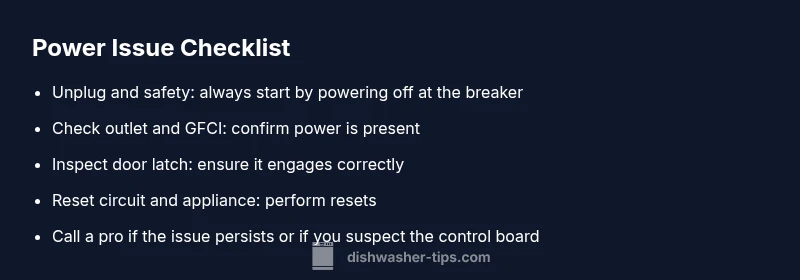
Keep a simple reference handy: 1) Check outlet power, 2) Reset breaker, 3) Inspect door latch, 4) Test with a known-good device, 5) Call a pro if issues persist. These steps cover the majority of no-power scenarios and help you avoid unsafe DIY fixes. Remember, if you smell burning, see sparks, or notice damaged wiring, stop and contact a licensed electrician immediately.
Steps
Estimated time: 60-90 minutes
- 1
Ensure safety and unplug
Begin by switching off the dishwasher at the outlet and, if possible, the circuit breaker. Wait for a moment to discharge any residual power. This prevents shocks and protects you while inspecting components.
Tip: Never touch wires with wet hands; use dry hands and insulated tools if needed. - 2
Check the power source
Test the outlet with a lamp or charger to confirm it has power. If the outlet is dead, reset the circuit breaker and check for a blown fuse. If the outlet works, move to the dishwasher’s plug and cord inspection.
Tip: If you use a tester, verify readings on both the hot and neutral pins. - 3
Inspect the door latch
Make sure the door latch fully engages when closed. A misaligned or damaged latch can prevent power from routing to the control board as a safety precaution.
Tip: Gently operate the latch by hand to feel for sticking or looseness. - 4
Test the control path
If you have the know-how, use a multimeter to check continuity on door switch and supply lines. Look for obvious damage, frayed wires, or loose connectors.
Tip: Only perform electrical tests if you’re comfortable; otherwise skip to professional help. - 5
Reconnect and re-test
Plug the unit back in, or restore power at the breaker, and run a quick diagnostic cycle to confirm power restoration.
Tip: If the control panel still stays dark, you likely have an internal fault needing service. - 6
Document and plan next steps
Record test results and any codes shown on the display. Use this log to communicate clearly with a technician if you need to call for service.
Tip: A clear history speeds up diagnosis and reduces duplicate testing.
Diagnosis: Dishwasher has no power
Possible Causes
- highPower supply issue (blown fuse or tripped breaker)
- highOutlet or GFCI not providing power
- mediumDoor latch switch failure
- lowControl board power supply fault
Fixes
- easyReset a tripped circuit breaker and replace any blown fuse
- easyTest the outlet with a known-good device to confirm power
- easyInspect the door latch and replace if damaged
- hardConsult a technician for control board issues
People Also Ask
What is the first thing I should check when my dishwasher has no power?
The first step is safety, then verify the outlet has power and that the circuit breaker hasn’t tripped. If the outlet is live but the dishwasher stays dark, inspect the door latch and power cord for issues.
First, ensure safety and check the outlet and circuit breaker. If power is present but the dishwasher won’t start, inspect the door latch and power cord.
Can a faulty door latch stop power from reaching the dishwasher’s electronics?
Yes. A faulty or misaligned door latch can trigger a safety shutoff that prevents the unit from powering on. Inspect and replace if necessary.
A bad door latch can stop power from reaching the control board; inspect and replace if needed.
Is it safe to reset the circuit breaker myself?
Yes, but only after you unplug the dishwasher and ensure hands are dry. Switch the breaker off, wait briefly, then switch it back on and test.
Yes, but make sure you’re dry and safe before resetting the breaker.
What should I do if the outlet is fine but the dishwasher still won’t power on?
This suggests an internal fault such as the control board or internal wiring. A professional diagnosis is recommended.
If the outlet is fine but the dishwasher won’t power, you likely have an internal fault and should call a pro.
When is replacing the control board warranted?
If tests show no power reaching the controls and a component fault is suspected, a control board replacement may be necessary.
If tests point to a faulty control board, replacement may be needed.
Can power surges cause a dishwasher to lose power completely?
Yes, power surges can damage upstream components. Inspect wiring and consider a surge protector or service check if recurring.
Power surges can harm the control system; have wiring checked if this happens often.
Watch Video
What to Remember
- Start with safety and the simplest checks
- Power loss is usually a breaker, fuse, or door switch issue
- Progress to door latch and control board checks if basics pass
- Call a pro for internal wiring or board faults
- Maintain the outlet and cord to prevent future problems