Do You Put Dishwasher Pod in Prewash? A Practical Guide
Learn whether you should put dishwasher pods in the prewash, how pods dissolve, and best practices for reliable cleaning. A practical guide from Dishwasher Tips for homeowners and renters.


You generally put dishwasher pods in the main wash compartment, not in prewash. The prewash stage is for loosening soils and rinsing lightly soiled dishes, while the main wash uses hotter water and longer agitation to dissolve and distribute the detergent. Always check your dishwasher’s manual; some models allow limited pod usage in prewash, but this is uncommon.
Do you put dishwasher pod in prewash? Understanding the basics
If you're asking the question do you put dishwasher pod in prewash, the simple answer is: usually not. Prewash is designed to loosen stuck-on residue and rinse dishes lightly before the main wash. Pods are formulated to release their detergent during the main wash when water is hottest and agitation is strongest. According to Dishwasher Tips, most modern dishwashers release detergent in the primary wash stage rather than the prewash. There are exceptions on some models where manufacturers allow limited pod usage in prewash or provide a special prewash option; always refer to your model's user guide for model-specific guidance.
How dishwasher pods work: dissolution, timing, and heat
Dishwasher pods are multi-stage detergent packets designed to dissolve as water heats and circulates. They combine a precoated detergent layer with colorants and enzymes that break down food particles. In typical operation, the pod begins to dissolve soon after the main wash starts, aided by water temperature and machine agitation. The timing ensures the detergent is present throughout the cycle, not just during prewash. If your water is very cold or your cycle is unusually short, dissolution may be incomplete, which can affect cleaning. For best results, use pods that are designed for automatic dishwashers and follow the manufacturer’s directions.
Detergent dispenser design and where pods go
Most dishwashers have a two-compartment or single-compartment detergent dispenser. Pods are designed to be placed in the main wash compartment where they will be released when the cycle commences. The prewash compartment is meant for initial rinsing or pre-wetting; placing a pod in the prewash area can prevent full dissolution and reduce cleaning effectiveness. Always ensure the dispenser is clean and free of splash residue before loading a pod. If your model has a dedicated prewash option, consult the manual to determine if it supports any pod usage during that phase.
Prewash vs main wash: what each stage does
The prewash stage is focused on loosening heavy soils and rinsing away loose debris, especially on heavily soiled items. The main wash uses hotter water, longer agitation, and extended contact time to dissolve detergents and lift remaining soils from dishes. Pods are designed to function optimally during the main wash; relying on the prewash alone can leave residues on dishes. If your foods or containers require more aggressive cleaning, consider adjusting cycle selection rather than trying to force a pod into prewash.
Pods, water temperature, and cycle selection
Detergent pods perform best in warm to hot water with a sufficiently long cycle. Cold or very short cycles can hinder dissolution and reduce cleaning effectiveness. For mixed loads, choose a standard or heavy-duty cycle with a hot water setting, and avoid adding extra prewash steps if you are using a pod. Some models offer a pre-rinse phase; in these cases, you may skip extra detergent in the prewash, relying on the main wash with the pod. Always match your cycle to the soil level and load type.
Hard water and mineral buildup: how to adapt
In hard water areas, minerals can interfere with detergent performance and cause filming on glassware. If you notice residues, consider using a rinse aid and a warmer cycle when possible. You may also opt for a higher-quality pod designed for hard water or run a dishwasher cleaning cycle periodically to remove mineral buildup. Dishwasher Tips suggests that in such conditions, selecting a longer main wash cycle with hot water provides better dissolution and rinsing.
Using pods with alternative prewash strategies (powder/liquid) and when it's beneficial
If your dishwasher's design or soils require more aggressive cleaning, you might experiment with powder or liquid detergents in the prewash, but only if your manual allows it. Pods are convenient and generally effective, but not every model supports their use in prewash. In cases where prewash is essential due to heavy soils, consider manually pre-rinsing or using a compatible prewash detergent variant as recommended by the manufacturer. Always avoid mixing pod types across cycles unless the manual clearly permits it.
Safety, storage, and handling of dishwasher pods
Store dishwasher pods in a secure cabinet away from children and pets. Pods can be a choking hazard and should never be placed where children can reach them. Keep the container sealed to preserve potency, and avoid transferring pods to other containers, which can create confusion and accidents. If a pod is crushed, wipe up any residue promptly and ensure the dispenser remains clean to prevent clogging.
Common mistakes that waste detergent and how to fix
Common mistakes include placing pods in the wrong compartment, loading heavily so items block the dispenser, or selecting cycles that run too briefly for proper dissolution. Such issues can leave residues or fail to clean thoroughly. To fix, verify dispenser alignment, reduce blockages by repositioning items, and select a cycle appropriate for soil level. For persistent problems, try a different pod formulation or consult the model’s troubleshooting guide.
Reading your user manual and model-specific quirks
Every dishwasher model may have unique guidance on pod use, dispenser design, and cycle options. Reading the manual helps you understand whether a pod can be used in prewash, where to place it, and which cycles maximize cleaning performance. If you don't have the manual, check the manufacturer's website for an online version or contact customer support. Adhering to model-specific instructions reduces waste and improves results.
Quick-start checklist and practical tips for daily use
Start with a clean understanding of your model’s detergent dispensing guidelines. Use pods designed for automatic dishwashers, ensure proper loading to avoid blocking the dispenser, and select cycles that emphasize a robust main wash. Keep rinse aid handy for better drying and stain prevention, and store pods safely away from children. With these practices, you’ll consistently achieve clean, dry dishes with minimal effort.
Tools & Materials
- Dishwasher pod (single-use)(Choose a pod compatible with your dishwasher’s load (standard 12-14 oz size depending on model))
- Main wash detergent compartment(Ensure the compartment is clean and dry before loading the pod)
- Rinse aid (optional)(Helps with drying and spotting; not a substitute for detergent)
- Owner's manual / dishwasher guide(Check for model-specific pods or prewash guidance)
Steps
Estimated time: 60-90 minutes
- 1
Read your dishwasher manual
Locate the detergent dispenser and confirm whether your model supports a pod in the main wash and where to place it. Review any notes about prewash or special cycles. This step reduces guesswork and prevents misloading.
Tip: Always start with the manufacturer’s guidance for your exact model. - 2
Prepare your dishes for a full load
Scrape off solid food, rinse lightly if necessary, and arrange items to maximize water flow. Avoid overcrowding and ensure tall items do not block the spray arms.
Tip: Heavy soils benefit from a normal or heavy cycle rather than extra prewash. - 3
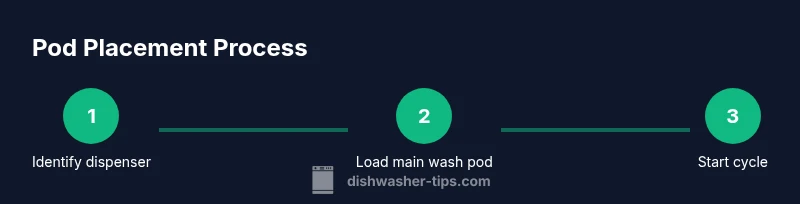
Place the pod in the main wash detergent compartment
Open the dispenser, place the pod in the main wash chamber, and close the flap securely. Do not place the pod in the prewash cavity unless the manual explicitly allows it.
Tip: Make sure the pod isn’t blocked by a utensil rack or tall glass; proper seating improves dissolution. - 4
Load the rack and select the appropriate cycle
Position dishes so water can reach all surfaces. Choose a cycle that matches soil level and water temperature, prioritizing a hot main wash for better detergent performance.
Tip: Avoid extra prewash options when using a pod; rely on the main wash for cleaning power. - 5
Start the cycle and monitor
Close the door securely and start the selected cycle. Pods are designed to release detergent during the wash; ensure the cycle runs to completion without interruptions.
Tip: If the cycle seems shorter than usual, verify that the detergent dispenser opened correctly. - 6
Inspect results and adjust if needed
After the cycle, check dishes for cleanliness. If soils remain, try a longer main wash, hotter water, or a different pod formulation next time.
Tip: Consider a rinse aid if drying or spotting is an issue. - 7
Finish with maintenance and safety steps
Remove empty pods and wipe the dispenser area. Clean any residue from the door seal and run a maintenance cycle periodically to prevent buildup.
Tip: Store pods out of reach of children and pets to prevent accidents.
People Also Ask
Should I put a dishwasher pod in prewash?
In most cases, pods should not be used in prewash. The prewash stage is for loosening soils, while the main wash handles dissolution and cleaning. Always follow your manual for model-specific guidance.
Typically, pods belong in the main wash. Prewash is only for pre-rinsing; check your model’s manual for any special cases.
Where should I place the pod in the dispenser?
Place the pod in the main wash detergent compartment, not in the prewash cavity. Ensure it sits fully and isn’t blocked by items.
Put the pod in the main wash compartment and keep the area clear so it can dissolve properly.
Can I use pods for heavy soils?
Pods work for many soils, especially when paired with the correct cycle. For very heavy soils, choose a heavy-duty cycle and ensure water is hot enough for optimal dissolution.
Yes, but pair with the right cycle and hot water to maximize cleaning power.
Do dishwasher pods work in cold water?
Most pods dissolve best in warm to hot water. Cold cycles may leave residues or reduce effectiveness, so use warmer settings where possible.
They’re designed for warm water; cold cycles can hinder dissolution.
What should I do if dishes still come out dirty?
Check cycle length and water temperature, verify proper loading, and consider a different pod formulation or a longer cycle for stubborn soils.
If dishes aren’t clean, adjust the cycle and loading, then try a different detergent pod next time.
Are dishwasher pods safe for kids?
Pod packets can be a choking hazard. Store pods securely and keep them out of children’s reach. Follow container safety guidelines on the label.
Yes, but keep pods out of reach and stored safely.
Watch Video
What to Remember
- Pod placement is main-wash focused
- Follow model instructions for your exact dishwasher
- Pods dissolve best in warm/hot main wash cycles
- Use rinse aid for better drying and fewer spots