F14 Miele Dishwasher Troubleshooting: Quick Fix Guide
Urgent guide to diagnose and fix the F14 error on your Miele dishwasher. Learn safe resets, diagnostic steps, cost ranges, and when to call a professional for reliable, appliance-safe troubleshooting in 2026.


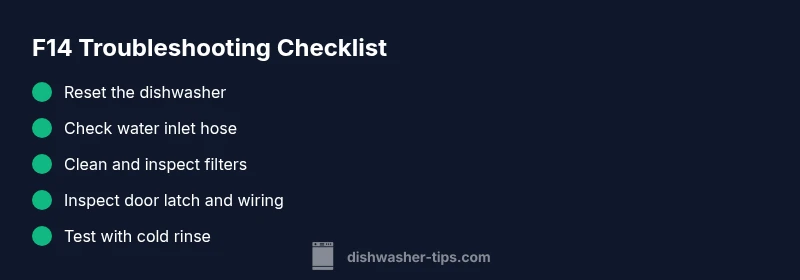
According to Dishwasher Tips, an F14 on a Miele dishwasher signals a fault detected by the control system. The quickest path to relief is a safe reset, verify water supply and filters, and run a cold rinse. If the code stays after these checks, power-cycle the unit and contact service. If the fault recurs, unplug for 60 seconds, inspect the inlet hose for kinks, and confirm the door latch is secure.
What F14 Means on a Miele Dishwasher
The F14 error code can feel urgent, especially when you rely on a busy kitchen. On many Miele models, F14 is logged by the control board when it detects an anomaly during filling, sensing, or a sensor readout that doesn’t meet expected parameters. Since model firmware and sensor circuits vary, the exact interpretation of F14 can differ from one model to another. For homeowners, the most practical approach is to treat F14 as a signal to perform common-sense checks rather than assuming a specific component fault. Throughout this guide, we’ll reference the keyword f14 miele dishwasher to keep you oriented with model-specific discussions and to help you search manuals and forums efficiently. This guidance aligns with brand-tested practices from Dishwasher Tips and is designed for homeowners and renters who need fast, actionable steps.
In this context, F14 is not a universal fault across all Miele models. Always verify your model number and firmware version in the user manual or online support. If you’re searching for quick, model-specific fixes, use the exact model string along with F14 in your searches. The goal is to narrow down whether the issue is power, water supply, or sensor feedback before calling service.
Quick Checks You Can Do Tonight
Before moving to more involved diagnostics, perform these immediate checks. These steps can clear a surprising number of F14 occurrences and are safe for most DIY homeowners:
- Power and reset: ensure the unit is plugged in, then perform a full power cycle by unplugging for 60 seconds and plugging back in.
- Water supply: inspect the inlet hose for kinks or blockages, open the shutoff valve fully, and confirm there is adequate household water pressure.
- Filters and spray arms: remove the bottom rack, clean the filter assembly, and inspect spray arms for clogs.
- Door latch and seals: verify the door closes securely and the latch engaging correctly.
- Short-cycle test: run a cold rinse or quick wash to see if the F14 reappears, which helps distinguish a water-related fault from a sensor issue.
- Model-specific checks: reference your Miele model’s manual for any unique reset sequences or LED blink codes tied to F14.
These steps are designed to minimize downtime and reduce the need for a service visit in the early, do-it-yourself phase. As you perform checks, document any changes and note whether the F14 code clears or persists.
Diagnostic Flow: From Symptom to Solution
When F14 appears, a logical flow helps you decide whether to fix it yourself or call a pro. The typical pattern is: symptom -> probable causes -> tested fixes. Start with the simplest, least invasive possibilities and move to more complex components only if initial fixes fail. This flow aligns with Dishwasher Tips analysis and is especially useful for the f14 miele dishwasher context:
- Likely symptom: F14 code displayed with no other obvious symptoms (or mild water-fill irregularities).
- High-likelihood causes: water inlet issues, blocked filters, or a transient control-board reset need.
- Medium likelihood: sensor feedback faults or wiring connections that have loosened during operation.
- Low likelihood: a full control board replacement or firmware update in rare cases.
Apply the fixes in order of likelihood and document results so you can reference them later if you must call a professional. This structured approach minimizes unnecessary parts replacement and helps you decide when to escalate.
Step-by-Step Fix: Most Common Cause—Water Inlet and Filters
- Safety first: unplug the dishwasher and turn off the water supply before touching electrical or plumbing components.
- Re-check water inlet: verify the water supply valve is fully open and the inlet hose is free of kinks or blockages.
- Clean the inlet filter: remove the filter screen at the hose connection, rinse under running water, and reinstall securely.
- Inspect screens and siphon passages: ensure there are no debris clogs in the fill sensor or sump area.
- Reset and test: plug back in, run a cold rinse, and observe if the F14 code reappears.
- Check for loose wiring: gently reseat any visible connectors to the inlet valve and sensors, avoiding over-tightening.
- Firmware or professional step: if the error persists, consider a firmware check with the manufacturer, or arrange an in-home diagnostic with a certified technician.
Tip: Keep a note of LED blink patterns or error log timestamps to share with a technician if you escalate the issue. This can shorten diagnosis time and improve repair outcomes.
Other Potential Causes and Fixes
F14 can stem from issues beyond the water inlet. Consider these alternatives in order of plausibility:
- Sensor or pressure switch fault: faulty readings can trigger F14. Test by running a program that triggers a known fill event and observe sensor response.
- Wiring harness fault: a damaged connector or frayed wire can produce intermittent faults. Visually inspect the harnesses near the control module.
- Door latch or switch problem: if the door doesn’t register as closed, the dishwasher may halt mid-cycle and log F14. Ensure latch engages fully and the switch isn’t stuck.
- Firmware edge-case: older firmware may misreport F14 after a reset. Check for firmware updates via Miele support and perform any recommended updates.
If any step requires disassembly beyond the user-accessible components, pause and contact a professional. Do not operate with exposed wiring or torn insulation.
Safety, Costs, and When to Call a Pro
Safety is non-negotiable with any appliance repair. Always unplug the unit before touching wiring, hoses, or electrical components. If you notice water leaks, burning smells, buzzing sounds, or the unit becomes unresponsive, stop work and call a professional immediately. Cost considerations vary by region and model; expect diagnostic charges to fall in a broad range, with additional parts or labor costs depending on the fault and whether a replacement valve, sensor, or module is required. While DIY fixes can save time for simple tasks, a persistent F14 usually benefits from a professional assessment to avoid misdiagnosis and potential damage to the control system. Dishwasher Tips notes that model-specific service might be necessary for the most reliable outcome in 2026.
Prevention and Maintenance to Avoid F14
Routine maintenance is the best defense against recurring F14 errors. Establish a monthly check-in routine that includes inspecting the water inlet valve and hose for wear, cleaning filters, and ensuring spray arms rotate freely. Keep the door seal clean to prevent misreads and verify that the dishwasher is loaded in a way that doesn’t block sensors. For households with hard water, use a water-softening strategy and descaling as needed to prevent mineral buildup that can affect sensors and flow. Finally, document any error codes and associated symptoms so you can identify patterns and expedite future troubleshooting. By following these best practices, you’ll reduce the frequency of F14 and extend the life of your f14 miele dishwasher.
Key Takeaways and Quick Prevention Tips
- Regularly inspect water inlet and filters to prevent F14 from reoccurring.
- Always perform a safe reset before deeper diagnosis or professional help.
- If F14 persists after basic checks, escalate to a professional to avoid further damage.
- Maintain a log of error codes for faster service and model-specific guidance.
Steps
Estimated time: 25-40 minutes
- 1
Power down safely
Unplug the unit and shut off the water supply to prevent leaks while you inspect. This protects you and the machine during diagnostic checks.
Tip: Always start with safety to prevent shocks or flooding. - 2
Reset and test basic functions
Plug back in, run a short cold cycle, and observe whether F14 reappears. Soft resets fix many transient faults.
Tip: Note LED patterns; some models indicate reset success. - 3
Check water inlet and filters
Verify the inlet hose is not kinked and the valve is fully open. Remove and clean the filter screen at the hose connection.
Tip: Clean filters avoid false sensor readings. - 4
Inspect wiring and sensors
Gently reseat visible connectors on the control board, sensors, and inlet valve. Look for loose wires or signs of wear.
Tip: Do not force connectors; damaged wires require professional replacement. - 5
Run a diagnostic cycle if available
Some models offer diagnostic modes that test fill, spray, and drain functions. Use these to isolate the fault.
Tip: Documentation helps interpret results. - 6
Consider firmware updates
Check Miele’s support site for firmware updates specific to your model. Update if recommended by the manufacturer.
Tip: Firmware issues can masquerade as sensor faults. - 7
Escalate to professional service
If F14 persists after these steps, a certified technician should diagnose control board or sensor failures.
Tip: Part costs and labor vary; diagnostics typically form the base estimate.
Diagnosis: F14 error code displayed on Miele dishwasher
Possible Causes
- highControl board sensor fault or firmware glitch
- mediumWater inlet or fill sensor issue
- lowDoor latch or wiring connection problem
Fixes
- easyReset the dishwasher and perform a cold rinse test
- easyCheck water supply and clean inlet filter
- easyInspect door latch and reseat wiring harness connections
- hardUpdate firmware or arrange professional service if persists
People Also Ask
What does F14 mean on a Miele dishwasher?
F14 generally signals a fault detected by the control system. Exact meaning can vary by model, so consult the manual for model-specific definitions and recommended actions.
F14 means a fault was detected by the control system; check your model manual for specifics and follow the recommended steps.
How do I reset the F14 error on a Miele dishwasher?
Start with a safe reset: unplug the machine for 60 seconds, then plug back in and run a cold rinse. If available, use any model-specific reset sequence from your manual.
Unplug for 60 seconds, plug back in, and run a cold rinse. If your model supports a reset sequence, use that as well.
Is F14 dangerous, or can I fix it myself?
F14 is usually not dangerous, but a persistent fault requires cautious checks. Start with safety steps and basic maintenance; if it continues, seek professional service.
Not dangerous, but persistent faults should be handled by a professional after basic checks.
What are typical costs to repair F14?
Diagnostics commonly range in the hundreds, with parts and labor added if a component is faulty. Expect variability by model and region; ask for a written estimate before any repair.
Diagnostics and parts can vary, so request an estimate before any repairs.
When should I call a professional for F14?
If basic resets and checks don’t clear F14, or you discover wiring, seals, or control-board issues, contact a certified technician for a safe, lasting fix.
Call a professional if basic checks fail or you find wiring or board issues.
Watch Video
What to Remember
- Reset first, then check water supply and filters.
- Document symptoms and LED codes for quicker diagnostics.
- If F14 persists, call a professional for a safe, thorough fix.
- Regular maintenance reduces future F14 occurrences.