Is Dishwasher Salt the Same as Soda Crystals? A Practical Guide
Discover whether dishwasher salt is the same as soda crystals. Learn how each product works, when to use them, and how to avoid common mistakes to protect your dishwasher.


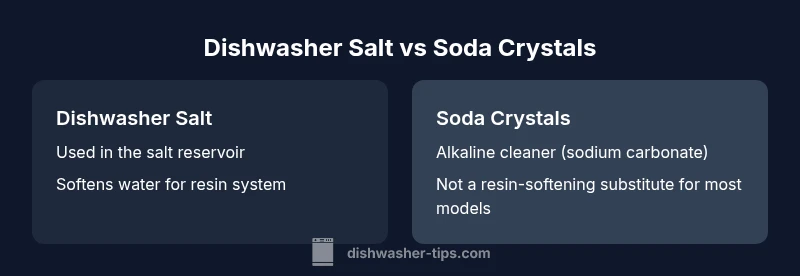
Dishwasher salt and soda crystals are not the same; they serve different roles in a dishwasher. Salt is used to soften hard water in compatible machines, while soda crystals (washing soda) are a cleaning agent. For most users, always use dishwasher salt in the dedicated reservoir and reserve soda crystals for cleaning tasks outside the dishwasher or as directed by the manufacturer.
Is dishwasher salt the same as soda crystals? Clarifying the basics
Is dishwasher salt the same as soda crystals? The short answer is: not exactly. For many households, this question pops up when reading labels or when a dishwasher has a dedicated salt compartment. According to Dishwasher Tips, understanding the distinct roles of each product helps protect your machine and deliver clean dishes. In this article, we compare dishwasher salt and soda crystals, explain how each works, and show when to reach for one or the other. By the end, you’ll know why the two products aren’t interchangeable in most cases and how to avoid common mistakes.
What is dishwasher salt?
Dishwasher salt is a pure, branded salt designed specifically for service in the dishwasher’s salt reservoir. It is not table salt or cooking salt. In many European and some other markets, the water-softening system in a dishwasher relies on this salt to regenerate the ion-exchange resin that buffers hard minerals in the water. The key thing to remember is that dishwasher salt is meant for use in the dedicated compartment; it does not mix with the detergent compartment. When used correctly, it helps reduce mineral buildup, improve rinse performance, and prevent limescale on dishes and inside the machine. Always check your model’s manual, but in general, a large portion of modern dishwashers require this salt to maintain optimal performance over time.
What are soda crystals (washing soda)?
Soda crystals, also known as washing soda, are sodium carbonate-based cleaning agents. They are effective for general cleaning, removing grease, and tackling mineral deposits in household cleaning tasks. They are not designed as a water-softening resin regulator for dishwashers. While soda crystals can help with exterior cleaning or certain laundry applications, they are not a substitute for dishwasher salt in the softening system. Misusing soda crystals inside the dishwasher’s salt reservoir can cause unexpected changes to water chemistry and may void warranties. In short, soda crystals are a cleaning aid, not a resin-regenerating salt.
How they work in your dishwasher
Dishwasher salt works by regenerating the resin bed that softens water. In hard water areas, the resin exchanges calcium and magnesium ions for sodium ions, reducing water hardness and improving detergent efficiency. Soda crystals, on the other hand, raise the cleaning power by alkalizing the wash, helping dissolve fats and prevent certain mineral deposits, but they do not soften water. Because the resin system relies on a controlled salt supply, using soda crystals in place of dishwasher salt can leave the resin starved for sodium ions and degrade performance over time. Always follow the manufacturer’s instructions and use the correct product in the proper compartment.
When to use each product
Use dishwasher salt when your dishwasher is designed to accept it and you live in areas with relatively hard water. The exact frequency depends on your water hardness and the dishwasher’s design; some models use salt continuously, others only when the hardness sensor indicates it’s needed. Soda crystals are better reserved for general cleaning tasks, including removing mineral buildup from surfaces around the home, or for specific cleaning cycles if recommended by the appliance manual. If you’re unsure, consult your model’s guide or contact customer support. In all cases, avoid mixing these products in the same compartment.
Risks of misuse and common mistakes
Common mistakes include using table salt with iodine or sea salt in the resin compartment, which can cause taste issues and scale formation over time. Using soda crystals inside the salt reservoir is another frequent error that disrupts the resin regeneration process and can affect cleaning performance. Never substitute dishwasher salt with soda crystals unless explicitly stated by the manufacturer. Regularly check hardness settings, confirm the correct product, and observe any change in cleaning results or persistent mineral spots on dishes. Safety and warranty considerations should guide your decisions.
How to identify the right product for your machine
Read the instruction manual and look for terms like “salt reservoir” or “water softening” in your dishwasher model. The packaging on dishwasher salt will say it’s for the salt reservoir; soda crystals will be labeled for general cleaning purposes. Check your local water hardness data (often provided by the utility company) to estimate how aggressively you need to treat water hardness. If you’re still unsure, contact the manufacturer’s support line or a certified technician. Your local retailer can also confirm which product is compatible with your dishwasher model.
Substituting and myths debunked
A popular myth is that soda crystals can replace dishwasher salt in the resin bed. This is not generally true for most models and can lead to reduced efficiency and mineral buildup. Conversely, trying to use dishwasher salt as a general cleaning agent is not advisable—it won’t have the same dissolving power or cleaning effect when used outside the salt reservoir. The correct pairing remains: dishwasher salt in the resin system, soda crystals for cleaning tasks where appropriate.
Practical maintenance checklist for salt and cleaning
- Verify the salt reservoir is filled according to your manual and avoid overfilling.
- Use the correct product in the correct compartment every cycle.
- Run a cleaning cycle with soda crystals only if your manual supports it in a separate cleaning phase.
- Test water hardness annually and adjust the salt dosage if your model supports automatic dosing.
- Inspect and replace seals if you notice persistent leakage or unusual residue.
Step-by-step: what to do this weekend to optimize performance
- Check your dishwasher manual for salt requirements and hardness settings.
- Refill the salt reservoir to the recommended level in a slow, careful pour.
- Run a test cycle with dishes and observe cleaning performance; note any scale or watermarks.
- Schedule a maintenance check if your intervals are longer than a year or if you notice reduced efficiency.
- Review local water hardness data and adjust accordingly for the coming months.
Performance considerations across water hardness levels
In hard water regions, the salt reservoir will be more actively used, and resin regeneration will occur more frequently. In softer water, the dishwasher may require salt less often, but it’s still important to keep the reservoir topped up if the manual specifies. Soda crystals can aid cleaning but should not be used as a water-softening substitute. Understanding your water profile helps you optimize both salt use and cleaning agents for consistently spotless dishes.
Comparison
| Feature | Dishwasher salt | Soda crystals |
|---|---|---|
| Main purpose | Water-softening resin regeneration | General cleaning agent (sodium carbonate) |
| Chemical composition | Pure sodium chloride suitable for resin system | Sodium carbonate-based compound for cleaning |
| Correct usage and dosing | Used in dedicated salt reservoir; dosing tied to water hardness | Used for cleaning tasks outside the resin system; not recommended as resin substitute |
| Effect on water hardness | Reduces mineral hardness impacting wash performance | Does not soften water; improves cleaning of deposits |
| Cost and availability | Widely available; cost varies by region | Common in cleaning aisles; affordable but not a water-softening solution |
| Best for | Homes with hard water using compatible models | Cleaning tasks and maintenance around the home |
The Good
- Precise water-softening in compatible dishwashers
- Widely available and clearly labeled for dishwasher use
- Can extend dishwasher life in hard water regions
- Usually affordable and easy to obtain
Disadvantages
- Not interchangeable with soda crystals; using the wrong product can reduce performance
- Soda crystals are not a substitute for resin softening in most machines
- Performance depends on local water hardness and machine design
Dishwasher salt is the recommended option for most dishwashers; soda crystals are not a direct substitute.
If your dishwasher supports salt-based softening, use dishwasher salt as instructed. Soda crystals should be reserved for general cleaning tasks outside the resin system unless your model explicitly allows their use. Following manufacturer guidance protects performance and longevity.
People Also Ask
Is dishwasher salt the same as soda crystals?
No. Dishwasher salt is designed to soften water in compatible dishwashers by regenerating the resin bed. Soda crystals are a cleaning agent (sodium carbonate) and are not a substitute for resin softening in most models.
No—salt softens water in the dishwasher, while soda crystals are for cleaning tasks outside the resin system.
Can I use soda crystals in place of dishwasher salt?
Usually not. Using soda crystals in the resin reservoir can disrupt the water-softening process and reduce wash efficiency. Only follow your manufacturer’s guidance if they explicitly approve such substitutions.
Generally not advisable unless your maker specifically says so.
Will using the wrong product damage seals or void a warranty?
Using the wrong product can contribute to mineral buildup, corrosion, or residue that affects seals over time. It may also affect warranty coverage if the manufacturer cites misuse.
Yes, misuse can cause issues and might affect warranty.
How do I know if my dishwasher needs salt?
Check your dishwasher’s manual for a resin-softening system and watch for a salt indicator light or hardness setting. If you live in hard water areas, you’ll likely need salt more often.
Look for a salt indicator and check your manual.
Where can I buy dishwasher salt?
Dishwasher salt is widely available in hardware stores, supermarkets, and online retailers. Look for labels indicating it’s for dishwasher salt reservoirs and avoid iodized table salts.
You can find it at most retailers that stock dishwasher supplies.
What to Remember
- Use dishwasher salt in the resin reservoir when required by your model
- Soda crystals are for cleaning tasks, not standard resin softening
- Do not substitute salt with soda crystals in the salt compartment
- Always check your machine’s manual and local water hardness before dosing
- Regular maintenance helps prevent mineral buildup and maintain efficiency