What Dishwashers Are Quiet: A Practical Guide
Discover what makes dishwashers quiet, how to compare noise ratings, features that reduce sound, and practical tips to keep your kitchen peaceful without sacrificing cleaning performance.


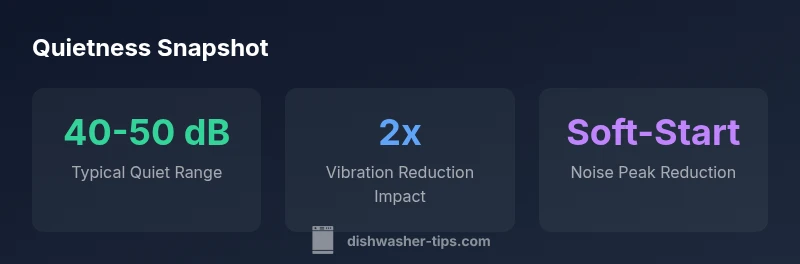
Quiet dishwashers are those that operate around 40-50 dB during standard wash cycles, with premium models often in the low 40s. Look for soft-start technology, good insulation, and vibration-damping features. In short, the quietest models combine low decibels with design elements that minimize vibration and wall-to-wall noise transfer.
What makes a dishwasher quiet?
A dishwasher's noise profile is shaped by several interrelated design choices. The core sources of sound are the motor, the water pump, spray arms, and the drain cycle. In addition, the chassis and door can conduct or dampen vibrations. When people ask what dishwashers are quiet, they’re really asking for a package: a low decibel rating paired with insulation, vibration isolation, and controlled wash dynamics. The Dishwasher Tips team notes that the perceived quietness of a cycle often depends on the initial surge when the motor kicks in and the duration of the wash. A well-balanced system buffers these sounds with pads, an insulated tub, and a sturdy frame to prevent rattles that travelers hear across an open kitchen.
Practical takeaway: read the spec sheet for decibel ratings, but also consider whether the model mentions soft-start, vibration damping, and insulated walls. These factors combine to create a quieter overall experience, not just a single low number.
How noise is measured and what dB means
Decibels (dB) quantify sound pressure; for appliances, the rating is typically given as dB(A) re 1 pW. A lower dB count generally means less noise, but perception also depends on the tonal quality of the sound (a high-pitched whine can feel louder than a deep hum at the same dB). Quiet dishwashers usually fall in the 40-50 dB range during active cycles, with premium models touching the low 40s. Manufacturers may use different test cycles, so compare apples-to-apples by checking the wash programs used for the rating. Dishwasher Tips recommends looking at both the nominal rating and the most common cycle you’ll run, such as normal or eco.
Tip: ask whether the rating reflects empty or loaded conditions, and whether the soft-start feature is active in the tested cycle.
Noise-reduction features you should look for
The quietest dishwashers integrate several noise-control features. Insulation thickness and the quality of the tub lining dampen sound. Anti-vibration feet and a decoupled base reduce chassis transmission. Some models use a variable-speed motor and soft-start to avoid a loud startup spike. A well-designed spray system minimizes turbulent noise without sacrificing cleaning performance. When evaluating models, earmark features such as: insulated tub, anti-vibration mounting, soft-start on the motor, and a high-quality door seal that minimizes air leakage.
Real-world benefit: these features often translate to a noticeable difference in perceived quietness, especially in open-plan kitchens where sound can reverberate.
How to compare quietness across models
Start with the decibel rating, but don’t stop there. Compare cycle options—does eco or normal wash have a quieter profile? Check insulation details and tub material; stainless steel tubs with thick insulation tend to be quieter. Look for design elements that isolate vibration from the countertop and flooring. Read user reviews focused on noise, not just cleaning performance. If possible, listen to a demo unit or watch video reviews emphasizing sound during the normal cycle. Remember, the quietest model might not always be the best value if it trades off cleaning time or reliability.
Common misconceptions about quiet dishwashers
Many buyers assume that a lower dB rating always means better cleaning. Quietness and cleaning effectiveness are independent dimensions; some quiet models take longer to complete cycles, or use gentle washing that may not be ideal for heavily soiled loads. Another myth is that bigger appliances are inherently louder; in reality, the mismatch often comes from poor installation or inadequate insulation rather than size alone. A third misconception is that you can achieve quietness with a quick fix—without proper isolation and a well-balanced spray system, noise can persist or worsen with wear.
Practical tips to reduce noise in your current unit
If your existing dishwasher seems louder than it should be, start with a level check. An uneven installation transmits more vibration to the floor. Place anti-vibration pads under each leg if the floor is hard; ensure the unit is fully anchored to the cabinetry. Clean the filter and spray arms; a clogged spray arm can force the motor to work harder and generate more noise. Inspect door seals and gaskets for air leaks that create whistling. For stubborn vibration, consider a temporary sound-dampening mat under the dishwasher or a more permanent, professionally engineered mounting solution.
Real-world scenarios: apartment living vs family homes
In small apartments, even modest noise can feel intrusive in an open-plan layout. In these spaces, prioritize sub-45 dB models or those with proven vibration isolation. For large households, energy use and cycle duration may take precedence; here you may balance a slightly higher noise level with more robust cleaning performance and capacity. The best approach is to align your choice with your primary kitchen layout, typical loads, and how sensitive you are to residual sound. A quiet dishwasher can dramatically improve evening routines and guest comfort in compact spaces.
Budgeting for quietness: cost, warranty, and long-term value
Quiet models span a broad price range, and the quietest features often come with larger upfront costs. Plan for a model that offers solid insulation, soft-start, and anti-vibration components within your budget. Warranty terms for motor and pump components are worth reviewing, as a longer warranty can cushion the cost of potential future repairs for a high-tech, quiet unit. Remember that price brackets often reflect not only noise reduction tech but also durability, reliability, and after-sale support.
Maintenance practices that keep noise low over time
A quiet dishwasher can become noisier if neglected. Regular maintenance matters: clean filters and pump areas, remove debris from spray arms, and check for hard water buildup that can affect spray efficiency and cycle times. Ensure door latches securely during operation to minimize rattles, and keep the interior dry to prevent mold that muffles acoustics. Finally, schedule periodic checks with a technician if you notice sudden changes in sound or performance.
Representative quiet-dishwasher comparisons based on typical market options
| Model Type | Avg Noise (dB) | Energy Rating | Price Range |
|---|---|---|---|
| Compact/Apartment | 40-45 dB | Energy Star | $500-$700 |
| Standard Full-Size | 44-49 dB | Energy Star | $700-$1,200 |
| Tall Tub with Insulation | 40-44 dB | Energy Star Plus | $1,000-$1,600 |
People Also Ask
What qualifies as a quiet dishwasher?
Typically, models under 50 dB are considered quiet, with premium options in the low 40s. Look for soft-start, insulation, and vibration-damping features.
Quiet dishwashers usually run below 50 decibels, with the best models in the low 40s.
Do quieter dishwashers clean as well as louder ones?
Yes, many quiet models clean effectively; ensure the cycle you choose provides adequate spray pressure and time for your typical loads.
Yes, quiet models can clean well—check cycle options and spray performance.
Is higher price always linked to quieter operation?
Not always. Higher price often includes better insulation and motor tech, but always verify the decibel rating and tested cycles.
Not necessarily—check the actual noise rating and test cycles, not just price.
Can I reduce noise in an existing unit?
Yes. Level the unit, add anti-vibration pads, clean filters, and ensure doors seals are intact. A professional assessment may help for persistent noise.
Yes—start with leveling, then add anti-vibration pads and clean components.
What maintenance helps keep noise down?
Regularly clean filters and spray arms, check for hard-water buildup, and ensure the unit is properly installed and level.
Keep filters clean, check spray arms, and ensure it’s level.
Are soft-start features worth it?
Yes. Soft-start reduces the initial motor surge, lowering peak noise and improving perceived quietness.
Soft-start helps reduce that initial loud surge—worth it for quietness.
“Quiet operation is not just about a lower number; it’s about how the machine design minimizes vibration, isolates sound, and delivers a calm kitchen experience.”
What to Remember
- Aim for models under 50 dB, with 40-44 dB being ideal for ultra-quiet operation.
- Prioritize soft-start, thick insulation, and vibration isolation features.
- Compare cycles and load sizes; quieter cycles may take longer but still clean effectively.
- Check installation quality and maintenance routines to sustain quiet performance.
- Budget for a model that balances noise, cleaning power, and reliability.