Difference Between Dishwasher and Built-In Dishwasher: A Practical Guide
Explore the difference between dishwasher and built-in dishwasher, weighing installation, space needs, efficiency, costs, and real-world scenarios to help homeowners decide which fits best.


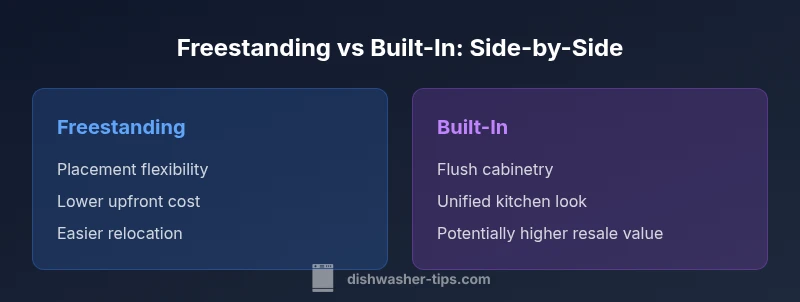
The difference between a dishwasher and a built-in dishwasher comes down to installation and integration. Freestanding or portable units sit free in the kitchen, while built-ins tuck under counters for a seamless look and cabinet-wide workflow. For renters or flexible layouts, freestanding wins on adaptability; for long-term kitchens, built-in models offer cleaner aesthetics and potentially higher resale appeal.
Understanding the Difference Between Dishwasher and Built-In Dishwasher
According to Dishwasher Tips, the most fundamental distinction isn't in how they clean dishes, but where and how they live in your kitchen. A standalone or freestanding dishwasher is a self-contained appliance that can stand apart from cabinetry, often with flexible placement and a plug-in setup. A built-in dishwasher, by contrast, is designed to be integrated into kitchen cabinet lines, tucked under the counter and aligned with surrounding panels. The practical effect is about permanence and aesthetics as much as performance. Freestanding units can be moved if you relocate, remodel, or reconfigure a space, whereas built-ins are typically chosen to blend with existing cabinets and countertop heights. Consumers should weigh how often they move, how much control they want over your immediate layout, and whether you prefer a seamless look or a flexible setup. The Dishwasher Tips team emphasizes that the core decision is about installation constraints, not just features. In households with renters or frequent reconfigurations, freestanding may be more appealing; in newly designed kitchens or long-term homes, built-in models often deliver a cleaner appearance and potentially higher resale appeal.
Key installation differences and what they mean for your kitchen layout
The installation approach drives many downstream decisions. Freestanding dishwashers typically require only a supply line, drain, and a receptacle, and they can be placed where plumbing is accessible. Built-ins demand tighter cabinet alignment, precise countertop clearance, and often cabinet modifications to ensure a flush, integrated appearance. This affects not just visual harmony but things like door swing space, accessibility of dishwasher controls, and ease of loading from different angles. When you plan a kitchen, sketch where you want the dishwasher relative to the sink and storage, and note how much room you have for a detached unit versus an under-counter fit. The Dishwasher Tips team notes that while both options perform similarly in cleaning power, the surrounding cabinet strategy dramatically influences daily use and long-term maintenance.
Space planning: matching your kitchen footprint to your needs
Spatial constraints frequently decide the winner. Freestanding models offer versatility in small or shared spaces and can be rolled out for cleaning sessions away from the wall. Built-ins are ideal when you want a unified look and a true under-counter footprint. If you remodel or build anew, a built-in option typically yields a sleeker aesthetic, aligns with standard cabinet heights, and reduces visual clutter. For renters, a freestanding unit can adapt to multiple layouts or temporary kitchens. The trade-off is that it may interrupt a continuous countertop line and require more conspicuous plumbing paths. In any case, measure doorway clearance, under-sink space, and the distance to the nearest water and waste connections to avoid surprises during delivery and installation.
Capacity, performance, and loading configurations across types
Capacity varies across both categories, but the configuration often matters more than the label. Freestanding models come in multiple widths, including compact and standard sizes, with flexible loading options that are forgiving in tight kitchens. Built-in dishwashers generally offer standard 24-inch widths and feature integrated racks designed to maximize interior space and ensure even water distribution. If you host large families or run dish-intensive households, compare interior layouts, rack heights, and spray arm configurations rather than just exterior size. The core performance—clean dishes, dry dishes, and reliability—remains robust in both categories, but user experience improves when interior geometry matches your typical cookware and loading habits.
Energy efficiency and water usage: real-world implications
Everyone cares about operating costs. Both freestanding and built-in dishwashers can meet high efficiency standards, but the efficiency often hinges on model class, cycle options, and load size rather than the installation type alone. Look for Energy Star ratings and water-use estimates per cycle, and consider how often you run heavy cycles (pots/pans) versus light cycles (silverware). In practice, built-in models sometimes offer more precise control over cycle times and smart features, contributing to overall efficiency in a fixed kitchen layout. The key takeaway: efficiency is model-specific, not solely dependent on whether the unit is freestanding or built-in.
Aesthetics, materials, and integration options for a polished kitchen
Aesthetic alignment matters for long-term satisfaction. Freestanding dishwashers are visibly separate, with finishes that may or may not match adjacent cabinets. Built-ins can be panel-ready, allowing the appliance to mimic surrounding cabinetry and achieve a cohesive look. When you choose between the two, consider how future renovations might affect the visible lines of your kitchen. If you prize a seamless, custom appearance, a built-in with matched panels often wins; if you value flexibility and quick swaps, a freestanding unit keeps options open for a future remodel.
Costs and installation considerations: upfront price versus long-term value
Cost dynamics differ meaningfully. Freestanding models typically carry lower upfront costs and simpler installation, making them attractive for renters or temporary setups. Built-in units generally cost more due to cabinet integration, potential countertop adjustments, and professional installation, but they can offer higher resale value in a fixed kitchen and a more integrated appearance that many homeowners prefer. When budgeting, separate the appliance price from the installation cost and consider whether you expect to stay in the home long enough to justify the added value of a built-in unit.
Maintenance access, serviceability, and common failure points
Maintenance is easier when you can access components without removing cabinetry. Freestanding models allow straightforward access through exposed panels and doors, which can simplify routine cleaning and parts replacement. Built-ins can require cabinet removal or panel detachment for servicing, adding a step to any repair. However, many modern built-ins use standardized components and serviceable parts, so ongoing maintenance remains comparable in many cases. If you anticipate frequent service, a freestanding model may reduce service-time costs and downtime, but the difference is often modest and model-dependent.
Real-world decision scenarios: renters, homeowners, and the value of flexibility
For renters who may move within a few years, a freestanding dishwasher offers portability and lower friction during transitions. Homeowners planning a kitchen remodel or building a new home may prioritize integration and a clean look, where a built-in is often the stronger long-term choice. Always compare the total ownership experience: initial cost, installation complexity, potential resale value, and the look you want in your space. Dishwasher Tips emphasizes aligning the choice with your lifestyle and future plans rather than chasing the latest feature set alone.
Authority sources and further reading
For deeper guidance, consult authoritative sources such as government and major publications that discuss appliance efficiency, installation standards, and kitchen design best practices. The U.S. Department of Energy provides energy and efficiency guidelines for dishwashers, while Energy Star offers practical filters for choosing efficient models. Consumer-focused outlets also compare real-world performance and reliability. These sources help ground your decision in proven benchmarks and practical experience.
Comparison
| Feature | Freestanding/Portable Dishwasher | Built-In Dishwasher |
|---|---|---|
| Installation and integration | Can be placed anywhere with access to plumbing and power; not tied to cabinetry | Designed to fit under a counter and be integrated with surrounding cabinets |
| Size and capacity options | Multiple widths (compact 18" and standard 24"); flexible placement | Typically 24" width; standard interior layouts optimized for under-counter use |
| Aesthetics and finish | Visible appliance; finishes may vary; less cabinetry cohesion | Panel-ready or matched finishes for seamless kitchen integration |
| Plumbing and electrical setup | Plug-in or hardwired; relatively simple installations | Requires precise cabinetry fitment and under-counter plumbing alignment |
| Cost and value | Lower upfront cost; installation is typically simpler | Higher upfront and installation costs; can boost home resale value |
| Maintenance access | Easier external access; quicker servicing in many cases | Access may require removing panels or cabinet components |
| Best for | Renters, temporary spaces, relocations | Long-term homes, fixed kitchens, higher integration goals |
The Good
- Flexible placement and easy relocation
- Typically lower upfront cost and simpler installation
- Wide range of models and capacities to suit budgets
- Easier seasonal or pragmatic swaps when plans change
Disadvantages
- Less integrated appearance in a finished kitchen
- Often bulkier or heavier to move than a built-in
- May have slightly lower resale appeal in some markets
- Higher efficiency gains sometimes realized in built-ins with panel integration
Built-in preferred for seamless kitchens and long-term value; freestanding suits flexibility and lower upfront costs.
If your goal is a clean, integrated look and you expect to stay put, choose built-in. If portability and budget are priorities, a freestanding unit is a strong, practical option.
People Also Ask
What is the main difference between a dishwasher and a built-in dishwasher?
The primary difference is installation and integration. Freestanding dishwashers stand independently and can be moved, while built-in models are designed to blend with cabinetry under the counter for a seamless kitchen look. Both perform similar cleaning functions, but space planning and aesthetics differ.
The main difference is whether the dishwasher sits freely or is integrated into the cabinetry. Freestanding units are portable, built-ins are flush with the kitchen design.
Can freestanding dishwashers be integrated with cabinets?
Freestanding dishwashers can be positioned near cabinets but are not truly panel-ready unless designed to resemble a standalone unit. If you want a seamless built-in appearance, you’ll typically choose a built-in or panel-ready model that matches your cabinetry. Mounting or partial paneling might achieve a similar effect in some layouts.
They can sit near cabinets, but for a seamless look you usually go built-in with matching panels.
Are built-in dishwashers more energy efficient?
Efficiency depends on the model, not the installation type alone. Both freestanding and built-in units can meet high efficiency standards if they carry Energy Star ratings and have modern sensors and efficient spray systems. Compare efficiency ratings on individual models rather than assuming based on type.
Efficiency depends on the model; both types can be very efficient if you pick Energy Star-rated options.
What sizes do these dishwashers come in?
Freestanding options come in compact (18 inches) and standard (24 inches) widths, offering flexibility for small or roomy kitchens. Built-in models typically use a standard 24-inch width and are designed to fit under typical counters with cabinet alignment in mind.
Freestanding comes in 18 or 24 inch widths; built-ins are usually 24 inches.
Is installation difficult for built-in dishwashers?
Installations for built-ins are more involved and often require professional help. They may need cabinet modifications, precise mounting, and alignment with plumbing and electrical lines. A capable installer ensures a flush integration and long-term reliability.
Yes, built-ins usually require professional installation for proper alignment and a clean look.
What should renters consider when choosing a dishwasher?
Renters should prioritize portability, ease of relocation, and lower upfront costs. Freestanding models allow quick swaps when moving between rentals, while built-ins may be less practical due to cabinetry changes and potential restrictions.
Renters should value portability and cost, with freestanding units offering the most flexibility.
What to Remember
- Assess whether flexibility or integration matters most
- Measure your space for under-counter clearance and access
- Compare energy/water efficiency by model, not by type alone
- Budget total cost: appliance price plus installation
- Renters benefit most from freestanding; homeowners from built-ins