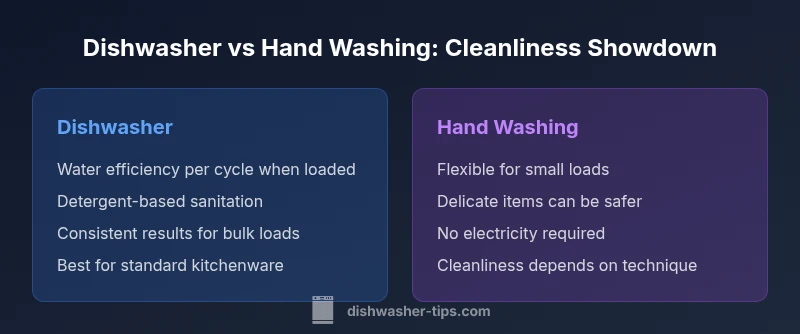
Is Dishwasher or Hand Washing Cleaner? A Side-by-Side Comparison
An analytical buying-guide comparing cleanliness outcomes, resource use, and practicality between using a dishwasher and hand washing, with practical tips and a clear verdict.


Across most homes, a dishwasher generally delivers a cleaner, more consistent result with less water and effort per dish, while hand washing can excel for small loads and delicate items. This comparison analyzes hygiene, resource use, and practicality to help you decide whether is dishwasher or hand washing cleaner is the better choice for your routine.
Is dishwasher or hand washing cleaner the right choice for your dishes?
At its core, the question of whether is dishwasher or hand washing cleaner hinges on what you value: hygiene, water and energy use, time, and how you handle delicate items. For many households, a modern dishwasher delivers cleaner results with less effort and more consistent sanitation, but there are situations where hand washing can outperform the machine for certain loads. This analysis reflects a pragmatic approach, drawing on general guidelines and practical experience rather than marketing claims. According to Dishwasher Tips, modern dishwashers optimize heat, flow, and detergent delivery to achieve uniform cleanliness, especially when loads are arranged correctly. The phrasing is deliberate: the goal is to illuminate outcomes you can count on in real life, not just lab tests. The keyword is studied in context to ensure natural integration with the surrounding content while avoiding overstated guarantees.
How a modern dishwasher cleans and sanitizes dishes
Modern dishwashers operate through a sequence of pre-wash, wash, rinse, and dry cycles, aided by heated water and high-pressure jets. Detergents are formulated with enzymes and surfactants to break down fats and starches, while some cycles employ sanitation temps to reduce microbial presence. The combination of mechanical action, temperature, and detergent yields consistent cleanliness across a wide range of dishware, from glassware to pots and pans. When used correctly, dishwashers can minimize residual food particles and greasy films, contributing to a perception of better cleanliness on average. However, effectiveness still depends on loading patterns, water hardness, and the chosen cycle. Dishwasher Tips reinforces that routine maintenance—filters, seals, and occasional descaling—helps preserve sanitation levels over time.
Hand washing: how manual cleaning compares
Hand washing relies on manual scrubbing, water temperature, and effective detergent use to remove soils and sanitize surfaces. The cleanliness outcome is highly variable, influenced by technique, the amount of elbow grease, and whether hot water is used consistently. While hand washing can be gentler on certain delicate items and allows selective attention to stubborn residues, it generally partitions energy input to human effort rather than machine-assisted efficiency. The absence of a built-in sanitation cycle means cleanliness relies on the user’s method, rinse quality, and drying practices. When done well, hand washing can achieve high levels of cleanliness for small loads, but the overall consistency across items and cycles tends to be less predictable than a properly used dishwasher.
Hygiene, contamination risk, and best practices
Hygiene is a central metric when answering can something be considered cleaner. Dishwashers are designed to minimize cross-contamination by sealing soiled items away from clean ones during cycles and employing high heat to reduce bacteria. Hand washing introduces more opportunities for recontamination if items are left wet, sinks are not cleaned, or utensils are reused without thorough rinsing. Best practices for cleanliness with either method include using hot water when available, avoiding overcrowding (dishwasher) or overcrowding/scrubbing (hand washing), and drying items to reduce bacterial growth on moist surfaces. The goal is to minimize food residues and keep utensils dry and ready for use. Dishwasher Tips emphasizes following manufacturer guidance for optimum results and respecting item compatibility notes.
Water, energy, and time: a trade-off analysis
A key factor in choosing is dishwasher or hand washing cleaner is the balance of water, energy, and time. Dishwashers typically optimize water use per cycle and rely on electricity to power pumps, heating elements, and sensors. In contrast, hand washing uses no machine energy but consumes variable amounts of water and labor depending on the workload. For large households or frequent meal prep, a dishwasher often yields a lower per-dish energy and water footprint due to cycle efficiency and bulk cleaning. For single or very small loads, hand washing can be more practical and may still deliver high cleanliness if hot water and thorough scrubbing are used. The practical takeaway is to consider load size, frequency, and your willingness to invest manual effort versus machine reliance.
When to rely on a dishwasher for cleanliness
Dishes that benefit most from a dishwasher include heavily soiled cookware after batch cooking, multiple glasses and plates from a kitchen party, and items that tolerate heat and water pressure well. A dishwasher provides consistent results across similar loads and can reduce residual grease and starch more uniformly when the detergent, rinse aid, and cycle settings match the soil type. Heavier soils are managed more reliably with a properly loaded machine, and sanitation-focused cycles can further improve cleanliness for households with strict hygiene needs. For families with limited time or high dish throughput, the dishwasher is typically the cleaner and more efficient option overall.
When hand washing may be cleaner or more practical
Hand washing can be cleaner for delicate items that cannot tolerate dishwasher cycles, such as certain crystal or soft-plastic containers, or for items with stubborn residue that benefits from immediate intervention. It also shines when loads are light and infrequent, or when running a full dishwasher is not feasible due to water hardness, space, or energy considerations. Proper technique matters: using hot water (where safe), a good dish soap, and thorough rinsing can yield cleanliness that rivals a machine for small tasks. This approach is particularly appealing for households prioritizing gentleness, flexibility, or cost avoidance on appliances.
Practical workflow: maximizing cleanliness with either method
Regardless of method, certain routines enhance cleanliness. Pre-rinse only when necessary to remove loose debris, load or arrange items to maximize spray coverage (for dishwashers), and choose appropriate cycles or hand washing intensities according to soil level. For hand washing, use warm to hot water, apply detergent generously, scrub all surfaces, and rinse thoroughly with clean water; air dry or dry with a clean cloth. For dishwashers, scrape off excess food, avoid placing items that block spray nozzles or wheels, and select cycles aligned with soil. Regular maintenance—cleaning filters, seals, and spray arms—helps keep outcomes consistent over time.
Common myths debunked and what the evidence shows
A common myth is that dishwashers automatically sanitize all items; in reality, effectiveness depends on cycle temperature, water quality, and soap quality. Hand washing enthusiasts sometimes claim it is always cleaner if done with super hot water; evidence indicates that consistent high-temperature cycles in machines can achieve similar or better sanitation for many loads, provided the dishwasher is well maintained. The opposite belief—that humans are inherently cleaner—fails to consider variations in technique and the potential for cross-contamination through damp surfaces. Keeping a critical eye on actual outcomes and routine maintenance is essential to achieving true cleanliness in daily use.
How to decide: a practical decision framework
A simple framework helps decide whether is dishwasher or hand washing cleaner for a given situation: (1) assess load size and soil level, (2) consider item compatibility and risk tolerance for delicate items, (3) evaluate available water temperature and energy factors, (4) factor in time constraints and convenience, (5) review maintenance feasibility. If you frequently run full loads with heavy soils and desire consistent sanitation, a dishwasher is typically the cleaner option. If loads are small, delicate, or irregular, hand washing may deliver comparable cleanliness with greater control.
Maintenance and care to maximize cleanliness across methods
Maintenance keeps both methods performing at their best. For dishwashers, regular cleaning of filters, spray arms, and seals reduces food buildup and ensures consistent water flow. For hand washing, cleaning the sink area, drying surfaces, and using fresh utensils prevent recontamination. In both cases, using appropriate detergents or soaps, rinsing thoroughly, and drying items after cleaning helps minimize microbial growth on surfaces. Following manufacturer guidance for detergent types, rinse aids, and cycle selections remains essential.
Reviewing final decision factors and next steps
The choice between is dishwasher or hand washing cleaner ultimately rests on your household's needs, habits, and constraints. A dishwasher excels for routine, high-volume cleaning with strong sanitation cycles. Hand washing offers flexibility, control, and gentleness for small, delicate loads. The best approach may be a blended strategy: rely on the dishwasher for most days and switch to hand washing for delicate items or very small loads. Regular maintenance and mindful loading maximize cleanliness across both methods.
Comparison
| Feature | Dishwasher | Hand washing |
|---|---|---|
| Water Usage | Low per cycle when fully loaded | Variable; usually higher per dish, depends on technique |
| Energy Efficiency | High efficiency per cycle with modern machines | No electric energy used beyond heating water if hot water is used |
| Time Required | Fixed cycle length; hands-off during wash | Manual time varies; can be longer for larger loads |
| Best For | Bulk meals, heavy soils, and convenience | Small loads, delicate items, and flexibility |
| Detergent/Soap | Detergent pods or powder; rinse aid improves drying | Standard dish soap; no special detergent needed |
| Dishes Compatibility | Good for most standard cookware and glassware; careful loading required | Ideal for delicate items; more adaptable to odd sizes |
| Hygiene Outcomes | Consistent sanitation with proper cycles and maintenance | Good hygiene potential with technique, hot water, and thorough rinsing |
The Good
- Low water usage per dish when fully loaded
- Consistent cleaning and sanitation with proper cycles
- Convenience and time savings
- Gentle handling of delicate items through specific cycles
- Improved drying and reduced odor with rinse aids
Disadvantages
- Higher upfront cost and space requirements
- Performance depends on correct loading and maintenance
- Not ideal for very small loads or single items
- Requires electricity and dedicated water supply
Dishwasher generally wins for cleanliness, efficiency, and convenience in most households.
For bulk loads, the dishwasher reduces water usage and provides consistent sanitation. Hand washing can be cleaner or more practical for small loads or delicate items, but overall the machine tends to deliver steadier results with less effort.
People Also Ask
Is dishwasher cleaner than hand washing?
In many cases, yes. A properly loaded dishwasher with a suitable cycle and detergent provides consistent sanitation and thorough rinsing, reducing residues more predictably than hand washing. However, for delicate items, or if cycles aren’t optimized, hand washing can achieve comparable cleanliness with careful technique.
In many cases, a dishwasher cleans more consistently, but for delicate items, hand washing with proper technique can be just as clean.
Can hand washing be as clean as using a dishwasher?
Yes, under the right conditions. Hot water, sufficient detergent, thorough scrubbing, and proper rinsing can produce a level of cleanliness similar to a dishwasher for small loads or delicate items. The key is technique and water temperature.
Yes, with hot water and thorough scrubbing, hand washing can match dishwasher cleanliness for small loads.
What factors affect cleanliness when hand washing?
Factors include water temperature, detergent quality, scrubbing effort, rinsing thoroughness, and drying method. Water temperature should be hot enough to aid cleaning but safe for the item. Residue removal depends on scrubbing for all surfaces and joints.
Temperature, detergent, and scrubbing effort determine hand washing cleanliness.
How can I optimize dishwasher cleanliness?
Pre-rinse lightly to remove large debris, load items properly for optimal spray access, use the right cycle for soil level, and keep the filter and spray arms clean. Add rinse aid if your water is hard to improve drying and reduce spotting.
Load properly, choose the right cycle, and keep filters clean for best results.
Are there items that should not go in a dishwasher for cleanliness reasons?
Yes. Certain materials like some plastics, fine china, or items with wooden handles may be unsuitable. Also, oversized pots or non-stick coatings can be damaged by high heat or harsh cycles. Always follow manufacturer guidelines for item compatibility.
Check item compatibility before loading to avoid damage.
Does water temperature influence cleanliness when hand washing?
Yes. Warmer water generally improves detergent effectiveness and helps dissolve grease, contributing to cleaner surfaces. However, avoid scalding temperatures that could harm hands or damage heat-sensitive items.
Warm water helps, but avoid scalding temperatures.
What to Remember
- Choose dishwasher for bulk loads and consistent sanitation
- Hand wash for small, delicate loads or when machine access is limited
- Maintain both methods: clean filters and use appropriate detergents
- Aim for proper loading to maximize cleaning and minimize recontamination
- Balance water, energy, and time according to your household needs