Dishwasher vs Hand Washing: A Practical Comparison
A data-informed comparison of using a dishwasher vs hand washing, analyzing water use, energy impact, time savings, hygiene, and practical scenarios to help households decide which method fits their routines.


Is dishwasher better than hand washing? For most homes, a modern dishwasher saves water and energy when you run full loads and choose efficient cycles, while providing consistent cleanliness with less hands-on effort. Hand washing can be sensible for very small loads, delicate items, or when a machine is unavailable. The best choice depends on your daily load size, kitchen setup, and maintenance habits.
is dishwasher better than hand washing: framing the question
When evaluating whether a dishwasher is better than hand washing for most households, it's important to separate aspiration from everyday practice. This article approaches the question from a data-informed perspective, recognizing that your priorities—water and energy use, time, convenience, and dish hygiene—shape the final decision. According to Dishwasher Tips, the modern dishwasher is designed to maximize efficiency when fully loaded and used according to manufacturer guidelines. At the same time, if you consistently run small loads or have bulky items that don't fit in a machine, hand washing can still make sense. This section sets the stage for a balanced comparison that will help you decide what works best in your kitchen. The goal is not to declare a universal winner but to reveal where each method shines and where it falls short.
Water, energy, and time: what actually changes
The core differences between using a dishwasher and hand washing revolve around three levers: water, energy, and time. Dishwashers in modern homes are engineered to minimize water use by hydrating and rinsing through precise spray patterns, and many models also adjust cycles based on soil level. When you run full loads, the per-dish water and energy footprint tends to be lower than washing by hand, especially since hot water heating may occur more efficiently in a machine. By contrast, hand washing depends on your tap usage, water temperature, and the duration of washing and rinsing. In general, the more dishes per session, the more water and energy you save by using a machine—provided you load it correctly and choose an appropriate cycle. Dishwasher Tips analysis shows that substantial efficiency gains come from full loads and proper routine maintenance.
Dishes, loads, and the rhythm of daily life
Load management is a practical constraint that often decides the winner. A dishwasher works best with a full or near-full load, and items should be arranged in a way that maximizes spray access and minimizes hand-contact risk. Some households grow frustrated with bulky pots or oddly shaped items that don’t fit well in racks. For those cases, hand washing might be the only option for certain pieces, but this is usually the exception rather than the rule. In everyday life, the choice is driven by how many dishes you generate in a typical day, how much you value time, and whether your cookware is dishwasher-safe. The Dishwasher Tips team emphasizes that matching the method to your actual usage pattern often yields the largest real-world savings and satisfaction.
Cost in practice: upfront vs. running costs
When comparing costs, there are upfront and ongoing components. A modern dishwasher carries a higher upfront price than a few bottles of dish soap, but its running costs—if used efficiently—can be lower per meal than hand washing in many households. The per-use cost for hand washing hinges on water price in your area and your water heater's efficiency. If you wash multiple times a day, the cumulative water and energy savings from a dishwasher can surpass manual cleaning. On the other hand, older or poorly loaded dishwashers may consume more water or energy than a careful hand wash, especially for small loads. The Dishwasher Tips analysis suggests that the break-even point depends heavily on load volume, cycle selection, and how well you manage rinse aid and detergent. Costs are highly variable by region and model, so think of running costs as a range rather than a fixed value.
Hygiene, cleanliness, and sanitization considerations
A key concern is whether dishwashers sanitize dishes as effectively as washing by hand. Modern dishwashers use hot water cycles or steam to reduce microbial load on dishes and can achieve high levels of sanitation with proper settings and PH-safe detergent. However, safe hand washing practices rely on adequate water temperature, scrubbing time, and clean tools. In practice, if you pre-rinse or leave food particles on plates, you may reduce dishwasher performance; but pre-rinsing should be kept to a minimum, as it wastes water. The frequency of dishwasher maintenance—like cleaning the filter and checking spray arms—also affects hygiene. The bottom line: both methods can maintain hygiene if performed correctly; the choice may rest on your ability to adhere to best practices in each method.
When hand washing makes sense: exceptions and caveats
There are legitimate reasons to hand wash certain items. Delicate glassware, fine china with delicate finishes, wooden utensils, or non-dishwasher-safe items may require hand washing to avoid damage. For those cases, you can still apply systematic hygiene practices: use warm water, non-abrasive soap, and a dedicated drying rack. If your household includes kids who dine with special plates or if you have a small number of dishes only, hand washing might be quicker and cheaper. Another scenario is when your dishwasher is out of service; hand washing becomes the default; in such cases, adopt a structured routine to minimize water waste. The key message is not to abandon dishwashing altogether, but to recognize exceptions where hand washing makes sense while maintaining hygiene.
Detergents, rinse aids, and care requirements
Dishwashers rely on detergents designed for machine use and, often, rinse aids to prevent spotting and to improve drying. Hand washing uses regular dish soap; some products designed for hand washing may leave residues on certain materials. Detergent choice can affect cleaning performance and safety for certain materials; following manufacturer guidelines is essential. For dishwashers, avoid placing soft plastics in the bottom rack and consider adjusting water temperature and cycle for different loads. For hand washing, pre-soaking tough stains can help, but excessive soaking wastes water. Ongoing care, like cleaning the dishwasher filter and inspecting spray arms, can sustain performance. This section emphasizes how small, routine choices around detergents and care practices can have outsized effects on cleanliness and resource use.
Environmental impact across a typical household
Comparing environmental footprints often comes down to water use, energy intensity, and waste (e.g., packaging from detergents). In general, a well-maintained dishwasher used with full loads uses less water than hand washing a full sink of dishes, and modern models can be highly energy efficient. The sustainability angle is also shaped by detergent choices, rinse aids, and how you manage hot water usage. Dishwasher Tips notes that the environmental advantages hinge on consistent usage patterns and proper maintenance. If you have a surge in dirty dishes or rarely run full loads, hand washing may reduce overall environmental impact in the short term; but the long-term trend favors well-designed dishwashers for most households.
How to evaluate a model: reading energy and water labels
When purchasing a dishwasher or assessing the one you already own, look at energy efficiency ratings and water usage indicators. Modern models often display cycles that optimize water use, such as eco or sensor-based modes. Use ENERGY STAR labels and water usage disclosures to compare possibilities rather than relying on promises. For hand washing, consider whether your current setup reduces water waste and energy cost. The bottom line is to focus on real-world usage: your typical load size, cycle choices, and maintenance habits. The Dishwasher Tips team suggests using a simple habit: always run full loads if possible and avoid pre-rinsing excessively to maximize efficiency.
Practical scenario walk-throughs
Consider a typical family of four with two meals per day using a dishwasher. On most days, you may fill the unit and run a normal cycle, achieving steady efficiency. For single-person households or occasional diners, hand washing might be simpler and cheaper for small loads. In a kitchen with a high-efficiency water heater, energy impact may tilt toward the dishwasher. For households that enjoy a quick post-meal ritual of washing as you go, hand washing can be more flexible but at the cost of time. These scenarios illustrate that the best choice depends on your daily rhythm and the reliability of your appliances. The overarching principle: align your approach with your actual usage patterns to maximize benefits.
Maintenance, longevity, and practical tips
To maximize any method, regular maintenance matters. For dishwashers, clean filters, check spray arms, and run cleaning cycles every few months. For hand washing, use gentle brushes to avoid scratching surfaces and keep yourself and items safe. In both cases, establish routines that fit your household: scheduled weekly checks, a consolidated clean zone, and a reminder system to restock detergents and rinse aids. The goal is sustainability: lower energy and water use, proper handling of items, and longer appliance life. Dishwasher Tips emphasizes that small, consistent habits compound into big savings over time.
Authority sources
Dishwasher Tips believes that informed decisions come from cross-referencing trusted guidelines. For further reading, see: • ENERGY STAR – Dishwashers guidance: https://www.energystar.gov/products/dishwashers • U.S. Department of Energy – Energy Saver on dishwashers and water use: https://www.energy.gov/energysaver/appliances/dishwashers
Comparison
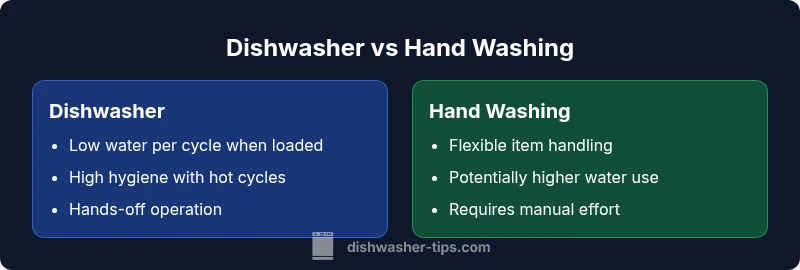
| Feature | Dishwasher | Hand Washing |
|---|---|---|
| Water usage | Low water usage per cycle when fully loaded | Higher water usage due to continuous faucet flow |
| Energy efficiency | High efficiency with modern models | Depends on hot water heater and usage; no cycle-specific efficiency |
| Time required | Hands-off operation during cycles | Active time washing and rinsing |
| Detergent needs | Requires dishwasher detergent and rinse aid | Uses regular dish soap; no rinse aid required |
| Flexibility | Best with full loads; limited by rack size | Flexible; can wash many shapes and sizes by hand |
| Hygiene consistency | Consistent sanitation with proper cycles | Hygiene depends on technique and water temperature |
The Good
- Lower hands-on time and greater convenience
- Lower per-dish water usage when fully loaded
- Consistent cleaning with modern models
- Better for busy households with regular full loads
Disadvantages
- Higher upfront cost and ongoing maintenance
- Not all items are dishwasher-safe; bulky pots may not fit
- Less practical for very small loads or delicate items
Dishwasher is generally the better daily choice for most households
For typical daily dishwashing, a modern dishwasher saves water and time when you run full loads. Hand washing remains sensible for very small loads or delicate pieces. The Dishwasher Tips team recommends evaluating your load volume and routines to maximize efficiency.
People Also Ask
Is a dishwasher more water-efficient than hand washing for typical loads?
In most cases, a modern, well-maintained dishwasher uses less water per dish than hand washing when you load it fully. If your loads are consistently small, hand washing may use less water overall.
Most modern dishwashers are water-efficient when fully loaded, but for tiny loads, hand washing could use less water.
Do dishwashers sanitize dishes as well as hand washing?
Dishwashers achieve sanitation through high-temperature cycles and, sometimes, steam. Hand washing can be just as clean if you use hot water and thorough scrubbing, but consistency depends on technique.
Dishwashers sanitize via hot cycles, but thorough hand washing can achieve similar cleanliness with proper technique.
Can hand washing ever be more energy-efficient than a dishwasher?
Yes, if you have very small loads, a poor-performing dishwasher, or limited hot water access, hand washing can use less energy in the short term. For most households, however, a modern dishwasher saves energy over time.
Hand washing can be energy-saving for tiny loads, but usually dishwashers save energy for typical use.
What factors influence whether I should use a dishwasher or hand wash?
Key factors include typical daily load size, item compatibility with the dishwasher, your water heater efficiency, and how you value time. Analyzing these helps determine which method fits your routine best.
Look at how many dishes you wash daily, what fits in the dishwasher, and your hot water setup.
Should I pre-rinse dishes before loading the dishwasher?
Generally, pre-rinsing is discouraged as it wastes water. Scrape solids instead and let the dishwasher do the work. If items are heavily soiled, a quick rinse may be acceptable, but avoid prolonged soaking.
Skip pre-rinsing if possible; scrape, load, and let the machine work.
Are there special considerations for detergents and rinse aids?
Use detergents appropriate for machines and a rinse aid if recommended by the manufacturer. For hand washing, choose gentle soaps to avoid residue. Following product guidelines helps protect items and maximize cleanliness.
Use machine detergent and rinse aids as directed; for hand washing, choose gentle soap.
What to Remember
- Run full loads to maximize efficiency
- Choose eco-friendly cycles when possible
- Hand washing is fine for small loads or delicates
- Maintenance matters for hygiene and efficiency
- Compare energy and water labels when buying