Is Dishwasher Salt the Same as Coarse Salt? A Practical Guide
Explore whether dishwasher salt and coarse salt are interchangeable, how each works in your dishwasher, and practical guidance to choose the right salt for reliable cleaning and appliance health.


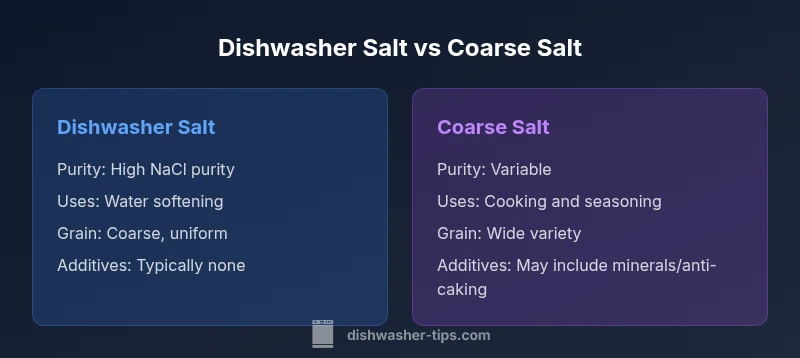
Dishwasher salt is not the same as coarse kitchen salt. Dishwasher salt is a pure, coarse-grained sodium chloride designed specifically to soften water in the dishwasher’s system, typically with no additives. Coarse salt is intended for cooking and may include minerals or anti-caking agents. Substituting one for the other is generally not advisable due to differing functions and chemical behavior.
Is dishwasher salt the same as coarse salt? Key distinctions
Understanding the basic roles of salt in different contexts helps homeowners avoid common mistakes. The direct question is is dishwasher salt the same as coarse salt? In short, no. Dishwasher salt is a dedicated product designed to work with water-softening systems inside dishwashers. It is typically a pure, coarse-grained sodium chloride with minimal additives. Coarse salt, by contrast, is produced for culinary uses and may carry minerals or anti-caking agents depending on the source. This difference in composition and intended use means the two salts behave differently in everyday household tasks and in appliance maintenance. Grasping these distinctions is the first step toward safer, more effective cleaning and longer-lasting hardware.
What exactly are dishwasher salt and coarse salt? Composition and labeling
Dishwasher salt is sold specifically for dishwasher water-softening systems. It is often labeled as salt for domestic use in appliances and is expected to be free of iodized additives and anti-caking agents. The goal is purity: a high-purity sodium chloride with a uniform grain that dissolves predictably in the dishwasher’s brine reservoir. Coarse salt used for cooking or brining may be sea salt or rock salt and can contain trace minerals, minerals that impart flavor, or anti-caking agents not appropriate for dishwasher internals. Labeling reflects this: dishwasher salt mentions “for dishwashers” or “for water softeners,” while cooking salt lists culinary uses. The practical upshot is that the two salts are formulated with different ends in mind, and that difference matters when the salt interacts with your appliance's mechanisms.
How dishwashers use salt: the water-softening process
All modern dishwashers rely on a resin-based water-softening system. When hard water passes through the ion-exchange resin, minerals like calcium and magnesium are captured by the resin beads, which are then recharged by a brine action. This brine comes from a reservoir that typically uses dishwasher salt. The salt dissolves to regenerate the resin, allowing the system to exchange hardness minerals for sodium ions again. In this context, purity and consistent dissolution are critical. Any contamination or inconsistent grain size can hamper the regeneration cycle and reduce the effectiveness of the water-softening process. This is why dishwasher salt is designed specifically for this purpose and why it is not interchangeable with culinary salts.
Does grain size matter? Salt granulation and its effects
Grain size affects how quickly salt dissolves and how reliably the brine is generated. Dishwasher salt is formulated in a way that promotes steady dissolution in the softener reservoir, enabling predictable resin regeneration. If the grains are too small, rapid dissolution can create excess brine or spurious backflow; if too large, dissolution may be incomplete, reducing hardness removal. Coarse kitchen salt can vary widely in grain size depending on brand and origin, and may include additives that slow dissolution or alter brine chemistry. For optimal results, follow your dishwasher manufacturer’s guidance on grain size and avoid substituting culinary-grade coarse salt where the system expects dedicated dishwasher salt.
Common myths vs. reality: substitution myths
A frequent myth is that any large granule salt can serve in the dishwasher. Reality shows that even large grains from cooking salt may contain trace minerals, or they may include anti-caking additives not intended for the appliance. Another misconception is that iodized salt is harmless in a dishwasher. In practice, iodine and other minerals can interact with the resin and alter performance, while anti-caking agents can contaminate the reservoir. The reality is that dishwasher salt is engineered to be pure and predictable, which is why most manufacturers require it for optimal operation.
Practical guidance: choosing the right salt for your dishwasher
Start by consulting your dishwasher’s manual or manufacturer website to confirm the recommended salt type and grain size. If your water is particularly hard, you may need a larger quantity or more frequent replenishment, but the product should still meet the device’s specifications. Choose dishwasher salt that is explicitly labeled for use with dishwashers and avoid iodized or mineral-rich salts. Look for a consistent grain size that dissolves evenly and check packaging for claims like “free from anti-caking agents.” Buying from reputable brands and storing salt in a dry place can extend shelf life and maintain performance over time.
Common mistakes and how to avoid them
One of the most common mistakes is filling the reservoir with the wrong salt. Always verify the product label and the grain size recommended by the manufacturer. Another pitfall is using salt substitutes or salt labeled for other appliances, which may have different dissolving properties or mineral content. Finally, users sometimes neglect periodic inspection of the salt reservoir and the dispenser’s salt cover, leading to clogs or uneven dosing. Regularly check for moisture exposure and ensure the container is sealed to avoid caking or contamination.
Real-world scenarios: homeowner tips and cost considerations
In regions with very hard water, households may find that a higher salt refill rate is needed to maintain soft water and prevent mineral deposits. In milder water areas, the salt might last longer, reducing annual costs. Price per bag varies by brand and granule size, but the total cost should be considered as part of ongoing maintenance rather than a one-off purchase. When planning purchases, consider the salt’s purity, the predicted lifespan, and the local water hardness. Consumers often find that investing in a higher-purity dishwasher salt yields better long-term results by preserving dishwasher components and reducing mineral buildup.
Maintenance and storage: keeping salt fresh and uncontaminated
Store dishwasher salt in a dry, cool place and in its original, labeled container if possible. Moisture is the enemy of salt purity, as clumping or caking can impair dissolution. Always reseal after use and avoid transferring the salt to containers that previously held other substances. A simple labeled bin with a moisture-absorbing lid helps ensure the salt remains free-flowing. If you notice dampness or clumping, check the storage area for humidity sources and consider a desiccant pouch to protect long-term quality.
Kitchen use vs. dishwasher use: kitchen salt for cooking
Never substitute culinary salt for dishwasher salt, and vice versa. Kitchen salt is designed for flavor enhancement and food safety, and often contains minerals or anti-caking agents that are unsuitable for the dishwasher’s resin system. Conversely, dishwasher salt is tailored for the resin's regeneration cycle and lacks flavor-related additives. Keeping these salts separate helps prevent performance issues, potential residue, and odor concerns in both your dishes and dishwasher interior.
Global availability and regional considerations
Availability varies by country and region. Some markets routinely stock dedicated dishwasher salts, while others rely on broad salt brands that sell both kitchen and appliance-focused products. If you’re unsure what to buy, consult the manufacturer’s local guidelines or speak with a regional service technician. In general, prioritize products labeled for dishwasher use and ensure the grain size aligns with your device specifications.
Quick decision path: how to decide in practice
- Check your user manual for the recommended salt type and grain size. 2) Confirm that the salt is labeled for dishwasher use only. 3) Avoid table salt or iodized varieties. 4) If in doubt, contact customer support or a service technician. 5) Regularly inspect the salt reservoir for clogs and replace as needed. Following these steps helps ensure reliable cleaning and protects your dishwasher from mineral buildup.
Comparison
| Feature | Dishwasher Salt | Coarse Salt |
|---|---|---|
| Purity/Composition | High-purity NaCl, minimal additives | Variable composition; may include minerals |
| Common Uses | Water softening in dishwashers | Culinary seasoning and brining |
| Grain Size | Coarse, uniform granules optimized for dissolution | Wide range of grains; can be varied by brand |
| Additives | Typically none or minimal anti-caking agents | May include anti-caking agents or minerals |
| Best For | Dishwasher performance and resin regeneration | Cooking, flavoring, and preserving |
| Price Range | $3-$15 per bag (varies by brand and size) | $2-$12 per bag (varies by brand and size) |
The Good
- Clear guidance reduces the risk of dishwasher damage
- Helps users understand product compatibility and safety
- Improves confidence for maintenance decisions
- Encourages correct salt selection and potential cost savings
Disadvantages
- Requires buying specialized salt products
- Might feel technical for casual readers
- Substitutes exist but are not recommended
Dishwasher salt is not the same as coarse salt; use the correct salt for each purpose.
For best results, follow your dishwasher’s salt recommendations and avoid substitutions. Using the wrong salt can reduce salt effectiveness, cause dispenser clogging, or leave mineral residues.
People Also Ask
Can I use table salt in my dishwasher?
No. Table salt often contains anti-caking agents or iodine that can buildup in the reservoir and affect resin performance. Dishwasher salt is formulated exclusively for the appliance. Using the wrong salt can reduce effectiveness and increase maintenance needs. Always follow the manual.
Table salt isn’t recommended for dishwashers. Use the salt specified by your manual to keep the system working smoothly.
Is dishwasher salt the same as coarse salt?
They are not the same. Dishwasher salt is designed for the resin-based water-softening system in dishwashers, offering predictable dissolution and purity. Coarse salt is intended for cooking and may include minerals or additives unsuitable for the appliance.
Not the same product; dishwasher salt is for your dishwasher, coarse salt is for cooking.
How can I tell if my dishwasher needs salt?
Look for a warning light or indicator on newer models; consult the manual for your model. In regions with hard water, you may need to replenish salt more often. If you see scale or mineral deposits, check the salt reservoir and hardness settings.
Check the indicator light and your manual; hard water often signals a salt refill.
Can I substitute salt types if my dishwasher isn’t salt-based?
If your dishwasher uses salt, you should not substitute. Only use the salt type the manufacturer specifies. Substituting can impair performance and void warranties in some cases.
If your model uses salt, stick to the recommended salt.
Does grain size matter for dishwasher salt?
Yes. The grain size affects dissolution and brine consistency, which in turn influences resin regeneration. Use the grain size specified by the manufacturer to ensure predictable performance.
Grain size matters for consistent resin regeneration.
Where should I store dishwasher salt?
Store in a dry, cool place away from moisture. Keep the container sealed to prevent clumping and contamination. Moisture exposure can reduce purity and hinder dissolution.
Keep salt dry and sealed to preserve quality.
What to Remember
- Check your manual for salt type.
- Use only the recommended dishwasher salt.
- Avoid table or iodized salt in the dishwasher.
- Match grain size to manufacturer guidance.
- Store salt in a dry, sealed container.