How Much Dishwasher Powder to Use: A Practical Guide
Learn exactly how much dishwasher powder to use for different loads, soil levels, and water hardness. This guide from Dishwasher Tips explains practical dosing, measurement tips, and how to adjust for best cleaning results.


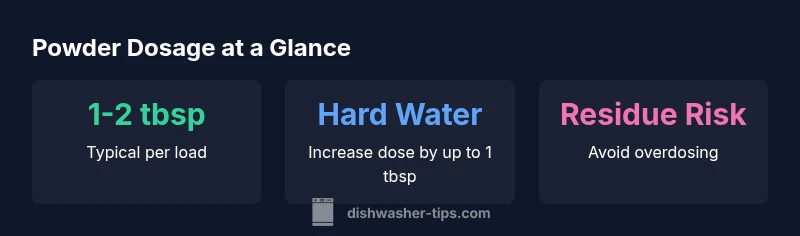
Most standard automatic dishwashers use 1 to 2 level tablespoons of dishwasher powder per load. Start with 1 tablespoon for lightly soiled dishes and increase to 2 tablespoons for heavy soils or hard water, then adjust based on results. Always follow the detergent’s packaging and your machine’s manual.
Why the Right Amount Matters
Getting the dosage right is essential for consistently clean dishes, efficient rinse cycles, and avoiding residue or suds that cling to glassware. According to Dishwasher Tips, the right powder amount depends on load size, soil level, and regional water hardness. When dosed correctly, powder dissolves evenly, reduces streaking, and helps the dishwasher complete its full cleaning cycle without needing extra washes. This section lays the groundwork for practical dosing by explaining how misdosing affects cleansing performance and energy use, which matters for homeowners and renters seeking reliable, AI-informed maintenance tips.
How Much Powder by Load Type
Dosing should scale with load type:
- Lightly soiled loads (glassware, plastics): 1 tablespoon as a starting point. If water is soft, this amount is often enough.
- Moderately soiled loads: 1 to 1.5 tablespoons, adjusting up to 2 tablespoons if residues persist.
- Heavy soils or pots and pans: 2 tablespoons as a baseline, possibly up to 2.5 when water is very hard. Always monitor results and adjust conservatively.
This approach aligns with typical user experiences and the guidance distilled from Dishwasher Tips Analysis in 2026. Remember that dishwasher models vary, and some may tolerate slightly more or less powder without adverse effects. To optimize performance, test one adjustment at a time and record outcomes for future reference.
The Role of Water Hardness
Water hardness is a major determinant of how much powder you should use. In hard water regions, minerals can bind with detergent, reducing effectiveness. The Dishwasher Tips team recommends starting at the higher end of the moderate dose range and evaluating results after a full wash cycle. If you notice film, white spots, or cloudiness, increase the dose slightly or consider a chelating additive recommended by your detergent manufacturer. For very soft water, you may reduce by 0.5 teaspoon to prevent over-sudsing and rinse inefficiency.
Soil Level, Dishwasher Type, and Detergent Efficiency
Your dishwasher’s design also influences dosing. Some older or non-HE machines may need a touch more powder for the same soil level, while modern HE models are designed to work with lower suds formulations. When selecting powder, verify that it’s compatible with your dishwasher’s rating (HE vs standard). If you regularly run heavy cycles, you might settle on 2 tablespoons for those cycles, but for routine daily washes, 1–1.5 tablespoons is often sufficient. Consistency matters: uniform dosing across cycles improves predictability and cleaning results.
How to Measure Powder Correctly
Accuracy matters more than you might think. Use standard U.S. measuring spoons (teaspoons and tablespoons) rather than guessing with a lid or scoop. Level off the powder with the flat edge of a knife or spoon for precise dosing. If your dishwasher has a detergent dispenser with a dosing chamber, fill it to the recommended line rather than packing powder into it. For powder that clumps, dry the powder before loading it into the dispenser or switch to a brand formulated to resist clumping. This method reduces under- or over-dosing and ensures consistent performance.
Troubleshooting and Adjustments
If dishes come out with film or residue, first check for under-dosing, then adjust by 0.5 teaspoon increments until results improve. If you see excess suds or a soap film, reduce the dose slightly and run a normal cycle with an empty load to flush out residual soap. Keep a simple log of load type, powder amount, water hardness, and results to guide future choices. Adopting a consistent dosing routine helps homeowners and renters achieve reliable dishware cleanliness.
],
headers":["Load Type","Powder Amount (teaspoons)","Notes"],"rows":[["Lightly soiled (glass, plastics)","3","Use 1 tablespoon (3 tsp) as a starting point"],["Moderately soiled","6","Increase to 1.5–2 tablespoons (4.5–6 tsp) if needed"],["Heavily soiled or pots","6-9","Consider 2–3 tablespoons (6–9 tsp) for hard water"],"caption":"Guidance on powder dose by load type"
Guidance on powder dose by load type
| Load Type | Powder Amount (teaspoons) | Notes |
|---|---|---|
| Lightly soiled (glass, plastics) | 3 | Use 1 tablespoon (3 tsp) as a starting point |
| Moderately soiled | 6 | Increase to 1.5–2 tablespoons (4.5–6 tsp) if needed |
| Heavily soiled or pots | 6-9 | Consider 2–3 tablespoons (6-9 tsp) for hard water |
People Also Ask
How do I know if I’m using too much powder?
If you notice persistent white film, cloudy glassware, or excess suds after a cycle, you may be overdosing. Start by reducing the dose by 1/2 teaspoon and re-running a cycle to compare results.
If you see film or extra suds, dial back the powder by a small amount and test again.
Should I use powder in HE (high-efficiency) dishwashers?
Many HE dishwashers are designed for low-suds formulas. Check your manual and the detergent label; some powders aren’t optimized for HE washing and can cause residue or foaming.
HE models usually work best with low-suds powders; follow the instructions on your detergent package.
Can water hardness affect powder dosage?
Yes. Hard water can reduce cleaning efficiency, potentially requiring up to an extra 0.5–1 tablespoon. Test and adjust based on results and consider a water-softening option if issues persist.
Hard water may mean you need a bit more powder to get the same cleanliness.
Is it okay to pre-dissolve powder before loading?
Pre-dissolving is not necessary and can cause clumping or spillover. The powder is designed to dissolve as the wash starts.
No need to pre-dissolve; just add to the dispenser and start the cycle.
What if I’m using powder at the same time as pods?
Avoid mixing powder with pods. Follow the packaging recommendations for your chosen detergent form—dosage cannot be directly converted between formats.
Stick to the detergent form you choose and don’t mix products.
How should I adjust for small loads?
For small, lightly-soiled loads, use about 1 teaspoon to 1 tablespoon, depending on soil and water hardness. Increase only if needed after testing a cycle.
Start small and test; you can scale up if the load isn’t clean.
“Getting the dosage right is one of the most effective steps for consistently clean dishes across cycles.”
What to Remember
- Start with 1 tablespoon for light loads; increase to 2 tablespoons for heavier soils.
- Hard water can require up to an extra tablespoon—test and adjust.
- Measure powder with level spoons for consistency.
- Avoid overdosing to prevent residue and extended wash times.
- Follow detergent packaging and your dishwasher manual for model-specific guidance.