How Much Dishwasher Gel to Use: A Practical Guide
Learn how to measure dishwasher gel correctly for reliable cleaning, energy efficiency, and minimal residue. This guide explains load sizing, soil level, water hardness, and how to adjust dosage safely.


To get clean dishes without residue, use the amount your gel brand recommends, typically 1–2 tablespoons (15-30 ml) per standard load. For heavily soiled or large loads, increase to 2–3 tablespoons (30-45 ml). Use less for small loads or high-efficiency machines, and avoid bottling gel beyond the cap. When in doubt, start with the manufacturer’s guidance and adjust gradually.
Why the right gel amount matters
Choosing the correct amount of dishwasher gel is essential for clean dishes, energy efficiency, and minimizing residue. According to Dishwasher Tips, using the recommended dose helps balance cleaning power with rinse performance, reducing the need for rewashes. When you use too little gel, food particles may cling to surfaces and the dishwasher may use more cycles to compensate. Overdosing can create excess suds, leave a cloudy film, and place stress on your dishwasher’s pump and seals.
Key consequences of dosing decisions:
- Under-dosing often results in dull dishes and stubborn spots.
- Over-dosing usually yields cloudy residue on plastics and glasses.
- In both cases, you may end up re-running cycles, wasting water and electricity.
Beyond cleaning, the dose interacts with water hardness, cycle selection, and detergent formulation. Gel detergents come with a dosage range on the label. Modern machines assume a certain water supply and spray pattern; deviating from this can affect dispersion. If you use a gel designed for low-suds operation, you may be able to use slightly less. The goal is consistent, reliable cleanliness without waste. A well-measured dose also protects seals and prevents buildup in the dispensing cup.
How to read your gel's dosage instructions
Gel detergent bottles provide a dosage guide usually inside the label or on the back. Look for terms like 'capful,' 'tablespoons,' or 'milliliters.' Some brands use a graduated bottle top with a marked line; others use a standard household tablespoon measurement. Always identify the recommended load type (standard, heavy soil, or pots and pans), and note any adjustments for water hardness or rinse aid. If the label offers multiple options, start with the lower end for an average load and increase only if needed. Before you begin, check that the dishwasher’s detergent compartment is clean and dry; a wet capsule can dissolve prematurely and cause over-sudsing. If you’re unsure, capture the dose in a separate measuring cup for consistency across cycles. Finally, record what you used for future reference.
Factors influencing gel dosage
Several variables influence how much gel you should use. Load size determines the starting point: a small load needs less gel, while a full rack with many utensils may require more. Soil level matters too: lightly soiled dishes can get clean with the lower end of the range, whereas heavily soiled pots and pans may need additional gel to break down stubborn residues. Dishwasher type (standard vs. high-efficiency) influences dosage because high-efficiency machines use less water and rely on precise dosing for effectiveness. Water hardness and mineral content can reduce cleaning power if the gel is not strong enough for the water you have. Finally, the gel formula (concentrated, low-suds, or standard) influences how the dose translates to rinse performance and film formation.
Gel dosage by load and soil level
For most standard loads, start with 1–2 tablespoons (15–30 ml). If you are cleaning heavily soiled cookware or large quantities, consider 2–3 tablespoons (30–45 ml). For small loads or lightly soiled dishes, you can use the lower end or even ahem slightly less if your label allows. If your water is very hard, you might need to test a cycle with a slightly higher dose, but never exceed the maximum recommended by the label. Always ensure the dosage corresponds to the cycle you choose (normal, heavy, or quick wash) to avoid over- or under-dosing. A slightly larger dose isn’t always better; start with conservative amounts and observe results over a few cycles.
Gel vs pods and other detergents
Gel detergents are liquid formulations that measure dose linearly with the bottle’s cap or a measuring spoon. Pods and powders behave differently because pods contain a pre-measured amount designed for whole cycles, sometimes with two chambers for different cleaning actions. If you switch between gel and pods, use only one detergent type per load and adjust your expectations accordingly. Pods can simplify dosing but may be less flexible for small loads. Gel allows finer control, which can be advantageous for very light or very dirty loads.
Practical dosing tools and methods
Use a dedicated measuring spoon or the bottle’s cap to ensure accuracy. Place the measuring tool over the detergent compartment to avoid spills. For highly variable loads, consider keeping a small log of the dose used per cycle to identify patterns that yield consistently clean results. If your bottle has a cap with measurement lines, align the line with the fill point when pouring. Store detergent upright and away from heat to prevent degradation and accidental spills.
Common mistakes and how to fix
Common mistakes include guessing dosages, under-loading, or rinsing dishes excessively before loading. If you notice white film on glassware or residue on plastics, adjust by increasing the dose slightly on the next cycle or checking for spray-arm obstructions. Conversely, if you see excessive suds or a foam spill, reduce the dose and ensure the bottle is sealed properly. Always consider water hardness and cycle selection before changing the dose. Regularly inspect the detergent cup for cleanliness to avoid trapping gel, which can alter the measured dose.
Special cases: high-efficiency machines, hard water, and baby bottles
High-efficiency machines use less water, so precise dosing is crucial. For very hard water, manufacturers often recommend a slightly higher dose, but always within the label’s max. Baby bottles and dishwasher-safe baby gear may require a specific rinse cycle and a careful dose to ensure no residue remains. If you own a countertop or compact model, use the smaller end of the dosage range and consider a cycle suited for light loads. When in doubt, start low and gradually increase as you confirm results.
Tools & Materials
- Dishwasher gel detergent (liquid)(Liquid gel designed for automatic dishwashers; check label for dose guidelines)
- Measuring tool(Cap or dedicated tablespoon to measure 1–2 tablespoons portions)
- Water hardness test (optional)(Helps tailor dosing in very hard water areas)
- Rinse aid (optional)(Can improve drying, not required for gel dosing)
- Gloves (optional)(Protect skin when handling strong detergents)
Steps
Estimated time: 30-60 minutes
- 1
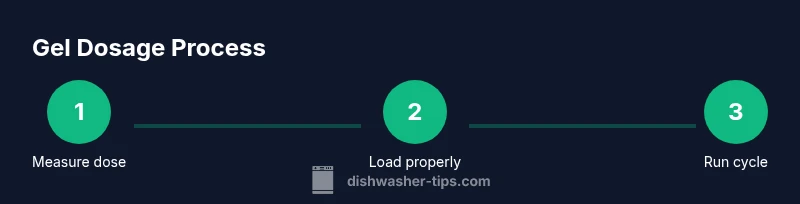
Measure the gel accurately
Inspect the label to find the recommended dose for your load. Use a measuring spoon or the bottle cap to portion 1–2 tablespoons for standard loads. If the label indicates milliliters, convert to the nearest practical amount and pour into the detergent reservoir. Avoid pouring gel directly onto dishes to prevent oversaturation of the glassware.
Tip: Pour over a towel to catch spills and wipe the reservoir rim after dosing. - 2
Load the dishwasher correctly
Arrange dishes so water and spray arms can reach every item. Place plates and bowls facing the center, keep bulky items from blocking spray arms, and avoid nesting utensils too tightly. Do not block the detergent cup; ensure it opens freely during the wash.
Tip: Load cups upside down or at a slight angle for better draining. - 3
Close and run a normal cycle
Close the door firmly and select a standard cycle with the water temperature and pre-wash options according to the load. Start the cycle and let the machine do the work. Ensure the detergent compartment seals properly after the cycle begins to prevent leaks.
Tip: Record the cycle type used for future reference to compare cleanliness. - 4
Evaluate results and adjust
After the cycle, inspect dishes for cleanliness and look for any film or residue. If needed, adjust the dose slightly higher for the next cycle or reduce for lighter loads, staying within the label’s max. Repeat a couple of cycles to confirm the adjustment works.
Tip: Keep a simple log of dose and results to optimize future loads. - 5
Store and maintain
Keep the detergent in its original container, tightly closed, and away from heat. Check expiry dates and replace if the gel thickens or smells off. Clean the detergent cup periodically to prevent buildup that can affect dosing accuracy.
Tip: Store upright to prevent leaks and ensure the cap lines stay visible.
People Also Ask
What happens if I use too much gel?
Using too much gel can cause excessive suds, leave a cloudy film on plastics, and may require a rerun. It can also place more strain on the pump. Start with the recommended dose and adjust only if necessary.
Too much gel can cause suds and residue, making it harder to rinse. Start with the recommended amount and test a cycle.
Can I mix gel with powder or tablets in the same load?
Do not mix detergent forms in the same load. Use one detergent type per cycle to avoid unpredictable results and potential residue.
Don't mix detergents in one cycle; use either gel, pods, or powder.
Is the cap measurement always accurate?
Caps are designed to measure doses for the bottle's formulation. Verify the measurement lines on the cap and use the bottle’s guidelines to ensure consistency.
Caps are usually accurate; follow the marks and the label.
How does water hardness affect dosing?
Hard water can reduce cleaning efficiency, so you might need a slightly higher dose within the label's max. Test a couple cycles to find the right amount.
Hard water may need a bit more gel; test a few cycles to decide.
Should I adjust the dose for small loads?
Yes. For small loads, use the lighter end of the dose range and avoid over-dosing small batches.
Yes, use a smaller dose for small loads.
What if my dishwasher has an auto-dose feature?
If your dishwasher auto-doses, follow the appliance’s guidance and use manual dosing only when the feature isn’t active or if the manual dose is needed for special cycles.
Let auto-dose handle most cycles, and only adjust manually if needed.
Watch Video
What to Remember
- Start with the label’s dose and adjust gradually.
- Consider load size, soil level, and water hardness.
- High-efficiency machines require careful dosing as per label.
- Keep a simple log to optimize future cycles.