How to Make Dishwasher Pods: A Practical DIY Guide
A complete, practical guide to crafting your own dishwasher pods at home, including ingredients, step-by-step instructions, safety tips, storage, and cost considerations. Learn with examples from Dishwasher Tips.


You can make your own dishwasher pods at home using common pantry ingredients and a simple molding process. This quick guide outlines a safe, scalable recipe, storage tips, and troubleshooting to keep pods stable and effective. According to Dishwasher Tips, DIY pods can reduce plastic waste, save money over time, and let you tailor cleaning power to your needs.
What are DIY dishwasher pods and why consider making them
If you’re curious about how to make dishwasher pods, you’re exploring a DIY option that can cut down on plastic packaging and give you control over the ingredients you use in your kitchen. DIY pods are concentrated cleaners molded into single-use shapes that dissolve in your dishwasher during the wash cycle. They’re convenient, reduce trips to the store, and can be customized to address hard-water minerals or scent preferences. According to Dishwasher Tips, home-made pods can offer cost savings over time when scaled, especially for households that run multiple loads per week. Before you begin, assess your dishwasher model and water hardness, as these factors influence how you formulate the mix and how well the pods hold together. This section lays the groundwork, including safety considerations and what you’ll need to get started. The goal is to build a reliable, repeatable process that yields consistent results in every batch.
wordCountNote": null? // placeholder, will be ignored by parser
Tools & Materials
- Washing soda (sodium carbonate)(1-2 cups for the dry mix)
- Citric acid(1 cup helps boost cleaning power and acts as a drying agent)
- Baking soda(1/2 cup (optional) to soften water and balance pH)
- Grated unscented Castile soap or mild liquid dish soap(0.5-1 cup grated soap or 1/4-1/2 cup liquid soap)
- Cornstarch or tapioca starch(1-2 tablespoons to improve binding)
- Water spray bottle(Spritz gradually to moisten the dry mix)
- Silicone molds or reusable ice cube trays(For pod shapes; helps release without crumbling)
- Gloves and eye protection(Protect skin from powders; use a mask if sensitive to dust)
- Measuring cups and spoons(Accurate measurements improve consistency)
- Airtight storage container(Keeps pods dry and ready for use)
Steps
Estimated time: 60-90 minutes active work, plus 24-48 hours drying
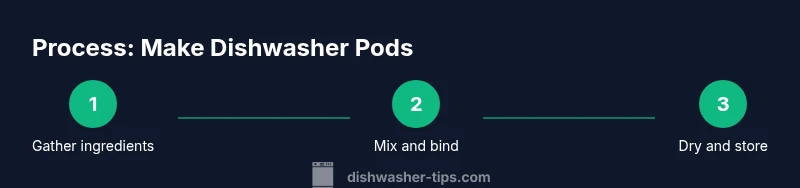
- 1
Gather and measure dry ingredients
In a large mixing bowl, measure 1 cup washing soda, 1 cup citric acid, and 1/2 cup baking soda. Add 1/2 cup cornstarch if using. This creates a stable base that dissolves cleanly in the wash. Keep your workspace dry to prevent premature clumping.
Tip: Sift the powders into the bowl to minimize lumps and improve uniformity. - 2
Incorporate the binding agent
Add grated unscented Castile soap (or 1/4-1/2 cup liquid soap) to the dry mix. Mix thoroughly so the soap distributes evenly, which helps the pods hold their shape.
Tip: Grating soap yields a finer, more even distribution than chunks. - 3
Moisten gradually with care
Lightly spritz the dry mix with a spray bottle while stirring. Add only enough moisture to allow the mixture to clump when squeezed; too much moisture will cause fizzing and hard-to-form pods.
Tip: Work in short bursts and test by squeezing a pinch in your hand. - 4
Add binding aids
If the mixture is still crumbly, sprinkle 1-2 tablespoons of cornstarch and stir until the consistency resembles damp sand that holds shape. This helps pods maintain form after drying.
Tip: Avoid over-wetting; the goal is a cohesive but not slick texture. - 5
Fill molds and compress
Firmly press the moistened mixture into silicone molds, compacting each cavity to remove air pockets. A light tap on the mold helps settle the material for a uniform pod.
Tip: Overfill slightly and level the tops to ensure straight edges. - 6
Unmold and air-dry
Carefully release the pods from the molds onto a clean tray. Allow them to air-dry in a cool, dry place away from direct sunlight for 24-48 hours until fully hard.
Tip: Place pods on parchment to prevent sticking and make transfer easier. - 7
Test one pod in a standard cycle
Run a trial load with one pod to observe dissolution, suds, and cleaning performance. If residue remains or the pod crumbles, reassess moisture and binding strength.
Tip: Start with a load of towels or a simple dishware batch to gauge effectiveness. - 8
Store properly and label
Store finished pods in an airtight container in a cool, dry area. Label batches with date to ensure you’re using the freshest pods first.
Tip: Keep out of reach of children and pets; pods resemble candy shapes.
People Also Ask
Is it safe to use homemade dishwasher pods in all dishwasher models?
Homemade pods can work in many modern dishwashers, but performance varies with water hardness and model. Begin with a small batch and test to avoid residue issues. Always supervise initial uses and adjust moisture and binders as needed.
Homemade pods work in many models, but start with a small batch to test performance and avoid residue.
What ingredients are essential for DIY dishwasher pods?
A typical core includes washing soda, citric acid, and a mild soap for cleaning and binding. Optional baking soda can adjust pH, while starch improves cohesion. Avoid adding fragrances that may leave residues.
The core is washing soda, citric acid, and a mild soap; add starch for cohesion if needed.
How long do homemade pods take to dry?
Pods generally take 24-48 hours to dry in a cool, dry place. Temperature and humidity can affect drying time, so plan for a full day or two.
Typically 24 to 48 hours to dry fully.
Can I customize pods for hard water or fragrance?
Yes, adjust the citric acid level for mineral control and omit fragrance to avoid residue. Adding a small amount of conditioner-free soap can help with cleaning in hard water.
You can tweak citric acid for hard water and skip fragrances.
What should I do if pods crumble after unmolding?
Increase moisture slightly or add 1-2 tablespoons of starch to improve binding. Let the pods cure longer in a dry area before testing again.
If they crumble, adjust moisture and binding agents and re-dry longer.
Watch Video
What to Remember
- Prepare your ingredients and tools before starting
- Moisture control is critical for pod stability
- Drying time is essential for hard, durable pods
- Test performance on a single cycle before scaling