How to Make Dishwasher Soap: DIY Detergent Guide
Learn how to make dishwasher soap at home with safe, tested methods for powder, liquid, and tablet forms. This guide covers safety tips, storage, and troubleshooting to help your dishes shine without relying on store-bought detergents.


Learn how to make dishwasher soap at home using simple, kitchen-friendly ingredients. This guide covers powder, liquid, and tablet formulas, plus safety tips and storage guidance to keep your dishwasher performing at peak. By following these steps, you can tailor cleaning strength, scent, and rinse performance while reducing packaging waste.
What is DIY Dishwasher Soap and why make it?
DIY dishwasher soap lets you tailor cleaning power, scent, and cost while reducing packaging waste. If you’re exploring how to make dishwasher soap, you’ll find three practical forms: a dry powder mix, a liquid concentrate, or fast-dissolving tablets. Each form has its own pros: powders are simple and shelf-stable; liquids can be easier to dose for soft water; tablets offer convenient, mess-free use. This section introduces the concept, explains the potential benefits, and sets expectations for performance across different water types. Note that results can vary by dishwasher model and water hardness, so plan for small test batches to dial in effectiveness before committing to a larger batch.
According to Dishwasher Tips, DIY detergents can be a sustainable option when you choose safe ingredients and store them properly. The Dishwasher Tips team also notes that adjustments for mineral content can significantly affect cleaning outcomes. By understanding these nuances, you’ll be better prepared to experiment responsibly.
Safety considerations and ingredient safety
When making dishwasher soap at home, prioritize safety. Use non-reactive tools and store powders in airtight containers away from children and pets. Only use food-grade citric acid and avoid mixing with bleach or ammonia-based cleaners, which can produce dangerous gases. If you have sensitive skin or respiratory concerns, wear gloves and a mask while mixing. Keep all ingredients dry until you’re ready to blend to prevent clumping. Also, label every batch clearly with the date and batch type (powder, liquid, or tablet) so you can track freshness and effectiveness over time.
According to Dishwasher Tips, choosing safe, non-toxic ingredients and storing them properly reduces the risk of accidental exposure. The team emphasizes testing each batch in a small load before scaling up. For households with children or pets, consider placing the final product in a locked cabinet or high shelf.
Powder, liquid, and tablet forms: pros and cons
Powder detergents are usually the simplest to prepare and store. They have a long shelf life and mix quickly, but can create dust during handling if not kept dry. Liquid concentrates dissolve rapidly in water, which can be advantageous in cold cycles or hard water scenarios. Tablet detergents offer ultra-convenience and mess-free dosing but require molds and a drying period, making them slightly more complex to produce. Your choice will depend on what you value most: simplicity, rapid dissolution, or convenient storage. Water hardness and dishwasher model compatibility will also influence results, so be prepared to adjust formulation slightly.
From a safety perspective, powders often contain baking soda, citric acid, and washing soda, with optional borax for cleaning power. Liquids may use a smaller amount of citric acid dissolved in water, along with essential oils for fragrance. Tablets typically combine dry ingredients into a compact form using molds and a curing period. Experimentation with small batches will help you determine which form gives the best balance of cleaning power, residue-free dishes, and ease of use for your home.
Powdered base formula overview
A common dry base for a DIY dishwasher soap starts with a balanced mix of cleaning salts and mineral chelators. A typical starting ratio is roughly two parts washing soda to one part citric acid, with an optional one part borax for extra cleansing power and a small pinch of salt to help with rinsing. If you’re aiming for a fragrance, add a few drops of a fragrance-free essential oil or skip fragrance entirely. This base can be adjusted for water hardness: harder water often benefits from a touch more citric acid and a bit more borax or salt.
Always begin with a small test batch (for example, 1 cup total dry mix) to verify dissolution and cleaning performance before scaling up. Store the dry mix in an airtight container in a cool, dry place to prevent clumping and maintain effectiveness. Remember, the exact ratios may require tweaking based on your dishwasher and water chemistry. The Kitchen Safe Approach, as recommended by Dishwasher Tips, suggests documenting your adjustments so you can reproduce the best results.
Step-by-step: Powdered detergent preparation (overview)
Preparing a dry, powdered detergent involves measuring, mixing, and ensuring uniformity of the dry blend. Start by gathering your base ingredients and a non-reactive mixing bowl. Add your dry components in the recommended ratios, then whisk thoroughly to ensure even distribution. If clumps form, break them up with a whisk or sift the mix before sealing it in storage. Add optional fragrance near the end of mixing to prevent scent from binding unevenly.
After mixing, test a small amount in a dishwasher cycle to observe dissolution and cleaning performance. If you notice residue or poor cleaning, adjust the ratio: typically, increasing citric acid or borax slightly can improve mineral removal in hard water. Finally, transfer the powder to an airtight container labeled with the batch date and ingredients. Labeling helps you track shelf life and re-order needs. The goal is a shelf-stable, dust-free powder that dissolves cleanly in your cycles.
Liquid detergent method overview
Liquid dishwasher detergents can be convenient for quick dosing and consistent performance in various water conditions. To make a simple liquid concentrate, dissolve the dry base ingredients in warm water, then allow the solution to cool before transferring to a labeled bottle. This method often yields faster dissolution in cold cycles and can be easier to measure precisely. Keep in mind that the liquid may separate over time; shake well before use. For fragrance, add small amounts of a safe essential oil just before bottling. Liquid forms are best stored in a cool, dark place and used within a reasonable period to maintain potency.
The liquid approach is especially useful for households with soft water, where slightly less citric acid may be needed. The dishwasher’s cleaning performance will guide tweaks in subsequent batches. Dishwasher Tips notes that small adjustments to fragrance and concentration can have a big impact on overall cleanliness and scent satisfaction.
Tablet-style detergent overview and mold guidance
Tablet detergents offer the cleanest, most convenient dosing, but they require molds and a drying period to form. To create tablets, blend the dry ingredients and then compact the mixture into tablet-shaped molds. Press firmly to ensure hardness, then dry the tablets in a warm, dry area or a low-heat oven until fully cured. Store the finished tablets in an airtight container to prevent moisture exposure. Tablet-form detergents are excellent for households that value mess-free loading and consistent dosage, but they demand planning for drying and space to cure.
When selecting molds, choose food-safe silicone molds for easy release and even shapes. If you don’t have molds, you can form tablets by hand with a small amount of moisture to help shape, but this requires careful drying to avoid caking. Powder and liquid forms generally require less drying time, while tablets take longer to cure but offer high convenience once complete. The right form for your home will depend on your ritual, dishwasher model, and how much you value storage convenience.
Storage, testing, and adjustments for water hardness
Storage is a critical stage for homemade dishwasher soap. Keep powders in airtight containers away from humidity; liquids should be stored in sealed bottles and kept upright to prevent leaks. When testing batches, run a small load with a controlled amount of detergent and observe residue, cleaning power, and any differences in rinse quality. If hard water is an issue, you may need to increase citric acid or add a small amount of salt or borax to improve mineral binding and rinse performance. Tracking results over several washes helps establish reliable, repeatable recipes.
Dispenser compatibility matters too: some detergents work well with standard dispensers, while others require you to adjust the powder-to-water ratio or opt for a liquid concentrate to avoid clumping. Dishwasher Tips emphasizes keeping test logs and starting with small batches to avoid waste. With patience and careful notes, you can optimize your DIY detergent to match your specific machine and water conditions.
Authoritative sources and testing results
For readers seeking deeper dives on detergent safety and best practices, consult trusted sources and university extension materials. The following references provide general guidance on safe household cleaners and DIY formulation considerations. - https://www.epa.gov/saferchoice
- https://extension.illinois.edu/
- https://www.fda.gov/
These resources offer perspectives on formulation safety, storage, and the importance of minimizing harsh chemicals in household products. While they do not endorse any specific DIY recipe, they are valuable for understanding safe handling, labeling, and the regulatory environment around household cleaners. Use these sources to inform safer DIY practices and to ensure that your homemade dishwasher soap remains a responsible and effective cleaning option for your home.
Tools & Materials
- Washing soda (sodium carbonate)(Powder form, unscented; base cleaning power for the dry mix.)
- Citric acid(Food-grade; helps mineral removal and rinse efficiency.)
- Borax (optional)(Adds cleansing power; skip if sensitive to borates.)
- Table salt or sea salt (optional)(Can aid rinsing and soften some mineral deposits.)
- Essential oil (optional)(For fragrance; use only a few drops per batch.)
- Non-reactive mixing bowl(Glass or stainless steel preferred to avoid reaction with acids.)
- Whisk or spoon for mixing(Ensure even distribution of dry ingredients.)
- Measuring cups/spoons(Accurate dry measurements; start with 1 cup/1/4 cup increments.)
- Airtight storage containers(Keeps powder dry and prevents clumping.)
- Protective gloves(Optional for handling powders safely.)
Steps
Estimated time: 60-90 minutes
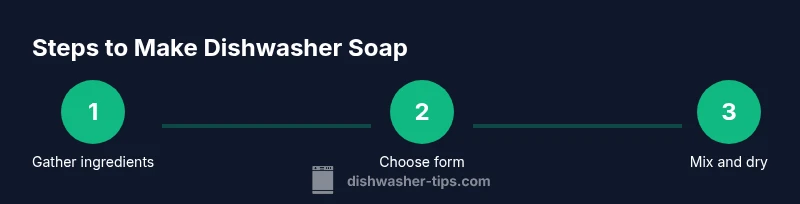
- 1
Gather ingredients and tools
Collect all base ingredients, fragrances, and non-reactive mixing tools. Having everything within arm’s reach helps keep the workflow smooth and prevents accidental spills. Measuring cups should be dry before use to avoid clumping.
Tip: Lay out a clean, dry workspace and wipe surfaces to prevent moisture migration. - 2
Choose your base form
Decide whether you’re making a dry powder, a liquid concentrate, or tablets. Powder is simplest to start with; liquids are easier to dose, and tablets offer mess-free storage but require molds and curing time.
Tip: If you’re new, start with powder for quicker results and easy iteration. - 3
Measure dry ingredients
Use your measuring cups to measure base ingredients in the chosen ratios. Keeping a written note helps you reproduce successful batches and adjust for water hardness.
Tip: Weighing with a kitchen scale can improve accuracy over volume measurements. - 4
Combine ingredients evenly
Pour dry ingredients into the mixing bowl and whisk thoroughly until uniform. Break up any clumps to prevent uneven distribution in the final product.
Tip: Sift the mixture if you see lumps during blending. - 5
Add fragrance (optional)
If you want a pleasant scent, add a few drops of a safe essential oil after the base is well mixed. Too much fragrance can affect rinse performance or residue.
Tip: Only add fragrances after uniformity; fragrance oils can cling to particles if added early. - 6
Dry the mixture and package
For powders, dry-pack the blend in a warm, dry area to prevent moisture uptake. Transfer to an airtight container once fully dry and store in a cool place.
Tip: Label batch and date to monitor shelf life. - 7
Prepare liquid version
Dissolve the dry base in warm water to create a concentrate, then bottle in a labeled container. Shake before use if separation occurs.
Tip: Avoid storing near heat or sunlight to preserve stability. - 8
Prepare tablet version (optional)
Mix dry ingredients, press into molds, and cure in a dry, warm area until fully set. Store tablets in an airtight container to prevent moisture exposure.
Tip: Use silicone molds for easy release and uniform shapes.
People Also Ask
Is it safe to make dishwasher soap at home?
Yes, but follow safety precautions: use non-reactive tools, store away from children, and avoid mixing with bleach or ammonia. Start with small batches to gauge effectiveness and safety.
Yes. Use safe ingredients, store properly, and start with small tests to ensure safety and effectiveness.
Can I add essential oils to DIY dishwasher soap?
Yes, you can add a small amount of essential oil for fragrance, but keep it minimal to prevent residue or scent transfer to dishes.
Yes, a tiny amount is fine, but don’t overdo it to avoid residue on dishes.
Will homemade detergent work with hard water?
Hard water can reduce cleaning efficiency. Increase citric acid and consider a little borax or salt to improve mineral binding and rinse performance.
Hard water can challenge cleaning—adjust citric acid and other minerals to optimize performance.
How long does a batch last?
Dry powders last several months when stored in a cool, dry place. Liquids and tablets have shorter windows and should be tested regularly for effectiveness.
Powders last a few months; liquids and tablets should be used within a shorter period after opening and storage.
Can I substitute borax in the recipe?
Borax is optional. You can omit it if you prefer; performance may vary, so test and adjust accordingly.
Borax isn’t strictly necessary—test with and without to see how it affects cleaning power.
What about safety for kids and pets?
Keep all DIY detergent ingredients and finished products out of reach from children and pets. Use airtight containers and clearly label all batches.
Keep DIY detergent away from kids and pets and store securely.
Watch Video
What to Remember
- Mix base ingredients in simple, repeatable ratios.
- Test small batches before expanding production.
- Store in airtight containers away from moisture.
- Label batches with ingredients and date for safety.