Is Dishwasher Detergent Better Than Pods? A Practical Comparison
An evidence-based, practical comparison of liquid/powder dishwasher detergents versus pre-measured pods. Learn about cleaning performance, dosing flexibility, cost, convenience, and environmental impact to decide what works best for your home in 2026.


Between liquid/detergent and pre-measured pods, is dishwasher detergent better than pods? The short answer depends on your priorities: dosing accuracy, packaging waste, and cost per load. For broad compatibility and flexible dosing, detergent wins; for convenience and consistent dosing, pods have the edge. This article analyzes the trade-offs to help you decide.
Understanding the core question: is dishwasher detergent better than pods?
At its essence, this question asks how two common options perform across cleaning power, cost, and practicality. For homeowners and renters, the choice affects money, waste, and the risk of misdosing in everyday loads. In this article we will compare liquid/detergent options with pre-measured pods, considering a range of dishwasher models, water conditions, and family sizes. According to Dishwasher Tips, the most meaningful comparisons consider not only final cleanliness but also ease of use, packaging and disposal, and compatibility with your machine. The phrase 'is dishwasher detergent better than pods' therefore depends on the lens you bring: do you value perfect dosing and low spill risk, or do you prioritize convenience and minimal handling? Throughout this guide we’ll unpack these factors, cite practical examples, and offer actionable tests you can run in the next month. This is not a one-size-fits-all answer; it’s a framework to help you decide based on your actual usage patterns in 2026.
wordCount”:208},
Differences in formulation and dosing between detergents and pods
Dishwasher detergents come in liquids, powders, and tablets, each with a matrix of enzymes, builders, surfactants, and occasional boosters. Liquid and powder forms give you control over dose, making partial loads and residue-prone days easier to handle. Pods are pre-measured solutions, designed to deliver a consistent amount per cycle with minimal user error. The formulations often rely on the same core chemistry but are packaged to exploit convenience and user-friendliness. One important nuance is how each format handles water hardness and temperature; pods may rely on their encapsulation to begin dissolving as the cycle progresses, whereas loose powders dissolve upon contact with water. In practice, your dishwasher’s performance is influenced by your chosen format, how you store the product, and the cycle you run. When evaluating is dishwasher detergent better than pods, weigh how flexible you need dosing, how much mess you’re willing to manage, and whether you are comfortable with the packaging footprint of each option.
wordCount”:161},
How performance varies with cycle conditions and load size
Performance in cleaning power is tied to the cycle length, water temperature, and soil load. With larger households or heavy soils, traditional detergents offer flexible dosing, allowing you to tailor the amount to the load. Pods provide predictable dosing that can simplify weekday routines, reducing the risk of under- or over-sudsing. In shorter cycles or cooler water conditions, some formulas may not fully dissolve, leading to white residue or dull dishes. In general, test a few cycles with both formats to observe differences in dish clarity, film, and utensil spotting. The takeaway is that the best choice is not solely about the chemical strength but about how reliably that strength translates under your normal usage patterns. The overall experience includes handling, storage, and potential residue on glassware, not only the final cleanliness score.
wordCount”:190},
Cost and value: price per load vs upfront cost
Cost is a major consideration when weighing is dishwasher detergent better than pods. Liquids and powders typically require measuring, which can reduce waste when loads are small but may add cost if you frequently run smaller cycles with less product per use. Pods tend to be pre-measured, offering convenience and consistent dosing, but the per-load price can vary with brand and packaging. In general, the value question hinges on load patterns, cycle length, and how much you value mess-free handling. Keep in mind that the packaging and shelf life of powders, liquids, and pods can influence long-term costs. Rather than chasing the lowest sticker price, consider your typical load size, frequency of heavy soils, and maintenance costs like replacement dispensers and storage space.
wordCount”:178},
Environmental impact and packaging considerations
The environmental footprint of dishwasher detergents hinges on packaging and formulation. Powders and liquids may come in recyclable cartons and jugs, while pods are enveloped in soluble film and plastic wrappers. Packaging choices influence the total waste produced per month, especially if you run multiple loads weekly. Additionally, enzyme concentrations and eco-friendly additives vary by brand; some formulas emphasize phosphate-free formulations and reduced packaging. According to Dishwasher Tips analysis, consumers increasingly weigh packaging sustainability alongside cleaning performance. For households aiming to minimize plastic waste, loose powders with refillable containers or concentrated liquids can be a compelling option, provided you have a sustainable storage method. Ultimately, the eco-footprint is not just about the product but the entire lifecycle from production to disposal.
wordCount”:198},
Safety, handling, and maintenance considerations
Pods pose a distinct safety profile: the compact, pre-measured form means a small, easily swallowed object if left within reach of children or pets. Liquid and powder detergents require careful handling to avoid spills on skin or in the cabinet, where accidental mixing with other cleaners can occur. Storage considerations include keeping products away from heat and moisture, which can degrade powders and cause clumping. In terms of maintenance, using the wrong format can contribute to dispenser clogging or residue buildup if the cycle doesn’t fully dissolve the product. A practical approach is to store each format upright and clearly labeled, keep a simple measuring cup for powders, and ensure the dishwasher is filled according to the manufacturer’s guidelines. Also check that your chosen detergent is compatible with your dishwasher’s material and rating to avoid corrosion or film on glassware.
wordCount”:211},
Practical tips for choosing based on water hardness and dishwasher type
Water hardness affects how well detergents dissolve and how quickly residues form. In hard-water regions, powders can leave white mineral deposits unless fully dissolved by hot cycles; pods often handle hard water with their encapsulation, but may leave some film if cycles are short. If you own an entry-level or older dishwasher, you might prefer liquids or powders due to variable performance with pods on older seals. For high-temperature dishwashers and for households that regularly run long cycles, either format can perform well, provided you select a formula designed for your water quality. For renters or small households, the convenience of pods is appealing; for families with kids and lots of dishes, the flexibility of detergent can reduce waste and optimize dosing across different loads.
wordCount”:193},
Common misconceptions and myths debunked
Myth: Pods are always safer for households with children. Reality: all forms pose some risk if accessed by kids; keep pods in a locked cabinet. Myth: Liquid detergents clean better than powders. Reality: both can clean equally well when dosed correctly; it’s more about cycle conditions and soil type. Myth: Pods dissolve completely in every cycle. Reality: cycle time and water temperature matter; pilots in cooler cycles may leave solubilization incomplete. Myth: More expensive pods equal better cleaning. Reality: price doesn’t always reflect cleaning performance; consider compatibility with your dishwasher and soil levels. Understanding these nuances helps you choose based on real needs rather than marketing claims.
wordCount”:142},
Quick-start decision framework for households
To decide quickly, map your priorities: dosing flexibility, convenience, and environmental impact. If you value control and cost efficiency for large families, detergent may be preferable; if you value mess-free handling and predictable dosing for small households, pods can be the better option. Start with a gentle test by running a moderate load with a typical soil level using both formats over two weeks. Compare dish cleanliness, any film or residue, and whether there’s any dispenser clogging. Keep notes on packaging waste and storage space to inform your final choice. This framework gives you a practical way to tailor the decision to your actual usage, not just marketing claims.
wordCount”:141},
Implementation plan and final practical notes
After choosing an option, implement a 30-day testing plan to confirm your decision. Week 1 focuses on cleaning performance across a variety of loads; Week 2 evaluates ease of use and dosing accuracy; Week 3 assesses packaging waste and storage needs; Week 4 consolidates your findings and sets a stable routine. For households with variable water hardness, consider running a calibration cycle with a test load to observe residue and clarity. The Dishwasher Tips team recommends documenting results and adjusting your routine accordingly. As you finalize your choice, remember that successful dishwashing hinges on consistent practice, proper loading, regular maintenance, and using a product that fits your home’s conditions rather than chasing universal perfection.
wordCount”:196}],
comparisonTable
comparisonTable
items
rows
rows
Comparison
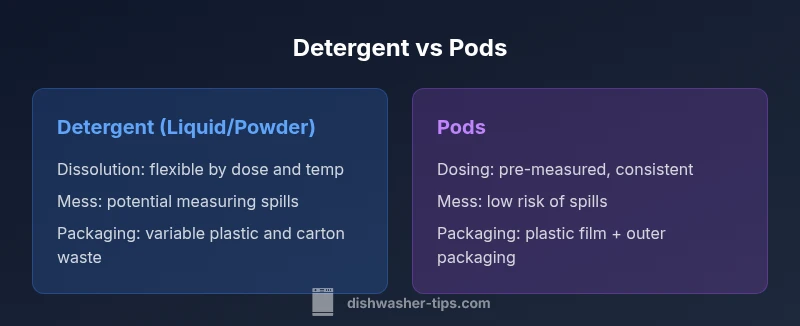
| Feature | Detergent (Liquid/Powder) | Pods (Pre-measured) |
|---|---|---|
| Dissolution / Dissolving Behavior | Flexible dissolution depending on dose and water temp | Pre-measured dose; dissolution tied to cycle timing |
| Dosing Control / Consistency | High control with manual dosing | Consistent dosing with no measuring |
| Convenience & Mess | Requires measuring; potential for spills | Mess-free handling; convenient |
| Packaging & Waste | Often larger packaging; empty containers recyclable | Plastic pods with film packaging; higher plastic footprint per load |
| Performance with Hard Water | Can tailor dose; more forgiving with hard water | Encapsulation helps but may rely on cycle conditions |
| Best For | Large families, variable loads, budget-conscious users | Small households, time-constrained users, portability |
The Good
- Offers dosing flexibility for varied loads
- Pods provide consistent, spill-free dosing
- Detergent options include powders and liquids for customization
- Can be cheaper per load when dialed in correctly
- Wide compatibility with cycle options and machine models
Disadvantages
- Pods can be pricier per load and generate plastic waste
- Powders or liquids require measuring and careful handling
- Some formats may not dissolve fully in short cycles
- Not all formulas are equally effective in hard water
Detergent generally wins for value and flexibility; pods excel in convenience for small households.
If you regularly run large loads or hard water cycles, choose detergent for better control and cost. If you prioritize ease and predictable dosing, pods are the simpler choice; your dishwasher and routine determine the best fit.
People Also Ask
Do pods dissolve in all dishwasher cycles?
Pod dissolution can vary with cycle length and water temperature. In short cycles or cooler water, a pod may not fully dissolve, leaving residue. Always choose a formula designed for your typical cycle and consider testing a few runs to observe performance.
Pod dissolution depends on cycle length and water temperature; test a couple of cycles to ensure full dissolution.
Are pods safer for households with children?
Pods pose ingestion risks if within reach of children or pets, just like liquids or powders. Store pods in a locked cabinet and supervise use around curious kids. Safety largely depends on storage and handling rather than the format itself.
Pods can be risky if accessible; keep them locked away and out of reach.
Can detergent work in all dishwasher models?
Most detergents (liquid or powder) work across a wide range of dishwasher models, but some older machines respond differently to formulations. Always verify compatibility with your manual and consider testing the detergent in a small load before expanding use.
Most detergents work in many models, but check your manual and test first.
How can I reduce packaging waste when choosing between these formats?
Consider loose powders or concentrated liquids in refillable containers, or select brands with recyclable packaging. For pods, look for brands that minimize plastic and use recyclable outer packaging. Your choice can influence monthly waste significantly.
Choose packaging with less plastic and recyclable options where possible.
What about septic systems?
Most dishwasher detergents are safe for septic systems when used as directed. Avoid excessive quantities and choose phosphate-free formulas if your system is sensitive. When in doubt, consult your septic service provider.
Most detergents are septic-safe if used as directed; avoid overuse.
Should I switch formats based on water hardness?
Hard water can affect how well detergents dissolve and how minerals interact with dishes. Pods can help in some hard-water scenarios due to encapsulation, but you may still need to select a formula designed for hard water and run hotter cycles or pre-wash when needed.
Hard water may favor a specific formula; test to see what works best.
What to Remember
- Start with your load size and soil level to pick a format.
- Consider your water quality; hard water affects dissolution.
- Pods offer mess-free dosing but often cost more per load.
- Liquid or powder detergents provide dosing control and flexibility.
- Test both formats for a month to verify performance and waste impact.