Pods vs Liquid: What Is Better Dishwasher Detergent in 2026
Compare dishwasher pods and liquid detergent to decide which cleans best, saves money, and fits your routine. Learn dosing, residue risk, hard water effects, and safety for smarter detergent choices.


what is better dishwasher pods or liquid? For most households, dishwasher pods offer convenient, pre-measured dosing and consistent cleaning, while liquids provide flexibility for variable loads and water conditions. The best choice depends on your water hardness, typical dish loads, and how much you value mess-free storage. This comparison highlights dosing, residue risk, cost, and practical use to help you decide.
what is better dishwasher pods or liquid in real-world practice
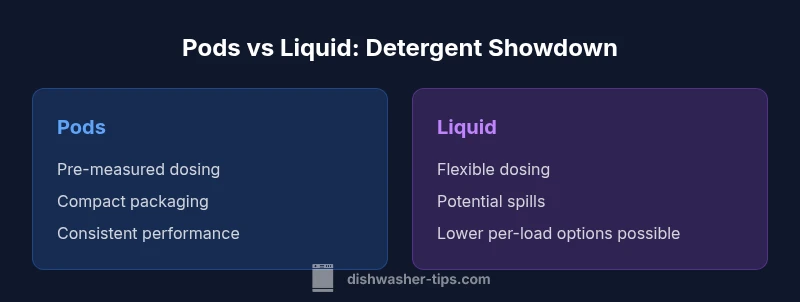
In practice, the question what is better dishwasher pods or liquid reflects two design philosophies: convenience versus customization. Pods come pre-dosed, which reduces user error and simplifies storage, making them a favorite for busy households. Liquid detergents offer flexibility to adjust dosing for different load sizes, soil levels, and even fluctuating water hardness. According to Dishwasher Tips, the best choice often depends on your routine and maintenance environment: are you a busy family running multiple loads daily, or do you mostly wash light, pre-rinsed dishes? In this section we explore the core differences and translate them into day-to-day outcomes, focusing on dosing, residue, compatibility with common dishwasher models, and overall cost. We’ll also consider practical quirks like spill potential when transferring liquids versus the cleaner handling of pods. By grounding the comparison in real-world use, homeowners can make an informed decision that reduces wash time and post-wash rework.
Diving deeper, pods shine where consistency matters: every load gets the same amount of cleaning power, which minimizes the risk of under- or over-dosing. Liquids excel when the user needs to tweak the dose for exceptionally dirty pots, baby bottles, or especially hard water. While pods lock in a dose, they can’t easily scale up for oversized or heavily soiled loads without switching brands or adding boosters. Liquid detergents, with variable dosing, allow precise adjustments but require more attention to measurement accuracy and storage hygiene. The choice isn’t about one being universally better; it’s about which approach better aligns with your dishwasher’s design, your daily rhythm, and your tolerance for refills and clutter. In the end, the right answer hinges on your household’s specific needs and how you balance convenience with control.
Dosing mechanics and dissolution: how pods and liquids behave
Dosing mechanics are the heart of the pods-versus-liquid decision. Dishwasher pods are pre-measured capsules designed to dissolve evenly in standard wash cycles. This reduces the chance of under- or overloading on a busy morning and minimizes the risk of soap buildup due to inconsistent dosing. However, pods can encounter dissolution issues in cold or very low-temperature cycles, or in older dishwashers that don’t fully reach the expected temperature. Liquids offer straightforward adjustability: you can tailor the dose to load size, soil level, or water hardness, potentially saving money when loads are light or dishes are minimally soiled. The flip side is dosing accuracy—human error in measuring a liquid can lead to under-cleaning or excessive suds, especially for households without a reliable measuring method. For best results, follow the manufacturer’s dosing guidelines, use a consistent measuring cup, and consider a rinse aid in hard water to minimize film and residue. In water-soft or moderately hard conditions, both formats perform well when used correctly; in extremely hard water, chelating agents and rinse aids become more critical to maintain spotless glassware and clean dishes.
Performance across soil levels and water hardness
Soil level and water hardness are two variables that strongly influence detergent performance. Pods tend to deliver consistent cleaning power across lightly soiled to moderately soiled loads because the dose is fixed and designed to handle common kitchen soils. In heavily soiled dishes—think baked-on pasta sauce or dried-on grease—pods may require longer wash cycles or a second rinse, particularly if the dishwasher lacks a strong pre-wash stage. Liquids shine when the load varies widely: you can increase the dose for stubborn soils or reduce it for lightly used dinnerware, potentially saving detergent per cycle. Water hardness also changes how well any detergent works. In hard water, all detergents benefit from a rinse aid and sometimes a secondary wash booster to prevent mineral residue and cloudy glassware. Pods with built‑in chelating agents provide some protection against mineral buildup, but the effectiveness depends on the brand and formulation. If you persistently contend with hard water, testing your water and adjusting with a rinse aid or water-softening approach can improve results for both pods and liquids.
Packaging, storage, and safety considerations
Packaging and storage are practical factors that often tilt the decision one way or the other. Pods are compact, pre-sealed, and convenient to store on shelves or in a cabinet. They reduce mess and eliminate the need to measure, which minimizes spillage—the kind of annoyance that accumulates over weeks of dishwashing. On the downside, pod packaging can be more costly per load, and the capsules themselves can pose a choking hazard for children or pets if left unsecured. Liquid detergents, by contrast, typically come in bottles or jugs that occupy slightly more space and require an accurate measuring cup to avoid overuse or waste. Spills are more common with liquids, but modern bottles often include child-resistant designs and spill caps. Storage safety is crucial for households with kids or animals; store pods out of reach and in a clearly labeled container, and keep liquids in a clearly marked, upright position to prevent leaks. Regardless of format, always use the product as directed and keep containers sealed between uses to preserve active ingredients and prevent evaporation or contamination.
Comparison
| Feature | Pods | Liquid |
|---|---|---|
| Dosing Consistency | Excellent (pre-measured pods) | Flexible (adjustable liquid dose) |
| Dissolution & Residue | Typically dissolves reliably in standard cycles; cold wash can slow dissolution | Dissolves readily; risk of overuse if not measured carefully |
| Performance in Hard Water | Includes chelating agents that help mineral buildup; depends on brand | Performance depends on dose and rinse aid; may require extra care in very hard water |
| Packaging & Storage | Pre-measured, compact; minimal mess | Bottle/jug packaging; larger footprint; potential leaks |
| Cost per Load / Value | Moderate-to-high per load; varies by brand | Lower per-load cost for basic brands; higher for premium options |
The Good
- Convenient pre-measured doses reduce user error
- Cleaner storage with minimal mess and spill risk
- Lower risk of awkward dosing in busy households
- Good for standard load types and average water conditions
Disadvantages
- Pods can be more expensive per load than basic liquids
- Dosing is fixed and may not suit oversized or heavily soiled loads
- Pods may not dissolve as reliably in very cold washes or older machines
- Liquid detergents require careful measuring to avoid waste and residue
Pods are the better all-around option for most homes, thanks to convenience and consistent dosing.
For households seeking ease and reliable results with routine loads, pods win out. Liquids excel when you need precise dosing for unusual or highly soiled loads and, with careful measuring, can offer cost savings. The best choice depends on your dishwasher, water hardness, and how you manage different loads.
People Also Ask
Are dishwasher pods safer than liquid for households with kids?
Pods are convenient but can be hazardous if swallowed by children. Store them in a locked cabinet and use the recommended dose. Liquid detergents also pose ingestion risk, so keep all detergents out of reach.
Pods are convenient but keep them away from kids and pets; always follow the dose and store securely.
Can I mix dishwasher pods with liquid detergent?
No. Mixing detergents can cause excessive suds, poor cleaning, and potential residue on dishes. Use either pods or liquid per cycle based on your preference.
Don’t mix detergents. Pick pods or liquid and stick to one per cycle.
Do dishwasher pods dissolve in cold water or low-temp cycles?
Most pods dissolve well in standard cycles, but very cold water or certain energy-saving settings may slow dissolution. If you notice residue, try a warmer cycle or a rinse aid.
Pods usually dissolve in normal temps; if you use cold washes, check dissolution and consider a warmer option if needed.
Are pods better for hard water than liquid detergents?
Pods can help with mineral buildup due to chelating agents, but rinse aids remain important in hard water. Liquids can also work well if you choose formulations with extra chelating agents and adjust dosing.
Pods help with minerals, but rinse aid is still key in hard water. Liquid can work with the right formulation.
How should I store dishwasher pods safely at home?
Store pods in a dry, cool place in their original container or a sealed, childproof box. Keep out of reach of children and pets, and check expiry dates.
Keep pods dry and secure; use the original container and keep away from kids.
Does brand reliability affect pod vs liquid performance?
Yes. Reputable brands tend to deliver consistent cleaning power and reliable packaging. Look for brands with clear safety information and consumer reviews.
Brand reliability matters for consistent cleaning and safe packaging; pick established brands and read reviews.
What to Remember
- Choose pods for consistent results and convenience
- Use liquid for highly variable loads or where precise dosing matters
- Pair any option with a rinse aid in hard water to prevent mineral residue
- Store detergents safely and out of reach of children/pets
- Test and adapt dosing for heavily soiled or oversized loads