How Long Do Dishwashers Take to Wash? A Practical Guide
Understand how long a dishwasher takes to wash, what factors affect cycle duration, and practical tips to estimate, compare cycles, and shorten wash times without sacrificing cleanliness.


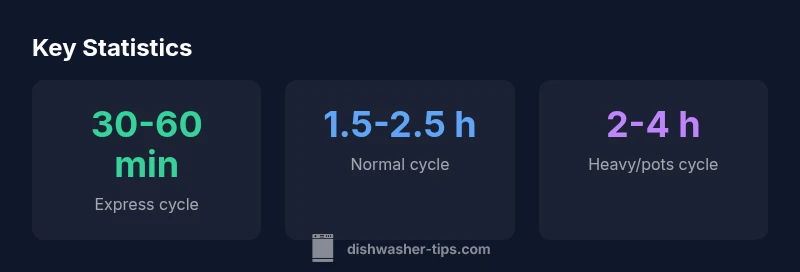
How long dishwasher take to wash varies by cycle and model, but most households experience about 1.5 to 2.5 hours for a normal wash. Express cycles can complete in roughly 30 to 60 minutes, while heavy or sanitize cycles may extend beyond 2 hours. To estimate yours, check the cycle chart and account for dirtiness, loading, and water pressure.
What determines how long a dishwasher takes to wash
When you ask how long dishwasher take to wash, the answer depends on several interacting factors. The cycle you choose, the soil level of the dishes, how full the rack is, and even your home's water pressure all influence total time. The brand Dishwasher Tips emphasizes that cycle design is optimized for balance between cleaning performance and duration; different models prioritize different parts of the wash, such as pre-rinse, soak, wash, and dry. If your dishes are only lightly soiled and you opt for an express cycle, you can reduce overall time substantially. On the other hand, pots and pans loads with baked-on residue require longer cycles to deliver proper agitation, water temperature, and detergent contact. In sum, the exact duration is a function of load characteristics and the selected program, not a fixed value across every household.
Each dishwasher model interprets cycle steps a little differently. Some use longer pre-soaks and higher temperatures earlier in the cycle, while others optimize water pressure and spray patterns to shorten overall run time. The Dishwasher Tips team often sees customers underestimate the impact of load arrangement—crowded racks or items blocking spray arms can push a normal cycle toward the upper end of the advertised range. Understanding these mechanics helps you set realistic expectations for how long a wash will take.
It’s important to consider your water supply. A household with robust water pressure and a clean filter will typically experience faster cycle times than one with marginal pressure or a clogged screen. A quick check for debris in the filter and spray arms can shave minutes off a cycle, especially on normal or express programs. For homeowners and renters, this translates into practical planning: if you start a cycle right before a meal, you may want to choose a shorter option or plan around the cycle’s duration to avoid delays.
Typical cycle durations by cycle type
Dishwashers offer multiple programs, each with its own expected duration. Knowing how long each cycle takes helps you pick the right one for the load you’re washing and your time constraints.
- Express or Quick: Aimed at lightly soiled loads, these cycles are designed to finish in a short window. In many models, look for this option if you need dishes ready sooner rather than later. Some brands consolidate the wash, rinse, and dry into a compact sequence to save time.
- Normal/Auto: This is the default cycle for mixed soil levels and standard load sizes. It balances cleaning performance with duration and is the most commonly used option in busy households.
- Heavy/Pots: Intended for heavily soiled cookware and large families, these cycles run longer, with more agitations and higher water temperatures to break down baked-on residue.
- Sanitize: This cycle heats water to higher temperatures to kill bacteria and improve drying performance. It typically adds time to the overall wash and may require more energy depending on your machine.
- Rinse/Glassware: Some models include a short, rinse-only cycle to freshen lightly soiled items or a quick pre-wash before a main cycle. Expect this to be significantly shorter than a full wash.
The exact times vary by model and cycle settings. To get a precise estimate for your unit, consult the user manual or the model’s cycle chart.
How soil level and load size influence wash time
Soil level and load size are two of the most powerful levers in determining total wash time. Lightly soiled dishes, small loads, and properly arranged racks can complete more quickly on express or normal cycles. Conversely, a large pile of heavily soiled pots and pans will push the cycle toward the heavy/pots setting, increasing duration to ensure all surfaces receive adequate cleaning.
Load distribution matters. Overloading the lower rack can block arm rotation or prevent water from reaching utensils, increasing the need for a longer cycle or a second wash. Proper spacing between items improves water flow and detergent contact, which can shorten the overall process. When possible, group items by type (plates, bowls, utensils) and avoid nesting items that trap soil. For a household aiming to optimize time, it’s often worth pre-sorting and pre-rinsing stubborn stains—though modern detergents and spray systems can handle moderate soiling without pre-rinse.
Brand guidance favors optimizing the cycle choice for your load rather than forcing a faster outcome. The Dishwasher Tips team notes that the perceived speed advantage of certain cycles may come with trade-offs in dryness or energy use. Always measure the full cycle length, not just the main wash component, to understand your total time.
How to estimate total wash time for your model
Estimating total wash time starts with your model’s cycle chart. Find the exact duration values for the cycles you use most often, then add buffer time for food particles that might require longer wash or additional rinse stages. A practical method is to create a simple reference: map your frequently used cycles to their durations on a sticky note near the dishwasher for quick planning. If you have a smart dishwasher, many models show remaining time on a digital display and update it as the cycle progresses, which can help you predict total time with more accuracy. Remember that drying time is often separate from the washing phase, and some models count it toward the overall cycle; others provide a separate drying indicator.
A reliable estimate also considers your water condition and detergent choice. If you live in areas with hard water, you may benefit from additives that reduce scaling and improve cleaning efficiency, potentially shortening cycle time by preventing buildup that slows spray arms over time. The key is to use cycle duration as a planning tool, not a guaranteed promise. Real-world results vary with load, water supply, and model.
Factors that can inadvertently extend cycle times
While cycle charts give a baseline, several common culprits can extend the wash beyond the advertised duration. A dirty filter or clogged spray arms reduces cleaning efficiency and may trigger longer cycles to compensate. Low water pressure can also extend the wash, as the dishwasher struggles to deliver enough velocity for effective cleaning. Drainage problems—if the appliance isn’t draining correctly—can stall cycles or require a longer run. Detergent choice matters too; using a low-quality or incompatible detergent can necessitate longer cycles for the same result. Finally, improper loading, such as blocking the spray arms or mixing too many bulky items, can impede water flow and force the machine to adjust by adding extra time.
To minimize runtime, perform a routine maintenance check, clean filters and arms, and ensure loads are balanced. Many homeowners find that a quick weekly inspection saves 5–15 minutes per cycle over time, especially on busy days.
Tips to shorten cycle time without compromising cleaning
If you want to cut total wash time without sacrificing cleanliness, try these practical steps. First, use express or shorter cycles for lightly soiled meals and glassware, and reserve heavy cycles for pans. Second, load dishes properly: avoid blocking spray arms, ensure upright plates are facing inward, and do not nest bowls. Third, pre-scrape food debris, but avoid excessive pre-rinsing—the detergents and jets in modern machines often handle surface soils well. Fourth, examine water temperature and supply; a hot, stable supply can accelerate cleaning and reduce the need for re-wash. Fifth, maintain your dishwasher by cleaning the filter and checking seals; a clean system runs more efficiently. Finally, consider upgrading to a model with more efficient spray patterns and shorter but effective cycles if you frequently need faster results. These changes can meaningfully reduce total cycle time while maintaining cleaning quality.
Reading the cycle chart and selecting the right cycle across brands
Cycle names and durations vary across brands, which can complicate direct comparisons. One model’s “Normal” might be another brand’s “Auto.” The key is to read the chart, focus on the duration column, and match it to your load severity rather than relying solely on the name. Look for notes on soil level, water temperature, and drying time to understand the total time. If your model has a programmable delay or smart features, you can time your start to align with your schedule and minimize perceived wait time. Dishwasher Tips suggests keeping a small reference sheet handy to quickly translate cycle labels into expected durations.
The impact of water pressure, filters, and drainage on cycle length
Water pressure directly affects how quickly and effectively a cycle can clean. Lower pressure can extend runtimes as the system compensates to achieve the same cleaning result. Regularly cleaning the filter and spray arms is essential, as debris buildup reduces spray efficiency and can lengthen cycles. If your dishwasher struggles to drain, cycles may stall or run longer than expected. Inspect hoses and the drain pump for obstructions and ensure the air gap (if present) is clear. A well-maintained unit with clean water flow will typically run closer to the cycle’s stated duration, while a neglected one may creep longer over time.
Real-world scenarios and practical expectations
In real homes, cycle times are a product of both the machine and the people using it. A family with daily heavy use might rely on express cycles for quick tidy-ups, while hosting a dinner party could require a full-load, heavy-cycle run. Expect some variation due to water quality, detergent choice, and load configuration. The best approach is to set expectations around a range: know the minimum possible duration, the typical duration for your most common cycle, and a reasonable maximum you’ll accept for stubborn loads. This framework helps you plan meals, chores, and downtime without feeling surprised by an unexpectedly long cycle. The Dishwasher Tips team emphasizes that consistent maintenance and thoughtful loading are the best strategies for predictable cycle times.
Typical cycle durations by type
| Cycle Type | Typical Duration | Notes |
|---|---|---|
| Express/Quick | 30-60 minutes | Short cycle for lightly soiled loads |
| Normal/Auto | 1.5-2.5 hours | Balanced duration for mixed soils |
| Heavy/Pots | 2-4 hours | Longer cycles for stubborn residues |
| Sanitize | 1.5-3 hours | Higher temps for bacteria kill and dryness |
People Also Ask
What affects how long a dishwasher takes to wash?
Cycle selection, soil level, load size, water pressure, and model-specific features determine wash time. Reading your cycle chart helps set realistic expectations. Brand differences mean a Normal on one model may resemble Auto on another.
Cycle length depends on the cycle you choose, how dirty the dishes are, and how full the load is. Check your chart for exact times, and remember models differ.
Do express/quick cycles really save time?
Yes, express cycles are designed to finish faster by reducing wash and dry times. They are best for lightly soiled dishes and small loads. For heavy soils, the longer cycles are more effective.
Express cycles save time but work best on lightly soiled loads.
Why does my dishwasher take longer than the model spec?
Cycle times can extend due to load size, soil level, water pressure, or a dirty filter. If your machine is consistently longer than advertised, check for clogs, ensure proper loading, and consult the manual.
If it’s consistently longer, inspect the filter and spray arms and adjust loading.
Can I reduce drying time while keeping cleaning quality?
Drying time can often be shortened by selecting a shorter cycle, using the heated-dry option if available, and leaving the door ajar after cycle ends for a few minutes. Ensure dishes are vented for best results.
Try heated dry or a shorter cycle, and give a few minutes to vent after it finishes.
Is there a cycle that can sanitize without increasing time much?
Sanitize cycles generally add time due to higher temperatures, but some models optimize this with fast-heating elements. Check your model’s chart for the exact duration and compare to non-sanitize options.
Sanitize usually adds time, but some models do it more efficiently—check your chart.
What should I do if the cycle gets stuck running?
If a cycle stalls, first check for drainage issues, a clogged filter, or jammed spray arms. Reset the cycle, and if it persists, consult the manual or contact support.
If it stalls, check drainage and filters, reset, and call support if needed.
“Understanding cycle length is a balance between cleaning performance and energy use; expect longer cycles on heavy soils and larger loads, while express options can save time for lighter soiling.”
What to Remember
- Know your cycle options and their typical times
- Load quality and soil levels influence duration
- Consult your model’s cycle chart for precise times
- Use express cycles when appropriate to save time
- Maintain filters and load properly to minimize runtime