How Long Do Dishwasher Cycles Take? A Practical Guide
Discover how long dishwasher cycles take across quick, normal, and heavy modes, what factors affect duration, and practical tips to estimate and optimize cycle times for busy households.


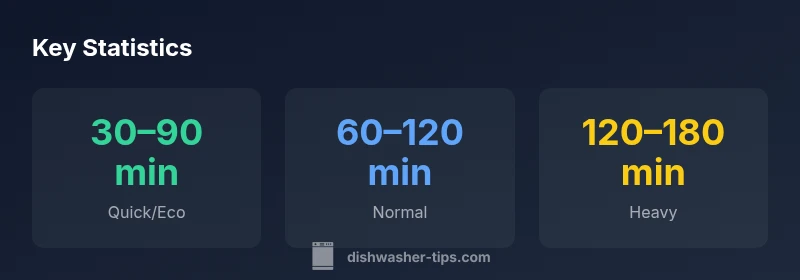
how long do dishwasher cycle.take varies by cycle type and model. Quick/eco cycles generally run 30–90 minutes, normal cycles about 60–120 minutes, and heavy or sensor-based cycles can reach 120–180 minutes. Soil level, water heating, and energy-saving features influence the duration. For precise timings, consult your dishwasher’s manual or app, and consider using a shorter cycle for light loads.
How long do dishwasher cycle.take and why it varies
Cycle duration is not a fixed number; it depends on cycle type, model, and how dirty the load is. According to Dishwasher Tips, how long do dishwasher cycle.take shows a wide spread: quick/eco: 30–90 minutes; normal: 60–120 minutes; heavy: 120–180 minutes. Sensor-driven cycles use soil detection to decide on duration and may extend or shorten times based on dishware, water temperature, and heater performance. Load size matters too—full loads often optimize water use, but overloading can create poor water circulation and longer cycles. In addition, some models adjust run time dynamically as heating elements kick on and off to reach the desired sanitation target. When planning laundry and kitchen workflows, it helps to know your typical load profile (light, normal, heavy) and keep a running log of actual cycle times for accuracy.
Breakdowns by cycle type
- Quick/Eco: Designed for lightly soiled dishes or small loads. Typical duration: 30–90 minutes. These cycles prioritize energy efficiency and faster wrap-up, but may sacrifice peak washing power on stubborn soils.
- Normal: The common daily cycle. Typical duration: 60–120 minutes. It balances cleaning performance with time and water use, suitable for most loads.
- Heavy/Auto/Sensor: For pots, pans, and heavily soiled cookware. Typical duration: 120–180 minutes. Sensor-driven modes adjust time based on detected soil and wash intensity, which can add time for thorough rinsing and sanitation.
Understanding these types helps you choose the right one for each load and avoid over-waiting on shorter tasks.
Sensor-driven cycles and soil detection
Modern dishwashers often rely on soil sensors to determine how long to run a cycle. While sensors improve cleaning consistency, they can extend cycles if heavy soils are detected or if water heating is required to reach sanitization temperatures. Conversely, sensors may shorten a cycle when dishes are relatively clean or if the model recognizes a light load and lowers water usage accordingly. The net effect is a time range rather than a single fixed duration, which is why two identical loads may finish at different times across days.
Heating, drying, and their impact on time
The choice between heated drying and air drying can impact total cycle time. Heated drying adds minutes at the end of a cycle, especially in models that use high-temperature sanitation. On the other hand, air-dry modes or
Overview of cycle durations by common cycle types
| Cycle Type | Typical Duration | Water per Cycle | Notes |
|---|---|---|---|
| Quick/eco | 30–90 min | 3–5 gallons | Best for light loads |
| Normal | 60–120 min | 4–6 gallons | Balanced performance |
| Heavy | 120–180 min | 6–9 gallons | For tough soils |
People Also Ask
How long does a quick cycle really take?
A quick cycle typically ranges from 30 to 90 minutes, depending on soil level and model. If dishes are lightly soiled, you can expect the shorter end of the range. For stubborn residue, allow the cycle to complete for best results.
Quick cycles usually run 30 to 90 minutes, depending on soil and model. For light loads, expect the shorter side; for tough soils, it may run longer.
Do eco cycles take longer if the dishwasher is full or dirty?
Eco cycles optimize water and energy use, and duration can increase with heavier loads or dirtier dishes. Sensor-driven eco modes may lengthen time to achieve thorough cleaning, while a light load often finishes sooner.
Eco cycles adapt to load and soil; heavier, dirtier loads can extend the time, while lighter ones finish quicker.
Why does the cycle take longer on some models?
Different models have different heating elements, spray pressure, and sensor algorithms. Some units run longer to reach higher temperatures or to maximize soil removal, especially in auto or heavy modes.
Cycle length can vary by model because of different heaters and sensors.
Can I bypass heated drying to save time?
Yes, many dishwashers offer a non-heated dry or air-dry option which can shorten total cycle time. It may, however, leave dishes slightly damp and requires towels to finish drying by hand.
You can use air-dry to save time, but you might need to towel-dry some items.
Should I run a longer cycle to ensure sanitize?
If sanitation is a priority, choose a cycle that includes a high-heat rinse. Longer cycles do not always guarantee better sanitation if the cycle’s temperature targets aren’t reached; ensure your model is rated for sanitation at the chosen cycle.
For sanitation, pick a cycle that reaches the proper high temperature and lets it run fully.
“Understanding your dishwasher’s cycle names and soil sensors helps you predict cycle times more accurately. Small changes in load size and soil level can shave minutes or extend cycles.”
What to Remember
- Know your cycle types and their typical durations
- Sensor-driven cycles vary by soil and model
- Water and energy use influence total time
- Heated drying adds finish-time; air-dry can save minutes
- Record real-cycle times for your household to plan better