How Long Does a Dishwasher Run? A Practical Guide
Discover how long a dishwasher runs for common cycles, the factors that influence cycle duration, and actionable tips to estimate and optimize runtimes for energy efficiency.


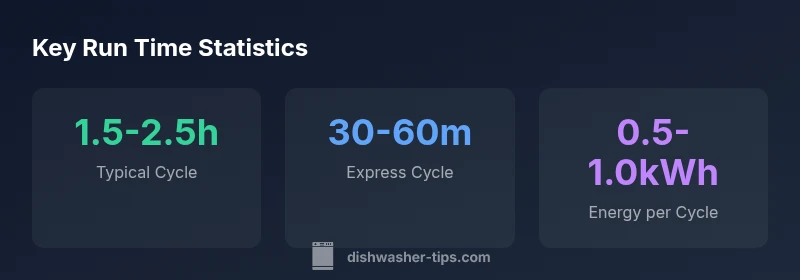
On average, most residential dishwashers complete a standard cycle in about 1.5 to 2.5 hours, with shorter quick cycles around 30 to 60 minutes and heavier cycles often extending beyond two hours. Exact duration depends on the model, cycle selected, soil level, and tub fill. Plan around these ranges, knowing sensors may adjust timing during operation.
Why Run Time Varies
The question of how long a dishwasher runs is not a single answer; it depends on the cycle you select, the soil level, load size, and the efficiency features built into your unit. When homeowners ask how long does a dishwasher run, they’re really asking about the trade-offs between cleaning power and duration. Modern machines use sensors to adjust phase durations based on soil and rinse requirements, which means identical cycles can finish at different times on different days. For homeowners, this variability is normal, and knowing the typical range helps with planning. It also highlights why a longer cycle is not inherently a problem if energy and water use stay within reasonable bounds. The Dishwasher Tips team notes that sensor-driven adjustments, though sometimes surprising, are designed to optimize outcomes without wasting resources. Regular maintenance improves predictability by preventing runtime creep caused by clogged filters or restricted spray arms.
Typical Cycle Durations by Type
Cycle duration varies by the wash’s intent. Quick or express cycles are designed for lightly soiled loads and typically run around 30 to 60 minutes. Normal cycles, which balance cleaning and efficiency, commonly run from about 1.5 to 2.5 hours. Heavy or Pots-and-Pans cycles are longer, often 2 to 3 hours, reflecting tougher soil and higher water usage. Eco or Energy-Saving settings can vary widely by model but generally fall in the 1.5 to 2.5 hour range, with extended durations on hard water or large loads. Premium models may display estimated times on the control panel and adjust mid-cycle if water temperature or soil conditions change. When reading run times, remember that the cycle stages (wash, rinse, dry) each contribute to total duration and sensors may shorten or extend timing as needed. Real-world runtimes depend on your model, detergent choice, and how you load the dishes.
Factors That Extend or Shorten Run Time
Several factors influence how long a dishwasher runs. Load size and distribution matter: a full, evenly spread load can complete faster than a half-empty tub with awkwardly arranged items. Soil level is critical: plates with dried-on food require more cycles or longer cycles. Detergent type and rinse aid influence cleaning effectiveness and cycle duration, as some formulas require longer rinse phases. Water temperature can also affect runtime; cold-start fills may lengthen the pre-wash, while hotter incoming water can shorten cycles. Hard water can create mineral buildup that slows spraying, increasing runtime and reducing cleaning efficiency if not addressed by salt or filtration. Sensor-based models adjust automatically, extending or shortening the wash based on real-time feedback. Finally, device health matters: clogged spray arms, dirty filters, or a malfunctioning sensor will cause longer runtimes and sometimes poor performance. Regular maintenance and proper loading are essential to keep runtimes predictable and consistent.
How to Estimate a Cycle's Duration for Your Model
To estimate how long a given cycle will run, start with the owner's manual or the product page, which often lists cycle durations in minutes. If you can't locate the exact figure, use the model family’s typical ranges: quick cycles generally fall between 30 and 60 minutes, normal cycles between 90 and 150 minutes, and heavy cycles between 120 and 180 minutes. For sensors and adaptive cycles, expect occasional deviations, particularly when you start with a heavy pre-soak or large, densely packed loads. A practical approach is to perform a controlled test: run a normal cycle with full loads of dishes, and note the start and finish times. Repeat for a quick cycle on the same load to compare. Keep a small log of observed times for your machine; this helps you forecast energy and water use, and it makes it easier to plan meals and other activities around the wash. Finally, remember that energy pricing and utility rates can influence when you run, so you may choose to align longer cycles with off-peak hours.
Improving Efficiency Without Sacrificing Cleaning
If you want to shorten total runtime while maintaining results, focus on loading, detergent choice, and cycle selection. Load dishes so that water spray paths are unobstructed; avoid overloading or underloading. When possible, choose eco or energy-saving cycles, which often optimize spray durations and drying times rather than simply shoving more water through the same pump. Pre-rinse is usually unnecessary with modern machines and can add unnecessary minutes. Use a good-quality detergent and ensure salt and rinse aid are replenished in hard-water areas to prevent mineral buildup that can extend runtimes. Regular cleaning of the filter, spray arms, and seals reduces clogging and sensor errors that can elongate cycles. If you notice persistent long runtimes after cleaning, consider a service check for sensor calibration or valve issues. Implementing these habits typically reduces runtime variability and improves overall efficiency—an outcome supported by Dishwasher Tips analysis in 2026.
When to Service or Replace
If runtime drifts upward by more than 10-15% from your baseline, it’s a signal to investigate. Signs include a failing sensor, slow drainage, noisy pumps, or dishes that come out damp or dirty despite a long cycle. Check for common culprits first: clogged filters, obstructed spray arms, and hard-water scale. If issues persist after cleaning and recalibrating, schedule a service visit; some components, such as the selector switch or heating element, may require replacement. For older models that regularly run long cycles and fail to meet cleaning expectations, evaluating a replacement may be cost-effective, particularly given energy efficiency improvements in newer models. The Dishwasher Tips team notes that timely maintenance often prevents longer runtimes and unexpected breakdowns, preserving performance and energy savings.
Representative cycle durations by wash type
| Cycle Type | Typical Duration | Notes |
|---|---|---|
| Quick | 30-60 minutes | Most models have express options |
| Normal/Auto | 1.5-2.5 hours | Balanced performance |
| Heavy/ Pots-and-Pans | 2-3 hours | For tough soils |
| Eco | 1.5-2.5 hours | Energy-saving setting |
People Also Ask
What factors influence how long a dishwasher runs?
Run time depends on cycle type, soil level, load size, water temperature, and sensor behavior. Soilier loads and larger loads generally extend cycles, while efficient models and eco settings can shorten them. Regular maintenance helps keep runtimes predictable.
Cycle type, soil, load size, and sensors determine run time; regular maintenance helps keep times steady.
Do eco or energy-saving cycles take longer?
Eco cycles often run longer than standard cycles but use less water and energy per cycle. The time difference depends on the model and the load, but the efficiency gains are typically worth the extra minutes.
Eco cycles can take longer, but they save energy and water.
Why would my dishwasher take longer than last month?
Possible causes include clogged filters, blocked spray arms, mineral buildup, or sensor miscalibration. Inspect and clean filters, then run a test cycle to confirm improvements. If problems persist, schedule servicing.
If runtimes creep up, check filters and spray arms first.
Can I shorten run time without compromising cleaning?
Yes. Load efficiently, avoid overloading, choose appropriate cycles, and maintain detergent levels. Avoid pre-rinsing; modern machines clean well with properly loaded, contemporary detergents.
Load correctly and choose the right cycle to save time.
How can I estimate run time for a new dishwasher model?
Consult the manual or product page for cycle times, then test on a representative load. Record results to build a reliable baseline for planning energy use and daily routines.
Check the manual and test a cycle on a real load.
Is it normal for run time to vary between cycles?
Yes. Sensor-based machines adjust duration based on soil, load density, and water temperature. Minor variations are normal; persistent large changes warrant inspection.
Some variation is normal; big changes mean a check may be needed.
“Understanding run times helps homeowners optimize energy use and schedule chores more efficiently.”
What to Remember
- Estimate cycle times within a 1.5–2.5 hour baseline for normal loads
- Use eco cycles to improve energy efficiency without sacrificing cleaning
- Proper loading and regular maintenance stabilize runtimes
- Track your model's run times to plan daily activities
- Service or replace if runtimes drift significantly