Dishwasher Built-In vs Freestanding: A Comprehensive Comparison
Meta description: Compare built-in and freestanding dishwashers to find the best fit for your kitchen. Learn installation, performance, and long-term costs with Dishwasher Tips.


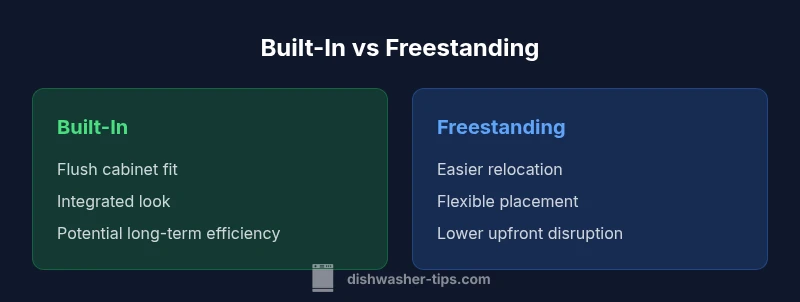
For most kitchens, built-in dishwashers offer a seamless, integrated appearance and better long-term efficiency, while freestanding models provide flexibility for renters or modular layouts. If you value a flush cabinet look and potential energy savings, choose built-in; if you need portability and easy installation, go freestanding. The right choice depends on your kitchen design and living situation.
Design and Fit: Built-In vs Freestanding Look
The decision between a dishwasher built in vs freestanding is as much about aesthetics as it is about function. According to Dishwasher Tips, the built-in option is designed to disappear into cabinetry, delivering a seamless, flush front that matches other appliances and hides the control panel. The freestanding model, by contrast, stands as a distinct appliance, which can be color-matched but will typically protrude slightly and may interrupt the cabinetry line. This section explores how each style affects room perception, cabinet integration, and resale value, and why your kitchen layout should drive the decision rather than impulse purchases. In small or open-plan kitchens, the built-in look can minimize visual clutter, whereas freestanding units offer design flexibility for rentals or periodically refreshed spaces. When considering the dishwasher built in vs freestanding debate, think about how the unit interacts with your countertops, base cabinets, and toe-kick space.
Installation and Space Considerations
Installation complexity is a major differentiator between a built-in dishwasher and a freestanding model. The dishwasher built in vs freestanding distinction becomes practical at this stage: built-in units require a precise cabinet cutout, integrated panels, and a level, secured mounting. Freestanding dishwashers require a sturdy, flat floor and an accessible power outlet, but they typically need less cabinetry alteration. Before purchasing, measure height, width, and depth and consider clearance for doors and plinths. For renters or homeowners who foresee relocation, freestanding units offer a practical advantage because they can be removed without permanent remodeling. Additionally, consider plumbing access: built-in installations often use a shared supply line behind cabinetry, while freestanding units must be positioned near a water supply and drain, with hoses routed to the nearest plumbing. This is a key factor in the dishwasher built in vs freestanding decision that saves time during installation and reduces the risk of costly mistakes.
Performance, Capacity, and Loading Flexibility
Performance in the dishwasher built in vs freestanding comparison hinges on model quality and rack configuration. Built-in dishwashers commonly offer more integrated design options, such as third racks, adjustable tines, and deeper baskets that maximize loading flexibility for bulky items. Freestanding units, while sometimes more compact, can still offer excellent cleaning performance if you select a high-quality model with a flexible rack system. In practice, choose based on your typical loads: households with large pots and irregular dish shapes may benefit from the adjustable racks common in premium built-in models, while small households or apartments may prefer freestanding units that fit tighter spaces without cabinetry alterations. Across both categories, loading pattern and detergent usage influence performance nearly as much as the machine’s base design.
Energy Efficiency, Water Use, and Operating Costs
Energy efficiency and water usage are central to the dishwasher built in vs freestanding decision, especially for budget-minded households. Modern machines in either category can exceed basic efficiency standards, but the available options differ by installation type. Built-in units often participate in energy and water optimization programs tied to cabinetry integration, enabling consistent performance with better insulation and reduced heat loss. Freestanding models can also be highly efficient, particularly compact or mid-sized units designed for apartments or smaller kitchens. When evaluating running costs, consider cycles that suit your typical load, soil level, and frequency of use. Over time, energy-efficient cycles and proper maintenance offset the initial investment for either type.
Durability, Reliability, and Maintenance
Durability in dishwashers is influenced more by build quality and serviceability than by whether a unit is built-in or freestanding. Both categories can be highly reliable if you choose reputable models and perform regular maintenance. The key maintenance considerations include cleaning filters, inspecting spray arms, and ensuring seals remain intact. Built-in units typically have more robust paneling options and longer service life in high-usage scenarios because they are designed as a permanent kitchen component. Freestanding models tend to be easier to service in temporary or rental setups, since they are easier to pull out for service or replacement without affecting surrounding cabinetry. Regardless of type, periodic checks for leaks, gaskets, and drainage are essential.
Real-World Scenarios: Renters, Remodels, and Small Kitchens
For renters or people who frequently relocate, freestanding dishwashers offer practical flexibility: they can be moved or replaced with minimal wall or cabinetry impact. In a full kitchen remodel where a flush look is desired, built-in is often the preferred path, as it aligns with updated cabinetry and a cohesive aesthetic. Small kitchens benefit from built-in units that maximize space by integrating into the cabinet line, while freestanding models can fill gaps where cabinetry is fixed or unavailable. If you expect to expand or reconfigure your space within a few years, a freestanding option may be a safer short-term investment. If you plan long-term residence with an updated kitchen, built-in often yields a better long-term return.
How to Choose: A Practical Step-by-Step Guide
Choosing between the dishwasher built in vs freestanding comes down to three practical steps: measure, assess, and plan. First, measure your space precisely, including clearance for door swing and toe-kick. Second, evaluate your kitchen layout and existing cabinetry: does your design call for a flush, integrated look, or do you need flexibility for future changes? Third, compare models by capacity, rack configuration, and energy-efficient options within each category. Make a short list of must-haves (for example, third rack, soil sensors, or silent operation) and nice-to-have features. Finally, consider installation costs and potential impact on resale value. By following these steps, you can confidently select the dishwasher built in vs freestanding option that best suits your needs, budget, and home environment.
Authority sources
- https://www.consumerreports.org/cappliances/dishwashers/
- https://www.energy.gov/energysaver/articles/how-to-choose-a-dishwasher
- https://www.nsf.org/
Comparison
| Feature | Built-in | Freestanding |
|---|---|---|
| Installation fit | Flush with cabinetry, requires cabinet cutout | Does not require cabinet cutout, sits on floor |
| Aesthetics/design integration | Seamless front, aligns with other appliances | Visible, standalone unit, flexible color options |
| Cabinetry requirements | Panel-ready or integrated panels | Standard exterior panels; minimal cabinetry work |
| Space and clearance | Precise measurements, often tighter tolerances | More forgiving in loose layouts |
| Relocation/relatability | Fixed in place; relocation requires remodeling | Easier to move or remove for renovation |
| Performance and capacity | Broad range of capacities; advanced racks common | Good to high performance depends on model |
| Price range (upfront cost) | Higher upfront cost due to cabinetry integration | Lower upfront cost with basic installation |
| Best for | Integrated kitchens, resale value, long-term remodeling | Renters, short-term living spaces, flexible layouts |
The Good
- Aesthetically integrated with cabinets for a cohesive kitchen
- Often optimized for energy efficiency in built-in configurations
- Higher resale value in updated kitchens
- Less risk of accidental displacement in busy households
Disadvantages
- Higher upfront installation cost and complexity
- Less flexibility to relocate or reconfigure the space
- Limited to matching cabinetry and hardware; longer lead times
Built-in wins for integrated kitchens; freestanding wins for flexibility
Choose built-in if you want a seamless, space-efficient kitchen with potential long-term efficiency. Choose freestanding if you need mobility, easier installation, or lower upfront costs.
People Also Ask
What is the main difference between built-in and freestanding dishwashers?
The built-in is designed to be flush with cabinetry for a seamless kitchen look, often offering more integrated features. Freestanding units sit on the floor and can be moved or replaced more easily, making them ideal for renters or flexible spaces.
Built-in dishwashers blend with cabinets for a clean look, while freestanding units are portable and easier to relocate.
Can I install a built-in dishwasher in any kitchen?
Not every kitchen supports a built-in unit without modifications. You need a proper cabinet cutout, panel-ready options if you want a seamless front, and adequate clearance for door swing and plumbing access.
Built-ins often require cabinet work and precise measurements.
Are built-in dishwashers more energy-efficient than freestanding models?
Both categories offer energy-efficient models; efficiency depends on the specific model and features rather than the installation type alone. Look for energy star ratings and soil sensors to maximize efficiency.
Energy efficiency depends on the model; check ratings and sensors.
Can I convert a freestanding dishwasher to a built-in later?
Converting a freestanding unit to built-in is challenging and usually involves cabinetry work and panel compatibility. In many cases, renting or remodeling scenarios favor selecting the right type from the start.
Conversion is possible in some cases but often impractical.
For renters or small spaces, which option is better?
Freestanding models tend to be better for renters due to easier installation and relocation. Built-ins suit long-term residences where a flush, integrated look is desired.
Renters often benefit from freestanding units; long-term homes fit built-ins.
What to Remember
- Measure space accurately before choosing between built-in and freestanding
- Prioritize cabinet integration for kitchens aiming at a sleek look
- Consider relocation needs if you’re a renter or plan future moves
- Balance upfront costs with long-term energy and water savings