Built-in vs Countertop Dishwashers: Key Differences Explained
Compare built-in and countertop dishwashers to decide which fits your kitchen. This analytical guide covers installation, capacity, space, water use, energy efficiency, and ownership costs for informed decisions.


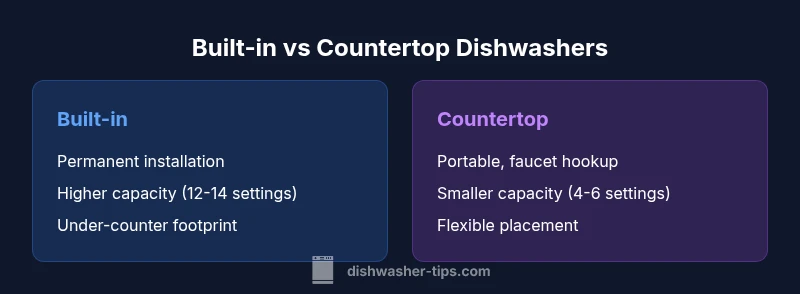
Built-in and countertop dishwashers differ primarily in installation, capacity, and configuration. A built-in is permanently mounted under the counter with a plumbed connection, while a countertop model sits on the counter and ties to a faucet. This comparison explains how each type performs in daily use, what to expect for setup, and which scenario fits your lifestyle best.
Why the distinction matters for homeowners
If you're evaluating options for your kitchen, understanding what is the difference between a built in dishwasher and a countertop dishwasher matters for daily use, space, and long-term cost. According to Dishwasher Tips, the right choice hinges on how you cook, how often you run full loads, and how much you value permanence versus portability. This section lays the groundwork by explaining the core differences in installation, capacity, and typical workflows, so you can quickly see which type aligns with your living situation. A built-in unit seems like a permanent upgrade with fixed plumbing and cabinetry, while a countertop model offers flexibility for renters, small kitchens, and temporary setups. The trade-off is clear: permanence and capacity versus mobility and simplicity. By the end, you will have a clear framework to compare two distinct appliance paths and make a decision that fits your home, budget, and daily routine.
Installation realities: built-in vs countertop
The installation reality is the first big differentiator. Built-in dishwashers are designed to live under the kitchen counter and require a secure mounting, a dedicated electrical circuit, and a fixed water line and drain. In most homes, a cabinet cutout or a new cabinet installation is necessary, which means a professional or a skilled remodel is often involved. In contrast, countertop dishwashers sit on the counter or slide into a compact space with a faucet adapter and a drain hose. They are much easier to relocate, which appeals to renters or people who move frequently. Because you do not alter cabinets or plumbing, countertop models typically involve less upfront labor, but they also constrain you to smaller loads. The trade-off is clear: permanence and capacity versus mobility and simplicity.
Capacity and loading: how many place settings you can clean in one cycle
Capacity is the most visible difference for a busy household. Built-in models typically handle about 12 to 14 place settings per cycle, with full racks of dishes, pots, and pans. Countertop units usually manage roughly 4 to 6 place settings, making them a fit for compact kitchens or individuals who wash smaller loads frequently. The practical impact is straightforward: if your household regularly uses the dishwasher for large family meals, a built-in model reduces the number of cycles and the time you spend washing. If you mostly rinse a few plates and cutlery, a countertop unit can be perfectly adequate and more affordable. Keep in mind that cycles vary by model, so verify capacity with the manufacturer’s specs and read user reviews for real-world loading scenarios.
Size and footprint: space planning in your kitchen
Size matters in a kitchen where counter space is at a premium. Built-in dishwashers are usually 24 inches wide and designed to tuck neatly under a countertop, with a depth around 24 inches and a height that fits standard base cabinets. Countertop models are much smaller and more flexible; many are 18 inches wide and can sit on a counter or be integrated into a cabinet opening with a temporary mounting kit. When measuring, consider clearance for loading doors, venting, and plumbing access. If you have a small apartment or island kitchen, a countertop unit may be the only practical option; in larger or remodel-ready spaces, a built-in could improve workflow and finish.
Plumbing and drainage: hookups and flow paths
Built-in dishwashers require a dedicated hot-water supply line, a stable drain, and an electrical outlet. The plumbing is typically hidden behind cabinetry, and installation is often a one-time, permanent upgrade. Countertop models connect to a standard kitchen faucet via a supplied adapter and drain to the sink or a removable hose. This setup is significantly more portable but demands a careful approach to water pressure and drainage to avoid leaks. In both cases you should ensure the sink’s drain is clear, and consider a hose guard to prevent kinks. The key difference is whether you are altering the plumbing for a long-term solution or selecting a flexible, temporary option.
Water usage and energy efficiency: what to expect in daily use
Water efficiency and energy use are tightly linked to load size and cycle choice. Built-in dishwashers often optimize water per cycle across larger loads, delivering efficiency gains when you regularly run full racks. Countertop units can be quite efficient for small or medium-sized loads, but their performance heavily depends on the model and how you space items. Dishwasher Tips analysis shows that evaluating energy ratings and cycle options on both types helps you compare real-world usage rather than ideal spec sheets. If your goal is to minimize water and electricity in a small apartment, a well-chosen countertop model with an energy-star rating could outperform a poorly loaded built-in unit.
Performance and cycles: durability, noise, and cycle variety
Both formats offer multiple cycles, but the performance envelope differs. Built-in models tend to offer a wider array of options—regular wash, quick wash, heavy-duty, delay-start—plus better sound insulation on higher-end models. Countertop dishwashers deliver essential cycles with shorter runtimes and lower energy draw per cycle, but they may be louder and have fewer options for stubborn grime. In practice, cycle length matters more for countertop units when you have a small kitchen where a longer run blocks counter space. Read reviews to gauge real-world efficiency and noise levels in your home environment.
Comparison
| Feature | Built-in dishwasher | Countertop dishwasher |
|---|---|---|
| Installation & mounting | Plumbed undercounter with cabinetry | Portable on countertop with faucet adapter |
| Capacity / place settings | Typically 12-14 settings per cycle | Typically 4-6 settings per cycle |
| Footprint / space | Standard 24-inch width, built into cabinetry | Around 18-inch width, on counter or compact cabinet opening |
| Water usage per cycle | Moderate to high depending on load | Lower per small loads, model-dependent |
| Energy efficiency | High efficiency with full loads | Model-dependent; depends on cycle and size |
| Upfront cost | Higher upfront cost; installation may be needed | Lower upfront cost; easy relocation |
| Best for | Families with regular full loads and permanence | Small households, renters, limited kitchen space |
The Good
- Portable option for renters and flexible spaces
- Higher capacity and permanent setup for built-ins
- Energy-efficient when fully loaded and chosen carefully
- Both types can meet ENERGY STAR criteria when matched to use
Disadvantages
- Installation and cabinetry work for built-ins can be costly
- Countertop units have smaller capacity and longer cycle times
- Countertop models may be louder and less robust for heavy use
Built-in wins for households with steady full loads; countertop wins for renters and compact kitchens.
Choose built-in if you want maximum capacity and a permanent, integrated kitchen solution. Choose countertop if space is tight, you rent, or you move frequently; it offers flexibility and lower upfront costs.
People Also Ask
What is the main difference between built-in and countertop dishwashers?
The main difference is installation and capacity. Built-ins are permanently installed under the counter with plumbing and cabinetry, while countertop models sit on the counter and connect to a faucet. Each type serves different living situations and load patterns.
The main difference is installation and capacity—built-ins are permanent; countertop units are portable and smaller.
Can countertop dishwashers be installed under a counter?
Most countertop models are designed for countertop use, not permanent under-counter installation. Some models and adapters exist that allow partial under-counter integration, but this is model-specific and may require professional guidance.
Usually not meant to be permanently installed under a counter; check your model’s specs.
Do built-in dishwashers use more water than countertop models?
Water usage depends on the model and load size. Built-ins often optimize for larger loads, while countertop units may use less water per cycle for small loads. Always compare per-cycle use rather than advertised capacity alone.
It varies by model; larger built-ins aren’t always worse for water use if loaded fully.
Are countertop dishwashers energy efficient?
Many countertop dishwashers are energy efficient and can earn ENERGY STAR ratings, especially when used with proper loads. Efficiency depends on the model and cycle choices.
Yes, many countertop models are energy efficient if you choose efficient cycles.
What’s the typical lifespan for these appliances?
Lifespan varies by usage and maintenance but modern dishwashers often last several years with proper care. Regular cleaning of filters and spray arms helps sustain performance.
With good care, both types can last many years.
What should I consider when deciding between the two?
Consider space, typical loads, installation feasibility, and total cost of ownership. If you need mobility and smaller loads, countertop may win; for frequent full loads and permanence, built-in is usually better.
Think about space, loads, and long-term costs when deciding.
What to Remember
- Assess kitchen space before choosing
- Match capacity to typical loads
- Factor in plumbing/installation needs
- Evaluate total ownership costs and energy use
- Check real-world performance via reviews and ratings