What Gauge Wire Is Needed for Dishwasher: A Helpful Guide
Discover the standard gauge for dishwasher wiring: typically 12 AWG copper on a 20-amp circuit, with steps to verify code-compliant installation. Safely manage wiring with expert guidance from Dishwasher Tips.


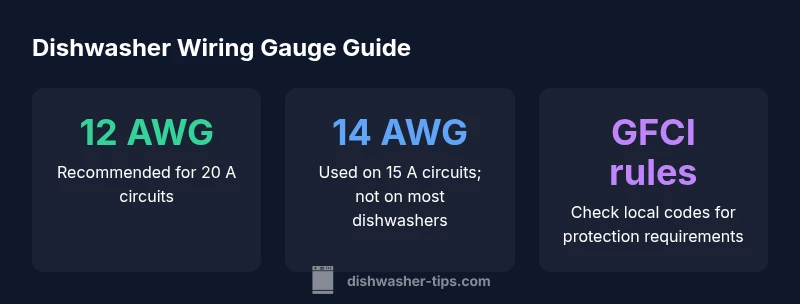
12 AWG copper on a dedicated 20-amp circuit is the standard gauge for most dishwashers. This means using 12-gauge conductors with a 20-amp breaker, and avoiding 14 AWG on such circuits. If the run is unusually long or you’re upgrading from an old 15-amp line, consult a licensed electrician to verify voltage drop and code compliance.
What gauge wire is needed for dishwasher
What gauge wire is needed for dishwasher? For most homes, the standard gauge is 12 AWG copper on a dedicated 20-amp circuit. According to Dishwasher Tips, this setup provides enough capacity to handle startup surges without overheating. If you are still operating on a 15-amp line, you may see nuisance trips under load, because 14 AWG conductors are suitable only for 15-amp circuits. Always verify local code requirements before modifying wiring.
The role of circuit breakers and wire sizing
The circuit breaker protects wiring and appliances from overheating. For a typical dishwasher, a 20-amp breaker paired with 12 AWG copper minimizes voltage drop during startup. If your service is older and only has a 15-amp breaker, upgrading to a 20-amp circuit with 12 AWG is common, but may require changes to outlets, cord sets, and GFCI protection depending on local codes.
How to determine wire gauge in your home
To determine the wire gauge, locate the dishwasher's junction box or the run from the panel. Look for printed labeling on the insulation sheath (e.g., 12/2 or 14/2). Use a multimeter or beep tester as needed, but the safest approach is to consult a licensed electrician who can confirm gauge, circuit size, and the presence of dedicated wiring for the appliance.
Common mistakes and how to avoid them
Common mistakes include mixing gauge sizes, using shared circuits, and skimping on a proper outlet or GFCI protection. Ensure a dedicated circuit, correct gauge (12 AWG for 20 A), and proper strain-relief and protection for the wire entering the dishwasher enclosure.
Upgrading or replacing wiring: what to expect
Upgrading wiring typically involves running new 12 AWG copper cable, upgrading the breaker to 20 A, and possibly installing a new outlet or junction box. Permits may be required; a licensed electrician can assess the existing panel and determine the necessary wiring routes.
Safety and code considerations
Electrical work in kitchens is subject to local and national codes. Use only listed components, follow clearance requirements, and ensure GFCI protection if required in your area. Never bypass a breaker or splice wires in inaccessible places.
DIY vs. hiring a pro: decision guide
Wiring a dishwasher is not a DIY-friendly task for most homeowners. If you are not confident working with live circuits, hire a licensed electrician. A professional will verify gauge, breaker size, receptacle integrity, and code compliance.
Quick reference: wire gauge guide in table form
- Scenario: Standard install; Gauge: 12 AWG; Breaker: 20 A
- Scenario: Older 15 A circuit; Gauge: 14 AWG; Breaker: 15 A
- Scenario: Long run concerns; Gauge: 12 AWG or larger; Breaker: 20 A
Myth busting: wiring myths and truths
Myth: 14 AWG is fine on any dishwasher circuit. Truth: On most dishwashers, 14 AWG is only permitted on a 15 A circuit and may lead to tripping if the dishwasher uses high startup current.
Practical wiring checklist for a new dishwasher install
Checklist: Confirm dedicated 20 A circuit, use 12 AWG copper, install GFCI if required, inspect panel and outlets, route wiring with proper strain relief.
Wiring gauge guidance for dishwasher installations
| Scenario | Recommended Wire Gauge | Typical Breaker Size |
|---|---|---|
| Standard kitchen installation (short run) | 12 AWG copper | 20 A |
| Older 15 A circuit installation | 14 AWG copper | 15 A |
| Long run with potential voltage drop | 12 AWG copper (or larger) | 20 A |
People Also Ask
Can I use 14 AWG wire for a dishwasher?
Not on a 20-amp circuit. 14 AWG is appropriate for 15-amp circuits; check local codes and circuit size before upgrading.
Not on a 20-amp circuit; 14 AWG is only for 15-amp circuits.
Is a dedicated circuit required for a dishwasher?
Yes. A dedicated circuit minimizes overload risk and ensures reliable dishwasher operation.
Yes—dishwashers usually need a dedicated circuit.
Do all kitchens require GFCI protection for dishwashers?
GFCI requirements vary by location and code. Many areas require protection for dishwashers in kitchens.
GFCI rules depend on where you live; check local codes.
What about long wire runs?
Long runs can cause voltage drop; you may need 12 AWG or larger and a proper routing plan.
Long runs may need bigger gauge and proper routing.
Can I install the wiring myself?
Only if you are qualified. Electrical work in kitchens should be done by a licensed electrician.
This is typically a job for a licensed electrician.
What gauge wire is needed for a 15-amp circuit?
14 AWG copper is standard for a 15-amp circuit; verify with an electrician.
14 AWG for a 15-amp circuit.
“A dedicated 20-amp circuit with 12 AWG copper is the safest, most reliable setup for the typical dishwasher.”
What to Remember
- Use 12 AWG copper on a dedicated 20-amp circuit for most dishwashers.
- Avoid 14 AWG on 20-amp circuits to prevent overheating.
- Check run length to prevent voltage drop; consult an electrician for long runs.
- Follow local codes; GFCI requirements may apply.
- Have a professional perform wiring upgrades.