How Much Dishwasher Salt: A Practical Guide
Comprehensive guide on dishwasher salt usage, how to estimate needs by water hardness, indicators to monitor, and maintenance tips for optimal cleaning.


There's no universal amount of dishwasher salt that fits every home. The required quantity depends on water hardness, your dishwasher model, and how often you run cycles. In hard-water areas, you’ll need to refill salt more often, while soft water reduces the need. Always follow the machine's salt indicator and the manufacturer's manual for exact refill guidance; consider testing your water hardness to estimate needs.
Understanding why salt matters
According to Dishwasher Tips, salt plays a crucial role in water softening for many dishwasher models that use ion-exchange systems. The Dishwasher Tips team found that when the salt is depleted, hard minerals can redeposit on dishes and inside the machine, leading to mineral buildup, cloudy glass, and reduced detergent efficiency. Salt is not a detergent; it enables the water to behave like softened water, improving rinse performance and preventing scale on spray arms and heating elements. In regions with hard water, dedicated salt dosing helps protect plates, bowls, and the dishwasher's internals. You’ll encounter different salt forms: some models use granular salt, others pellet salt, and a few require specialized forms. Always consult your manual to confirm the type and granule size recommended by the manufacturer, and keep the salt reservoir clean to avoid clogs.
How salt usage is determined
Salt usage is influenced by several factors beyond mere habit. Water hardness stands out as the primary driver; harder water consumes more salt because the ion-exchange resin must be regenerated more often. Dishwasher design also matters: certain models regulate salt dosing automatically, while older units rely on user refilling. Load size and cycle type contribute as well—heavy loads and intensive cycles can increase salt usage, especially if you frequently wash heavily mineral-laden dishes. Detergent choice, rinse aid use, and even the frequency of dishwasher maintenance can affect perceived salt needs. In short, how much salt you use is a function of water quality, equipment, and how you operate the machine.
Reading your dishwasher's salt indicator
Most modern dishwashers feature a salt level indicator on the control panel or a dedicated warning light. When the indicator changes color or illuminates, it signals that the reservoir needs a refill. Some models use a simple refill tab, others a digital gauge showing a percentage or a scale. If you notice increased mineral residue, cloudy glass, or dullware even after a wash, check the salt level first. Remember that indicators can dim over time or be obstructed by detergent residue, so consult the manual for calibration tips. Regular inspection, alongside visual checks of the reservoir, helps prevent shortages.
Salt usage and water hardness: practical estimation
To estimate salt needs, begin with your water hardness. If you’re unsure, request a water hardness test from your local utility or use a home test kit. Once you know the hardness level, set expectations for refill frequency with your dishwasher model. In general, hard water regions require more frequent refills than districts with soft water. Track your refill dates for several cycles to identify a personal pattern. If your model supports adjustable salt dosage, consider starting at the recommended setting and adjust based on observed results. Keeping a small log can make refill planning straightforward.
Salt types and why it matters
Dishwasher salt comes in granules or pellets and is designed especially for dishwasher use. The form and purity influence how quickly the resin regenerates and how effectively minerals are removed from the water. Some machines tolerate larger grains; others demand finer granules for quicker dissolution. Always use the salt type recommended by the manufacturer, which ensures proper dissolution in the water and prevents clogging of the system. Avoid substitutes or table salt unless explicitly approved by the appliance maker, as additives can harm seals or resin.
Maintenance tips to avoid salt overuse
A proactive maintenance routine can reduce unnecessary salt usage. Keep the rinse aid at an appropriate level, as proper rinse aids can improve mineral removal and reduce salt demand. Clean the salt reservoir periodically to prevent salt crusts that impede dissolution. If you live in a hard-water area, consider a whole-home water softening solution to reduce overall mineral load. Use eco-friendly detergents as a secondary measure, since high-alkaline formulas can interact with salt in unpredictable ways. Finally, run full loads when possible to maximize salt efficiency per cycle.
Common mistakes and how to fix
Common mistakes include overfilling the salt reservoir, ignoring the salt indicator, and using non-approved salt varieties. Overfilling can cause salt leakage and corrosion, while underfilling leads to mineral buildup and reduced wash performance. If the indicator is inconsistent, inspect the reservoir cap for a faulty seal or debris. Replace with manufacturer-approved salt if you notice poor dissolution, and never mix different salt types in the same reservoir. If mineral spots appear, re-check water hardness and adjust accordingly.
Regional differences and model variation
Salt needs vary by region due to water hardness, and even within the same city you may notice differences between neighborhoods. Dishwasher models also vary: some have automatic salt dosing aligned with a built-in hardness sensor, while others place the duty on the user. When purchasing a new machine, review the salt handling specifications and your local water hardness to estimate ongoing salt needs. This helps plan refills and budget accordingly.
Quick-check steps for a healthy salt routine
- Check the salt indicator first thing after loading for a wash.
- Refill salt only when the indicator shows; avoid guessing based on appearance.
- Use only dishwasher-approved salt; avoid table salt or generic substitutes.
- Consider a water hardness test to calibrate expectations.
- Schedule a periodic maintenance sweep to prevent mineral buildup and preserve appliance life.
Salt usage guidance by water hardness
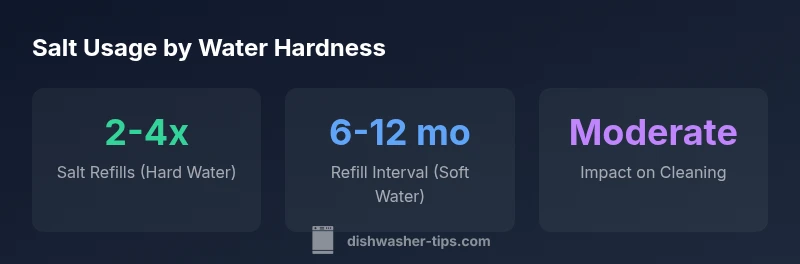
| Water hardness | Salt need guidance | Notes |
|---|---|---|
| Soft water | Low salt needs — monitor indicator | Indicator may stay off for long periods |
| Moderately hard | Medium salt needs — follow indicator | Refill intervals common every few months |
| Hard water | Higher salt needs — refill more often | Indicator lights up sooner |
People Also Ask
Do I need to use dishwasher salt in every wash?
Not necessarily. If your water is soft or your dishwasher model is self-regenerating, you may go longer between refills. Always check the salt indicator and manual for guidance.
You don’t always need to refill every wash; check your indicator and manual.
How do I know if I need more salt?
Watch the salt indicator on your dishwasher. If it lights up or changes color, or if you notice mineral spots on dishes, it’s time to refill.
Check the indicator; if in doubt, refill according to the manual.
Can I run without salt if I have softened water?
Soft water reduces salt needs, but some machines still rely on salt for efficient ion-exchange. Follow the indicator.
Soft water lowers salt needs, but follow the indicator.
Does salt affect rinse aid or detergent?
Salt supports rinse efficiency by softening water, which can improve detergent performance. It does not replace rinse aid.
Salt helps with rinse but isn’t a substitute for rinse aid.
Is table salt suitable for dishwasher use?
Only use salt labeled for dishwashers; regular table salt can contain additives that may clog components. Use manufacturer-approved salt.
Use only dishwasher salt, not table salt.
“Salt usage is often overlooked until mineral buildup appears; staying on top of refills protects cleaning performance and prolongs the life of your dishwasher.”
What to Remember
- Follow the salt indicator and manual for exact refill levels
- Hard water increases salt consumption
- Soft water reduces salt needs
- Different dishwasher models require different salt types
- Test your water hardness for better estimates