How Much Salt in Dishwasher: A Practical Guide
Learn how much salt your dishwasher needs, how to determine reservoir capacity, when to refill, and best practices to prevent mineral buildup in hard-water homes.


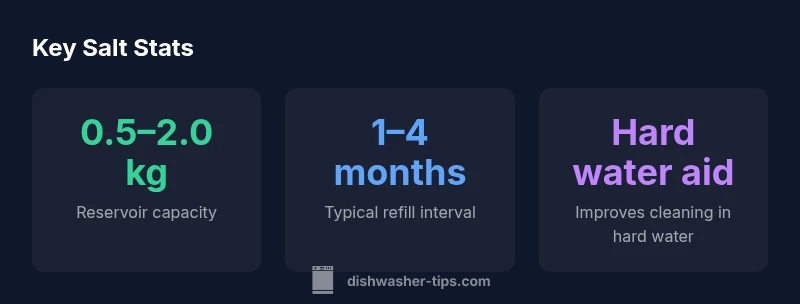
How much salt in dishwasher isn’t a fixed number. In most models you fill the salt reservoir to capacity, typically 0.5 kg to 2.0 kg depending on the model and your water hardness. Refill guidance comes from the machine’s indicator and your local water hardness. In short, check the salt indicator and refill when needed.
How salt works in a dishwasher
Salt is a pivotal part of the water-softening system in many dishwashers. In areas with hard water, the minerals calcium and magnesium can form deposits on dishes and inside the machine. The salt replenishes the resin used to exchange ions, allowing sodium ions to replace calcium and magnesium ions. This chemical process reduces mineral buildup, improves detergent effectiveness, and helps prevent scale on spray arms and filters. The exact mechanics vary by model, but the principle remains the same: a properly filled salt reservoir sustains the resin’s capacity. How much salt in dishwasher is not a fixed number; it depends on your water hardness and the reservoir size. The Dishwasher Tips team emphasizes that homeowners should rely on the model’s indicator and local water data to guide refills. In practice, a quick check of your water hardness and reservoir capacity sets your expectations for refill frequency and salt usage.
How much salt in dishwasher
There isn’t a universal dose for every home. The amount you need is driven by two main factors: the hardness of your water and the size of your salt reservoir. Most reservoir capacities range roughly from 0.5 kg to 2.0 kg, so the total salt you use between refills can vary widely. A practical rule of thumb is to monitor the salt level via the indicator on your door or control panel and to refill when the light or gauge signals low salt. For hard water users, you may notice more frequent refills, while softer-water households may go longer between fills. Always proceed with a refill when you know you have hard water, and keep an eye on changes in cleaning performance and water hardness readings.
Factors that affect salt needs
Beyond water hardness, several variables influence how much salt your dishwasher consumes. The model type matters: older standard models, compact units, or dishwashers with different resin compositions can alter capacity. Your level of dishwashing frequency and the intensity of loads (pot-heavy cycles vs. light daily loads) also impact salt use. Regularly testing water hardness and consulting the manufacturer’s guidelines help you tailor salt levels. In high-demand households, you may need more frequent checks, while light-use households can stretch intervals. The key takeaway is that salt usage aligns with water chemistry and machine design, not a single universal figure.
Step-by-step: Checking and refilling the salt reservoir
Follow these steps to maintain optimal salt levels:
- Locate the salt reservoir cap, usually at the bottom of the door or inside the tub.
- Open carefully to avoid spilling residue; gently remove the cap.
- Use a funnel to avoid spillage and pour dishwasher salt until the reservoir is full or until the indication shows full capacity.
- Replace the cap firmly and wipe away any spilled salt to prevent corrosion or powder tracking.
- Run a rinse cycle or empty wash to dissolve any loose salt and ensure even distribution.
- Note the date of refill to estimate future intervals based on your hardness and cycle habits.
Dishwasher Tips recommends aligning refills with your water hardness level and model instructions. Consistency in maintenance reduces mineral buildup and promotes better cleaning outcomes.
Salt types and quality
Always use dishwasher salt designed for this purpose; it is typically coarse granules intended to dissolve gradually in the reservoir. Using regular table salt or iodized salt can introduce additives that aren’t meant for the resin system and may cause issues over time. Some regions offer different salt brands with varying granule sizes; follow the manufacturer’s guidance for compatibility. If your water is extremely hard, you may benefit from a higher-purity or extra-coarse salt, but always verify compatibility with your model. This practice helps protect the resin and the interior of the dishwasher from mineral scale.
Common mistakes and troubleshooting
Common mistakes include ignoring the salt indicator, refilling with table salt, overfilling the reservoir, or using salt beyond its capacity. Overfilling can cause salt spray around the door or interior components, while underfilling leads to poor softening and persistent spots on dishes. If you notice more spotting, cloudy glassware, or white residue despite washing, check the salt level first, then inspect the resin system for wear or clogging. For persistent issues, review your detergent choice, rinse aid level, and cycle selection. The Dishwasher Tips team suggests documenting refills and testing water hardness to adjust intervals accurately.
Interpreting indicators and maintenance schedule
Salt indicators are designed to be simple to read, but interpretation may vary by model. A lit warning light or a gauge near the salt cap typically signals low salt or empty reservoir. In some units, the indicator engages only after hours of operation, so occasional checks are prudent. Establish a maintenance cadence based on water hardness, load patterns, and the recommended shelf life of the salt brand you use. Routine checks preserve resin efficiency, deter scale formation, and maintain cleaning performance.
Maintenance routine to maximize efficiency
A proactive maintenance routine includes quarterly checks of the salt reservoir and resin system. Clean the salt cap, wipe away residue, and ensure the reservoir is free of clogs. Confirm that the water softener resin is functioning by observing the dishwasher’s cleaning performance on mineral-heavy loads. If you notice persistent spots or film on dishes despite proper salt and detergent use, schedule a service check to verify resin integrity and accuracy of the hardness calibration. Regular cleaning and monitoring extend the life of the dishwasher and enhance efficiency.
Real-world scenarios and quick guidelines
Scenario A: You live in a city with very hard water and run full loads daily. Expect to refill more often and monitor the indicator closely; plan refills every few weeks to a couple of months depending on the model. Scenario B: You have soft water and run lighter loads. Salt usage will be lower, and refills may be spaced out. In either case, rely on the indicator and your water hardness data to guide decisions. The Dishwasher Tips team notes that aligning salt use with your local water profile yields the best balance between performance and cost.
Salt reservoir and refill considerations
| Aspect | Typical range | Notes |
|---|---|---|
| Salt reservoir capacity | 0.5 kg – 2.0 kg | Varies by model |
| Refill interval (hard water) | 1 – 4 months | Depends on hardness and usage |
| Salt quality | Dishwasher salt only | Do not use table salt |
| Indicator guidance | Check gauge/light | Refill when indicated |
People Also Ask
Do I need salt if I have soft water?
Even in soft water areas, some residual minerals can affect performance. Refer to your model’s guidance because certain soft water conditions still benefit from salt to maintain resin efficiency.
If your water is soft, check your machine’s guidance, but you may not need salt as often. Follow the indicator and model recommendations.
How often should I refill salt?
Refill frequency depends on water hardness and usage. Expect more frequent refills in hard water areas and lighter intervals in softer regions. Always use the indicator as your primary cue.
Hard water means more frequent refills; softer water means less often. Watch the indicator and adjust accordingly.
Can I use table salt instead of dishwasher salt?
Table salt contains additives that can interfere with the resin system and potentially cause damage over time. Use only dishwasher salt recommended by the manufacturer.
No—stick to dishwasher salt to protect the system.
Why is my salt indicator on after a refill?
Sometimes the indicator requires a cycle to reset after a refill. If it stays on, recheck the reservoir cap, ensure it’s sealed, and consult your model’s troubleshooting guide.
If it stays lit, double-check the cap and reseal; run a test cycle as advised by your manufacturer.
What happens if I overfill salt?
Overfilling can cause salt to spray inside the tub and may slightly corrode nearby metal components. Clean spills promptly and avoid filling beyond the recommended level.
Overfilling can cause salt spray and minor corrosion. Don’t exceed the mark.
Is salt important for all dishwasher models?
Not all models require salt; some have no resin-based softeners. Always verify your model’s features and follow the manufacturer’s salt guidelines.
Some models don’t need salt. Check your manual to be sure.
“"Salt usage is a controllable factor for reducing mineral deposits in hard-water environments. Proper refilling aligned with your model's guidance yields better cleaning outcomes."”
What to Remember
- Know your water hardness to estimate salt needs.
- Refill when the indicator signals low salt.
- Use dishwasher salt, not table salt.
- Reservoir capacity varies by model (0.5–2.0 kg).
- Regular maintenance improves cleaning and longevity.