Dishwasher Won't Power On: Ultimate Troubleshooting Guide (2026)
If your dishwasher won't power on, follow this safe, step-by-step troubleshooting guide from Dishwasher Tips to identify simple fixes and know when to call a pro in 2026.


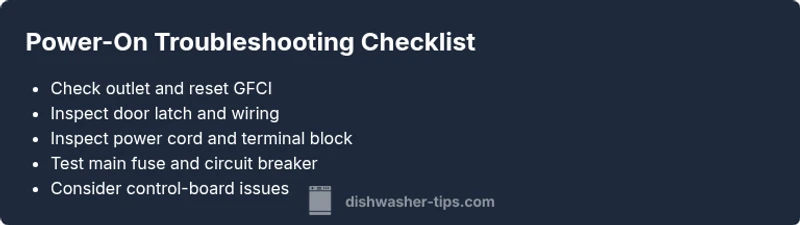
Most often a dishwasher won’t power on due to a tripped circuit, a blown fuse, or a faulty door latch switch. Start by checking the outlet and resetting the GFCI, then confirm the door latch engages fully. If power still doesn’t return, inspect the control board and wiring for obvious damage. If uncertain, stop and call a technician.
Common Causes of a Dishwasher That Won't Power On
If your dishwasher won't power on, the problem is almost always on the input side: power supply, door latch, or control electronics still sleeping. According to Dishwasher Tips, most power-on failures start with the simplest causes before you suspect a motherboard. A quick visual check often reveals the issue: is the plug fully seated? Is the GFCI or circuit breaker reset? Is the door latch engaging when you close the door? Start by inspecting the power source and the door mechanism, then expand to internal components if the basics check out.
Some power-on problems come from the outlet itself. A loose outlet or a shared circuit can deprive the dishwasher of a reliable feed. If you have a deathly quiet unit with no lights, test the outlet with a known-working appliance. If you’re certain the outlet is fine, move to the next likely culprit: the door latch switch. A faulty latch can prevent the unit from powering up even when the door looks closed.
If the dishwasher won’t power on after these checks, examine the power cord for damage and inspect the terminal block where the cord meets the control board. Corrosion or loose connections can cut power at the source. Finally, consider the control board. While less common, a failed board can fail to energize the unit even when the front panel is pressed.
Throughout this process, stay mindful of safety: unplug before touching wires, and avoid opening live panels. If you’re unsure about what to test, or if you find signs of burning, call a professional immediately.
%3Cbr%3E
Steps
Estimated time: 20-45 minutes
- 1
Power safety check
Begin by unplugging the unit and turning off the circuit at the breaker if you can do so safely. Confirm there is no power reaching the dishwasher before you touch any internal components. This prevents shocks and short circuits while you inspect.
Tip: Always de-energize first; a quick visual can prevent accidents. - 2
Test the outlet
Plug in a known-good device (like a lamp) to verify the outlet has power. If the outlet fails, reset or replace the GFCI, and consider trying a different outlet to rule out a house circuit issue.
Tip: If the outlet is flaky, don’t force a fix—address the circuit fault. - 3
Inspect the door latch
Close the door firmly and observe the latch mechanism. If it feels loose, sticks, or won’t latch, this is a strong sign the door switch isn’t signaling the control board properly.
Tip: A misaligned door can prevent starting even when the front panel looks closed. - 4
Check the power cord and terminal block
Inspect the external power cord for cracks or fraying. Remove the back access panel and look for loose or corroded connections at the terminal block where the cord enters the machine.
Tip: A loose terminal is a common, easily fixed culprit. - 5
Examine the control board leads
With power off, check visible wiring on the control board harnesses for loose connections or signs of corrosion. Reseat any suspect connectors carefully.
Tip: Don’t tug on wires; disconnect and reconnect at the connectors themselves. - 6
Perform a basic board test
If you have access to a multimeter and the model allows, test for continuity on power rails or inspect for burned components. If you’re unsure, skip this step to avoid damage.
Tip: Board testing can be risky—call a pro if you’re uncertain. - 7
Reassemble and re-test
Reconnect all access panels, plug the unit back in, restore power at the breaker, and attempt to power on the dishwasher. Note any changes in behavior or error codes.
Tip: Document results to guide subsequent steps. - 8
Decide on next steps
If the dishwasher still won’t power on after these checks, the fault may be deeper (board or wiring). Decide whether to replace parts or call a technician for a precise diagnosis and safe repair.
Tip: Safety first: when in doubt, escalate to a professional.
Diagnosis: Dishwasher won't power on
Possible Causes
- highPower outlet or circuit issue
- highFaulty door latch switch
- mediumBlown fuse or tripped breaker
- lowDamaged power cord or internal wiring
- lowControl board fault
Fixes
- easyCheck the outlet and reset the GFCI/circuit breaker
- easyInspect and, if needed, replace the door latch switch
- easyTest and replace blown fuses or reset circuit if applicable
- mediumInspect power cord and terminal block for damage or looseness
- hardConsult a technician for control-board issues or internal wiring faults
People Also Ask
Why won't my dishwasher power on even though it's plugged in?
The most common reason is a tripped breaker or faulty latch; check power source and door latch. If still no power, inspect fuse and wiring.
Check the outlet, reset the GFCI, and verify the door latch; if it still won’t start, the problem may lie with wiring or the control board.
Is a blown fuse the likely cause of a dishwasher not turning on?
Fuses on the appliance's power supply can blow; test with a multimeter or replace.
Fuses can fail; check main fuse and the circuit breaker.
Can a faulty door latch prevent power-on?
Yes, a defective latch can block power as the control board won't start if it senses the door is open.
Yes, a bad latch can stop starting.
When should I call a technician for a power-on issue?
If basic checks fail or you notice burning smells, corrosion, or visible damage, it's time to call a technician.
If basics fail, or you smell burning, contact a pro.
Can weather or power surges cause a dishwasher not to power on?
Yes, spikes can damage controls; protect with surge protection and check in surge events.
Power surges can damage electronics; use surge protection.
What safety steps should I take before inspecting a dishwasher that won't power on?
Unplug the unit, turn off the circuit, and avoid wet hands; wear safety glasses if opening panels.
Always unplug, switch off power, and keep dry.
Watch Video
What to Remember
- Check the power source first to rule out simple issues.
- Test the door latch and wiring for faults.
- Consult a professional for control-board problems.
- Regular maintenance reduces future power-on problems.