How Long Should the Dishwasher Run: A Practical Guide
Discover how long a dishwasher should run, what factors influence cycle duration, and practical tips to optimize timing for energy and cleaning performance.


On average, a full dishwasher cycle runs about 60 to 120 minutes, depending on the cycle you choose, the soil level, and water temperature. Eco modes tend to be shorter, while heavy-duty cycles push toward longer durations. For time savings, select quick or rinse-only options for light loads, and always consult your user manual for exact timings.
How long should the dishwasher run
According to Dishwasher Tips, run time is influenced by cycle choice, soil level, water temperature, and energy settings. The Dishwasher Tips Team found that many models adjust timing automatically when sensors detect load weight and dirt. By understanding these factors, you can choose the most efficient option without sacrificing cleaning power. In practice, eco modes tend to be shorter, while heavy cycles push toward longer durations. Always check the user manual for your exact timings, as manufacturers tune cycles for performance and efficiency. For homeowners, this means selecting the right cycle based on load complexity rather than sticking to a single expected duration.
Understanding run time is not just about minutes counted; it’s about optimizing the balance between energy use, water heating, and cleaning power. A sensor-driven dishwasher may shorten or extend a cycle mid-run, depending on how dirty dishes are and how hot the incoming water is. The bottom line: don’t chase a fixed duration. instead, aim for a cycle that delivers clean dishes in the most efficient way for your home and water heater.
In many households, a midweek load of mixed plates and glasses can be finished comfortably within an hour on a Normal cycle, while heavily soiled pots may require a longer Heavy cycle. As you gain experience with your model, you’ll learn which cycles consistently meet your cleanliness standards within a reasonable time window.
How Different Cycles Affect Duration
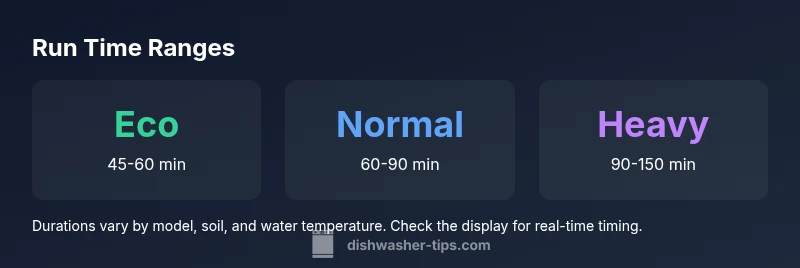
Cycle duration varies widely by model and setting. A typical Eco cycle may run 45–60 minutes, prioritizing energy and water efficiency with lower wash temperatures. A Normal cycle often lasts 60–90 minutes, giving a balance of temperature, wash action, and rinse quality. Heavy or Pots-and-Pans cycles can extend to 90–150 minutes, designed to tackle baked-on residue or bulky loads. Modern dishwashers frequently use sensors to adjust timing based on detected soil and water temperature, which means the same cycle could take slightly longer or shorter on different days or loads. When budget and time are tight, run times are rarely fixed; instead, rely on the cycle’s goal (eco vs heavy) and the machine’s feedback to determine what to expect.
If you’re trying to estimate run time for a busy household, set expectations around a window rather than a single minute. For example, plan 1 hour for most mixed loads on Normal mode, 1.25–1.75 hours for Heavy cycles, and 40–60 minutes for Eco cycles under light soil conditions. Remember that some dishwashers display “time remaining” that updates as the cycle progresses, so you may see values shift as cleaning progresses.
Understanding these differences helps you choose cycles that align with your schedule. The more you use your dishwasher and note how it behaves with different soils and loads, the better you’ll get at predicting run times without sacrificing results.
How Soil, Load Size, and Temperature Change Timing
Soil level and load size are the biggest nonmanual levers on run time. Lightly soiled, small-to-medium loads may finish sooner because the machine needs less mechanical action and less hot water to dissolve detergents. Heavily soiled pots and pans trigger longer wash phases and more robust rinses, extending cycles by a significant margin. Temperature also plays a role: hotter incoming water can shorten some phases if the heater doesn’t need to work as hard; however, very cold water or slow heating can lengthen the early wash and pre-wash segments. If you routinely pre-rinse heavily soiled items, you might see shorter overall cycles on some models, but this is not universal—trust how your particular machine behaves.
To get consistent results, pre-sort by soil level and place large, heavily soiled items in the bottom rack where spray arms have the best reach. Don’t overload the dishwasher; crowded baskets can impede water flow and require longer cycles to achieve the same cleanliness. The sensors on many newer models adjust run time to match soil, but they still rely on your loading discipline to represent typical loads.
Finally, consider water hardness. In harder water areas, you may see slightly longer cycles because detergents need more time to dissolve and carry away mineral deposits. If you know your water is hard, you can compensate by using the recommended detergents and adjusting rinse aids to optimize performance within the cycle time.
Tips to Optimize Run Time Without Sacrificing Cleanliness
- Match the cycle to the load: use Eco for lightly soiled items, Normal for everyday loads, and Heavy for pots and pans. The goal is not to maximize time but to maximize cleaning efficiency within a reasonable window.
- Load properly: avoid blocking spray arms, keep tall items from shielding smaller ones, and don’t cram plates too tightly. Proper loading improves cleaning, which can reduce the need for longer cycles.
- Skip pre-rinsing heavy soils only if you’re confident in the cycle quality. Excessively rinsing can waste water and extend run times if the machine still needs to re-wash.
- Maintain your dishwasher: clean filters, spray arms, and the inlet valve to prevent flow restrictions that lengthen cycles.
- Consider a timer-friendly schedule: use quick or express cycles for quick turnarounds, but only when dishes are not heavily soiled.
- Use rinse-aid when appropriate to improve drying and reduce the need for longer post-cycle air-drying.
When Run Time Changes: Common Scenarios and Quick Fixes
If you notice a run time that’s unexpectedly long, start with the basics: check for clogged spray arms, ensure the door seal is intact, and confirm the water inlet isn’t blocked. A slow fill or incomplete heating can stall cycles and extend time. If a previously reliable Eco mode suddenly takes longer, inspect the filter and seals for buildup, and verify your water heater is delivering hot water efficiently. For older machines, a professional service can determine whether worn pumps or coils are affecting cycle length. Lastly, if your dishwasher consistently runs longer than its stated range, consult the manual or support to rule out sensor malfunctions or water temperature issues.
In many cases, a simple cleaning of filters and spray arms can reduce run time by several minutes per cycle, especially on Eco or Normal modes. If your model supports adaptive wash technology, give it a few cycles to learn your typical loads before expecting consistency. The key is to maintain the machine and use cycles appropriate for the load.
How to Read Your Dishwasher's Display and Timers
Most modern dishwashers show a time remaining indicator that updates as the wash progresses. If you notice a fluctuating or rapidly changing timer, remember that sensors frequently re-assess soil and water temperature, causing the remaining time to shift. A steadily increasing time may indicate a problem with water heating or normal wear; a decreasing time usually signals the cycle is finishing sooner than expected. Check for error codes on the display and refer to the manual for guidance. If you rely on the timer for planning, add a small buffer to accommodate potential changes in cycle duration.
By getting comfortable with how your unit reports run times, you’ll be able to plan your evenings more efficiently. You’ll also be less tempted to interrupt a cycle early, which can leave dishes less-than-clean and potentially require a second run.
Practical Examples: Everyday Loads
- Lightly soiled glassware and flatware: expect a short wash—often in the 45–60 minute range on Eco or Quick settings when available.
- Everyday mixed loads: Normal cycles typically run 60–90 minutes depending on soil and water temperature.
- Heavily soiled pots and pans: Heavy cycles may span 90–150 minutes and may require higher water temperatures to break down baked-on residue.
- Partial loads: If you must run a partial load, choose a cycle designed for smaller loads or use a shorter cycle where possible. This improves efficiency without forcing an extra full cycle later.
- Special cases: If you have hard water, consider a rinse aid and ensure you’re using the correct detergent to prevent mineral buildup, which can extend cycle times over time.
Quick Maintenance Checks to Keep Run Time Consistent
- Clean filters and spray arms every few weeks.
- Check door latch and seals for proper sealing to prevent leaks that might extend cycles.
- Ensure the heating element and inlet valve are functioning correctly.
- Schedule annual checkups if your unit is several years old, as wear can contribute to longer cycle times.
Typical dishwasher cycle durations
| Cycle Type | Typical Duration | Notes |
|---|---|---|
| Eco | 45-60 minutes | Energy-saving, lower temperature |
| Normal | 60-90 minutes | Balanced wash and rinse |
| Heavy | 90-150 minutes | Pots & pans, heavily soiled |
| Rinse & Hold | 5-15 minutes | No wash, just rinse |
| Express | 10-30 minutes | Light loads only |
People Also Ask
Why is my dishwasher taking longer than the cycle duration listed in the manual?
Sensor-driven cycles, heavier soil than expected, hard water, or a failing heater can lengthen a cycle beyond the listed duration. Check soil level, water temperature, and ensure the heater is functioning. If the delay persists, consult the manual or service to verify sensor accuracy.
Sensor-driven cycles and soil conditions can extend run times beyond the manual. Check soil, temp, and heater performance.
Is it true that eco cycles always take longer?
Not always. Eco cycles optimize energy and water use, and some models complete similar tasks in shorter times with advanced sensors. In other cases, eco cycles run longer to conserve resources. Compare eco cycle times on your specific model and evaluate whether energy savings justify the duration.
Eco cycles can be longer or similar in duration, depending on the model and soil.
How can I speed up a wash without sacrificing cleanliness?
Choose the express/quick cycle for lightly soiled loads, load dishes properly, and avoid pre-rinsing heavy soils unnecessarily. Ensure you’re using the right detergent and rinse aid if your model recommends it. Efficient loading and cycle selection deliver clean results faster.
Use express cycles for light loads and proper loading to stay efficient.
What should I do if my dishwasher starts but won’t finish the cycle?
Check for error codes on the display and consult the manual. Inspect the door seal, inlet valve, heater, and filters for blockages or wear. If no obvious fault is found, consider a service check for sensor or heating element issues.
Look for error codes, inspect seals and filters, and consider service if the issue persists.
Can I run a cycle for a partial load without wasting energy?
Yes, if your model supports a smaller-load or half-load option. Otherwise, wait for a full load to maximize efficiency. Always choose a cycle that matches the soil level and load size to avoid wasting water and energy.
Partial loads are best with a model that supports small-load cycles.
“Run times are most efficient when you balance soil, load size, and cycle choice; sensors will adjust timing to save energy while delivering clean results.”
What to Remember
- Learn that run times vary by cycle and load
- Use eco modes for lightly soiled loads to save time and energy
- Proper loading and regular maintenance help keep cycles efficient
- Read your dishwasher’s display for real-time timing and adjust accordingly