How to Find the Size of Your Dishwasher: A Practical Guide
Learn how to find the size of your dishwasher with simple exterior measurements, cabinet clearances, and tub capacity. A complete step-by-step plan to ensure a perfect fit and reliable performance.


To find your dishwasher size, begin with exterior measurements: width, height, and depth. Check the model label for exact width and install clearances. If you’re replacing an old unit, measure the cabinet opening and door swing. Then estimate interior capacity by place settings or tub size. Dishwasher Tips notes standard units are typically 24 inches wide, with 18-inch compact options.
What size means for dishwasher installation
Understanding size is the first step to a smooth installation or replacement. The “size” of a dishwasher includes three exterior dimensions—width, height, and depth—as well as the interior tub capacity that determines how many place settings you can load. When you buy or replace a unit, you’re balancing the physical footprint in your kitchen with the capacity you need for daily use. According to Dishwasher Tips Analysis, 2026, standard built-in dishwashers are designed to fit a 24-inch-wide opening, while compact models commonly start at 18 inches. This guidance helps homeowners plan layouts, choose models that leave adequate clearance for doors, and avoid installation headaches later. For renters, you’ll also want to check the cabinet framework and any removable panels to ensure compatibility with service access and venting. By knowing both external fit and internal capacity, you can compare models confidently and prevent the common problem of ordering a size that won’t clear cabinetry or plumbing.
How to measure exterior dimensions accurately
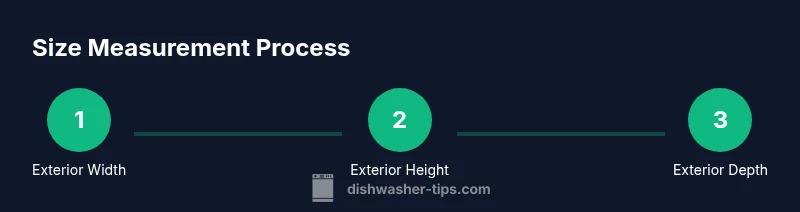
Exterior measurements determine whether a dishwasher will physically fit in the kitchen footprint and align with the cabinet opening. Start with the width: measure from the outside left to the outside right of the face panel, including any door handles or trim. Then measure the height from the finished floor to the top edge of the unit, noting any toe-kick clearance required by your cabinet base. Finally, measure depth from the front of the face panel to the back of the unit, ensuring you account for any door panel or hinge protrusions. If you have counter seating or an overhang, capture the space behind the unit to prevent interference during installation. Pro tip: take two measurements for each dimension at slightly different points to confirm consistency, as walls and flooring can introduce subtle variances. Tracking these three numbers gives you the baseline for compatibility with standard and compact models.
How to measure the cabinet opening and clearance
Measuring the cabinet opening is crucial to avoid purchasing a unit that won’t slide into place. Measure the width of the opening, then subtract a small clearance (often about 1/8 to 1/4 inch on each side) so the dishwasher door can open without getting stuck against the cabinet walls. For height, compare the opening to the unit’s stated height, and ensure there is clearance above the unit for venting and for the door to swing fully. Depth is often less forgiving; you’ll need to account for plumbing, wiring, and any rear radiator or water lines. If the space is tighter than typical, consider a compact 18-inch model or a flush-install option if your cabinet allows for it. Always record your minimum and maximum clearances so you can verify compatibility across models.
How to estimate interior capacity and tub size
Interior capacity is typically described as place settings or as liters/quarts of tub capacity. A standard 24-inch dishwasher usually accommodates about 12–14 place settings, while an 18-inch compact model might hold around 6–9 place settings, depending on rack design and folding tines. If you don’t have a model’s tub specification, you can estimate by comparing to known loads: count the number of dinner plates (10–12 per standard rack) and estimate how many bowls, cups, and utensils will fit in the remaining space. Keep in mind that interior capacity is affected by rack configuration, spray arms, and the presence of a third rack or adjustable tines. This estimate helps you match a model’s performance to your everyday dishwashing needs.
Understanding dishwasher configurations and space planning
Dishwashers come in several configurations that affect size and fit. Built-in models are designed to slide into a cabinet opening with finished sides, while semi-integrated units require a panel to match your cabinetry. Portable or countertop models offer different footprint considerations and usually don’t require a fixed cabinet. When planning space, consider plumbing access and electrical outlets, the door swing into the room, and the potential need for a left- vs right-swing door. If you have an oddly shaped kitchen or an unusual opening, a professional assessment can prevent surprises at install time.
Common mistakes and ways to avoid them
Common mistakes include assuming width is enough without checking height clearance, ignoring toe-kick space, and failing to account for door swing. Always re-measure after removing old appliances and before buying a new model. Another pitfall is using a measurement that doesn’t include valve protrusions or panel gaps; these small features can add inches that block installation. To avoid mistakes, use a two-person approach for measurements, keep a dedicated measurement sheet, and double-check dimensions against the model’s official spec sheet.
What to do with your measurements after you’re done
With measurements in hand, create a simple data sheet listing exterior dimensions, opening clearance, and interior capacity estimates. Attach copies of the manufacturer’s spec sheets when shopping, so sales staff can verify fit quickly. If you’re replacing an existing unit, bring the measurements to the installer or kitchen contractor to confirm alignment with your cabinetry and plumbing. Finally, store digital copies in a kitchen remodeling folder for future reference, including any notes about access panels, shut-off valves, and service clearance.
Next steps: using your measurements to buy, install, or replace
Armed with the measurements, you can compare models with confidence. When shopping, filter results by width (18 or 24 inches at a minimum) and review height and depth to ensure fit. If you’re not installing the unit yourself, bring your measurement sheet to the installer so they can verify space and plan for the water inlet and drain connections. For renters or temporary setups, consider a portable model that doesn’t require cabinet mounting, and verify that there is a suitable outlet and water supply. Finally, plan for a professional installation if you have existing plumbing or electrical constraints; this reduces the risk of leaks and warranty issues.
Tools & Materials
- Tape measure (at least 6 feet)(Flexible steel or fabric tape for tight corners)
- Notepad and pencil(For recording measurements and model numbers)
- Step ladder or stable stool(Useful for reaching cabinet tops and label locations)
- Flashlight(Illuminates dark corners around the appliance and cabinet)
- Camera or smartphone(Capture photos of labels and installation space)
Steps
Estimated time: 45-75 minutes
- 1
Gather measuring tools
Collect a tape measure, notebook, and pencil. Ensure the space around the old dishwasher is accessible and free of clutter so you can move around safely and measure accurately.
Tip: Keep your tools within arm’s reach and designate a measurement area to avoid mix-ups. - 2
Locate the model label
Find the rating or model label on the dishwasher—often on the door frame, side panel, or interior rim. Note the official width, height, and depth as stated by the manufacturer.
Tip: If the label is hard to reach, check the user manual or manufacturer website for the spec sheet. - 3
Measure exterior width
Close the door and measure the widest point across the front, including any door handles. Record width to the nearest 1/8 inch.
Tip: Take measurements at multiple vertical lines to confirm the widest point. - 4
Measure exterior height
Measure from the finished floor to the topmost part of the unit, taking notes of any raised trim or leveling feet.
Tip: If your cabinet sits on a raised base, measure from the floor to the top edge at both the left and right sides. - 5
Measure exterior depth
Measure from the front face of the unit to the back, accounting for the door hinge, exterior panel, and any protrusions.
Tip: Back off 1/4 inch to accommodate back plumbing and clearance for flex hoses. - 6
Measure cabinet opening
Measure the cabinet opening width, height, and depth. Subtract recommended clearances (typically about 1/8–1/4 inch per side as directed by the manufacturer).
Tip: Double-check that the opening aligns with the appliance’s minimum and maximum dimensions in the spec sheet. - 7
Check door swing and toe-kick
Ensure the door can fully open without hitting cabinetry and that the toe-kick area remains unobstructed for leveling and airflow.
Tip: If the door interferes, you may need a different model with a smaller door swing or a flush-install option. - 8
Estimate interior capacity
Review tub size and rack configuration to estimate how many place settings the unit will hold. If possible, compare with known models you’re considering.
Tip: Look for the number of rack levels and adjust expectations based on your typical load. - 9
Record and verify
Compile all exterior and interior measurements in a single data sheet. Cross-check against manufacturer specifications before purchasing.
Tip: Keep digital copies and photos for quick reference during shopping or installation.
People Also Ask
What is the standard size of a built-in dishwasher?
Most built-in dishwashers are 24 inches wide, with heights around 33-34 inches and depths near 24 inches. Always verify with the model label.
Most built-in dishwashers are 24 inches wide, with typical height around 33 to 34 inches and depth about 24 inches. Check the model label for exact specs.
Will an 18-inch compact dishwasher fit in a 24-inch space?
An 18-inch compact can fit in a 24-inch space if the opening accommodates the width and there is adequate clearance behind and above for plumbing and ventilation.
An 18-inch unit can fit in a 24-inch space if there’s enough clearance for the plumbing and ventilation around it.
How should I measure for flush installation?
For flush installation, verify the cabinet interior width is compatible with the appliance width, and ensure the door clears the surrounding cabinetry when opened. You may need an installer for precise alignment.
For flush installation, check that the cabinet is wide enough and that the door clears the surrounding cabinetry when opened.
Do I need to measure interior capacity?
Yes. Interior capacity affects how many place settings you can load. Use tub size and rack configuration as a guide, especially if you regularly wash large pots or longer utensils.
Yes. Interior capacity matters for how many place settings you can fit; look at tub size and rack design.
What if my space is nonstandard?
If the opening is odd, consult a professional before buying. Some spaces require custom panels, trim kits, or a different model with adjustable features.
If your space is nonstandard, talk to a pro before buying to see if you need a custom solution.
Can I reuse my existing plumbing and electrical setup?
Many replacements can reuse existing lines, but you should have the connections inspected during installation. Some new models require updated valves or outlets.
Reusing plumbing is common, but have a pro verify connections and outlet requirements.
Watch Video
What to Remember
- Measure exterior width, height, and depth precisely.
- Check the model label for official specs and required clearances.
- Estimate interior capacity using tub size or place settings.
- Account for door swing and toe-kick clearance in your space.
- Document measurements and use them to guide model selection.