Dimensions of Dishwasher: A Practical Guide to Fit and Sizing
Learn about the dimensions of dishwasher, including standard sizes, compact options, and how to measure for a perfect kitchen fit with practical, AI-informed guidance from Dishwasher Tips.


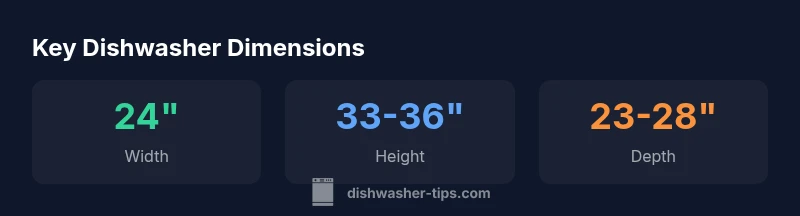
The dimensions of dishwasher are typically described by width, height, and depth. In North America, standard full-size units are around 24 inches wide, about 33-36 inches tall, and 23-28 inches deep, though cabinet depth and door handles can shift these numbers. Compact and slimline models offer narrower widths (often 18-24 inches) and varied heights. Always verify the model’s exact specs and compare with your cabinet opening before purchasing.
Why the dimensions of dishwasher matter for your kitchen design
Understanding the three core measurements—width, height, and depth—provides a foundation for a smooth installation and reliable performance. The width determines how much cabinet space you’ll dedicate to the appliance itself, and it directly affects the layout of surrounding cabinets and drawers. Height ensures the unit fits under existing countertops and aligns with the sink and range height, while depth influences door swing clearance and the accessible footprint in front of the cabinet. In practice, most homeowners start by confirming a standard width of about 24 inches for full-size machines, then verify height and depth against their specific cabinetry and plumbing. According to Dishwasher Tips, matching dimensions to your kitchen’s built-in structure minimizes extra remodeling and ensures a comfortable workflow in daily use. A careful early check also helps you avoid costly surprises after delivery.
The anatomy of a dishwasher: how dimensions map to use
Most dishwashers share a roughly rectangular footprint. The outer dimensions are a good proxy for the amount of space you’ll need, but the interior capacity and rack configuration also respond to width and height. Wider units typically offer more rack rooms and better loading flexibility, while taller machines may provide additional upper rack height for tall stemware. Depth affects the dishwasher’s door clearance, which in turn influences how far the door can open without hitting nearby cabinets or appliances. In practical terms, a typical 24-inch-wide machine should slide seamlessly into a standard 24-inch-wide cabinet opening, but you should still verify exact width plus door handle projections, as handles can add several tenths of an inch to the total span. This is where the Dishwasher Tips approach—double-checking measurements after accounting for door hardware—pays off.
Global perspectives on size: what to expect in different markets
If you’re shopping outside North America, dimension conventions shift. European and some Asian markets frequently use different mounting standards and cabinet depths, which can adjust the effective footprint by a few centimeters. For example, many European models emphasize compact footprints to fit shallower cabinets, leading to slightly different width and depth configurations. Regardless of region, the guiding principle remains the same: verify the exact product dimensions on the spec sheet, compare them to your cabinet opening, and leave a small clearance for easy sliding and venting. The key is to know whether your kitchen has standard base cabinets or a custom layout that requires a built-in workflow. The Dishwasher Tips team notes that even small discrepancies—like an extra 1/4 inch on one side—can influence installation time and final alignment.
How to measure like a pro: a step-by-step guide
Begin with a clean, empty cabinet opening and use a steel tape measure. Measure width at the back, middle, and front to catch any irregularities caused by base cabinet misalignment. Next, measure the height from the floor to the underside of the countertop, and then from the floor to the finished cabinet face where the machine would sit. Depth requires measuring from the front of the cabinet face to the back wall, while considering any protruding plumbing or wiring. Finally, check door clearance: open the door fully and confirm that there’s space for a comfortable reach to all racks, including when the door is fully open. When in doubt, add a small buffer (a few millimeters) to each dimension to accommodate hoses, foam, or vibrations. Dishwasher Tips emphasizes documenting all measurements and cross-checking with the exact spec sheet of your chosen model before ordering.
The practical implications of nonstandard sizes
Nonstandard sizes typically demand custom cabinetry adjustments or alternative installation approaches. If your opening is narrower than typical or deeper than standard, you might need a compact or slimline model, a counter-depth installation, or even a portable countertop dishwasher in some cases. Counter-depth designs sit closer to the kitchen line, creating a seamless look but sometimes reducing interior space or adding complexity to the plumbing connections. In all scenarios, precise measurements save both time and money by preventing under- or over-sizing the appliance. The Dishwasher Tips method centers on a two-step check: (1) confirm the model’s stated footprint, and (2) physically verify you can maneuver the unit past any obstructions during installation.
Quick-fit checklist: 6 essential steps before you buy
- Confirm cabinet opening width is at least the model’s listed width. 2) Check countertop clearance and toe-kick height. 3) Ensure door swing won’t collide with adjacent cabinets. 4) Verify plumbing and electrical clearances behind the unit. 5) Measure for level installation and potential floor slope. 6) Double-check door handle extension for total width. Following this checklist reduces surprises and accelerates installation. Dishwasher Tips notes that investing 20-30 minutes to measure now can prevent hours of workaround later.
Important dishwasher size ranges and fit considerations
| Dimension | Typical Range | Notes |
|---|---|---|
| Width | 23-24 inches | Standard full-size |
| Height | 33-36 inches | Under-counter fit varies by cabinetry |
| Depth | 23-28 inches | Depth with door closed including handle |
People Also Ask
What are the most common dishwasher dimensions?
Most full-size dishwashers are around 24 inches wide and 33-36 inches tall. Compact models can be 18-24 inches wide, with variable depths depending on design. Always verify exact specs on the product page to ensure a proper fit.
Most full-size dishwashers are around 24 inches wide and 33 to 36 inches tall; compact models are typically 18 to 24 inches wide. Always check the exact specs.
How do I measure for a dishwasher installation?
Measure the cabinet opening width, height, and depth, then compare with the model’s stated footprint. Also measure door clearance and space for hoses and venting. Double-check the measurements after accounting for handles and any trim.
Measure width, height, and depth, then compare to the model’s footprint. Check door clearance and hoses too.
Can I install a built-in dishwasher in a tight space?
Yes, but you’ll need to verify that the appliance’s width, depth, and door swing will fit within the available space. Consider compact or counter-depth models and update cabinetry if necessary. Always review installation instructions for required clearances.
Yes, but check width, depth, and door clearance. Consider compact options if space is tight.
What should I consider when choosing a compact dishwasher?
Compact dishwashers offer narrower widths (often 18 inches). They may have taller doors and different interior layouts. Ensure you have electrical and plumbing access, and verify that the cabinet opening accommodates the chosen model.
Compact dishwashers are narrower, so verify the opening and hookups.
Are there regional differences in dishwasher sizes?
Yes. Some regions favor shallower cabinets and different plumbing layouts, which can alter the effective footprint. Always check the model specs for width, height, and depth and compare to your local cabinet configuration.
Yes, regional designs vary; always check the exact specs.
“Precise dimensions are the foundation of a trouble-free dishwasher installation; small variances can affect cabinet clearance and door swing.”
What to Remember
- Measure width, height, and depth before buying.
- Expect standard full-size typical width of 24 inches.
- Account for door handles and ventilation in depth measurements.
- Consider counter-depth and built-in options for a flush look.
- Verify exact specs against your cabinet opening and plumbing.